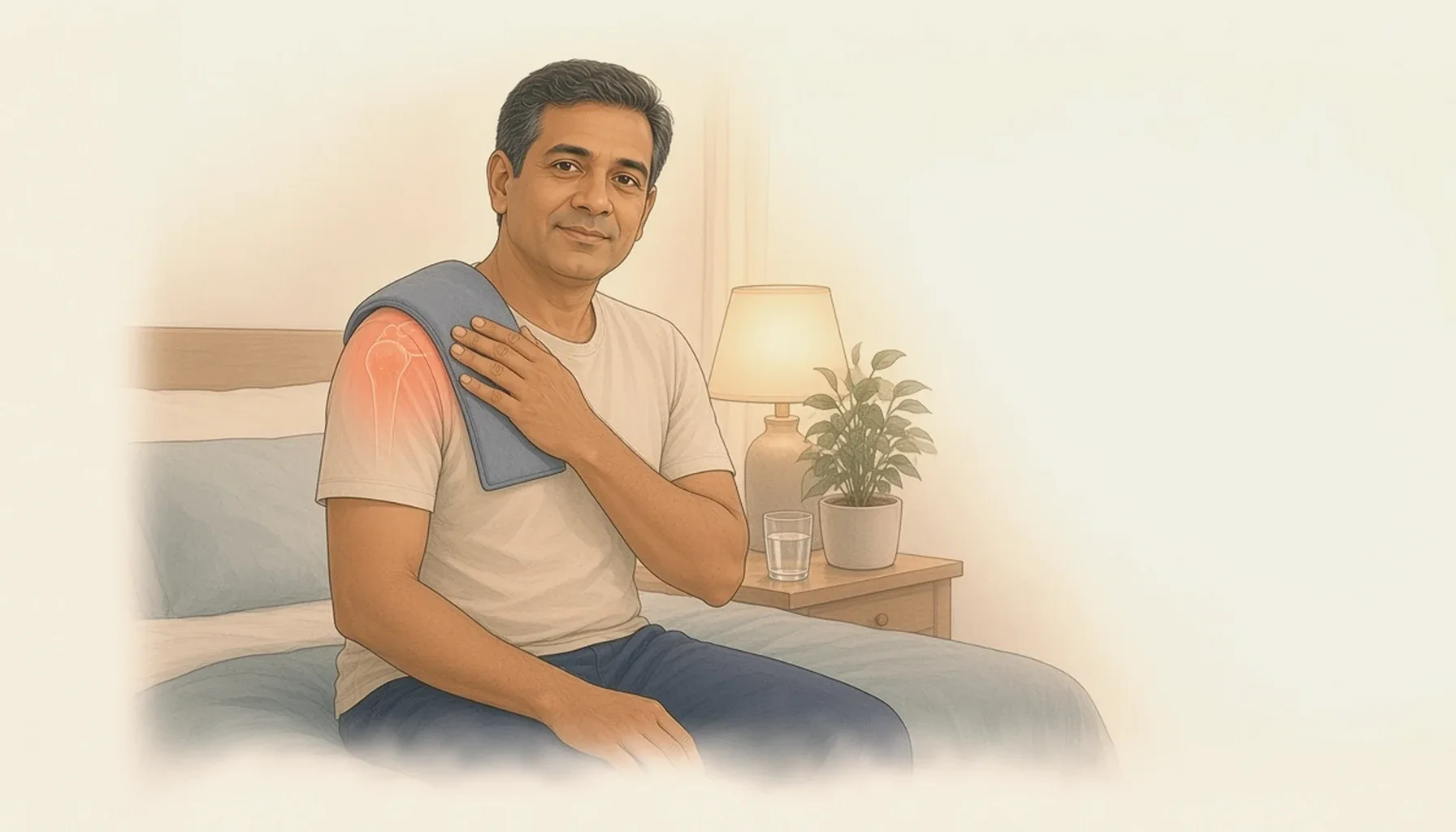
Icing your shoulder for a short time before bed may ease pain for some people, especially after injury or surgery. Randomized studies after shoulder surgery found that people who used cold slept better. We found no trial that tested icing only at bedtime in people who have not had surgery. Use a cloth under the pack, limit each session, and do not sleep with the pack in place.
Key takeaways
- After shoulder surgery, randomized trials found that people who used cold had less pain at night and more restful sleep.
- A 2024 review of 6 trials with 233 patients found cryotherapy was generally helpful for pain after shoulder surgery, though the studies were small and had some risk of bias.
- We found no trial that tested icing only before bed in people who have not had surgery. A 2015 review found limited trial evidence for cold after everyday musculoskeletal injury.
- Many clinical instructions advise about 15 to 20 minutes per session, with a thin cloth between the pack and the skin. A 2004 review found no evidence for one best length of cold treatment.
- Do not fall asleep with a plain ice pack on your skin, because you cannot check the skin while you sleep.
- Ice is more often used when the shoulder feels swollen or irritated. Heat may fit better when stiffness is the main problem, including some cases of frozen shoulder.
If night pain is your main concern, start with our guide to why shoulder pain gets worse at night. After a repair, see ice or heat after rotator cuff surgery.
Why does shoulder pain often feel worse at night?
Shoulder pain that wakes people up is common. In a 2015 study by Austin and colleagues of 56 people who later had arthroscopic rotator cuff repair, 89% had sleep disturbance before surgery. At 6 months after repair, 38% still had sleep problems. The American Academy of Orthopaedic Surgeons (AAOS) notes that pain when lying on the affected shoulder is a typical complaint with a rotator cuff tear.
Lying on the sore side and fewer daytime distractions can make an ache easier to notice. Our post on the best sleeping position for shoulder pain covers setup ideas. Icing is one evening habit people try, not a substitute for a comfortable position or for clinical care.
What do studies say about ice and sleep?
In a 1996 study by Speer and colleagues, 50 patients who stayed at least one night after shoulder surgery were randomly assigned to a cryotherapy device or no device. On the night of surgery, the cold group had less severe pain, had pain less often, slept better and perceived less need for pain medicine. By day 10, they reported less pain and less swelling.
A 2001 randomized study by Singh and colleagues assigned 70 patients after shoulder surgery to continuous cryotherapy or to a control group. On day 1, the cold group reported significantly less pain during sleep, more comfort in bed and more restful sleep. From days 7 through 21, they reported less frequent and less intense pain, and less pain during rehabilitation.
A 2024 systematic review by Gabiatti and colleagues looked at 6 randomized trials with 233 patients after various shoulder operations. Cryotherapy, delivered with devices or ice packs, was generally effective for postoperative shoulder pain. One included study found no significant difference versus the control group. The authors noted small samples, mixed methods and some risk of bias.
These trials often used a cold therapy device that can run longer than a bedside ice pack. They do not prove that a short session at bedtime will have the same effect. They do show that cold can reduce pain after shoulder surgery and that better sleep was part of what patients reported.
Two later trials compared a machine with a simpler pack. A 2015 trial by Kraeutler and colleagues randomized patients after arthroscopic rotator cuff repair or subacromial decompression to a compressive cold device or a standard ice wrap for the first week. Among the 46 patients who finished, average pain, worst pain and pain medicine use did not differ significantly on any day. A 2018 trial by Noyes and Denard randomized 40 patients after total shoulder replacement to continuous cold therapy or plain ice. Pain, sleep quality, satisfaction and narcotic use were similar through 14 days. The authors noted that a machine may offer convenience and that its extra cost may not be justified. That study was in shoulder replacement, so it is related evidence, not a direct test after rotator cuff repair.
A well fitting ice wrap is a reasonable option when your surgeon has not prescribed a machine. Our comparison of shoulder ice pack wraps covers what to look for.
Does ice help if you have not had surgery?
A 2015 review by Malanga and colleagues describes the usual effects of cold as reductions in pain, blood flow, swelling, inflammation, muscle spasm and metabolic demand. The authors also state that most recommendations for heat and cold are based on clinical experience, with limited evidence from randomized trials after acute musculoskeletal injury and delayed onset muscle soreness.
A 2004 systematic review by Bleakley and colleagues assessed 22 randomized trials of ice for acute soft tissue injury. The mean quality score was low. The review found no evidence for one best mode or length of cold treatment. It found marginal evidence that ice plus exercise was the most effective approach, after ankle sprain and after surgery.
We found no randomized trial that asked people with bursitis, a rotator cuff tear or other nonoperative shoulder pain to ice only before bed and then measured sleep. An evening ice pack is a reasonable thing to try for a sore, irritated shoulder, but it is not a proven bedtime treatment for every shoulder problem.
If bursitis is your main issue, see shoulder bursitis at night. If you have a tear and are not having surgery, see how to sleep with a rotator cuff tear without surgery. After a repair, follow your surgeon's cold plan first, and use our rotator cuff surgery recovery guide for the broader timeline.
Should I use ice or heat before I sleep?
Your clinician's advice comes first.
Cold is the usual choice when the joint is swollen or recently irritated, including the early weeks after surgery. Our post on ice or heat after rotator cuff surgery explains that pattern in more detail.
Heat is more often used when stiffness is the main problem. The Malanga review lists increased blood flow, metabolism and elasticity of connective tissue among the effects of heat. A 2013 systematic review by Bleakley and Costello looked at 36 studies with 1,301 healthy participants. It found evidence that heat increases range of motion, and that heat plus stretching works better than stretching alone. The evidence on cold and range of motion was mixed. Those studies were in healthy people, so they do not tell us exactly how heat works in a painful shoulder, and risk of bias was high.
If frozen shoulder is the issue, stiffness is often the main problem, and heat may feel more useful than ice. Our post on why frozen shoulder hurts more at night covers that pattern. Some people use gentle heat if the joint feels tight, and cold later if it feels sore after activity. Our guide to when to use ice, heat and compression walks through the general approach. If one option increases pain, stop and ask your clinician.
How do I ice my shoulder safely before bed?
Do the session while you are awake, then get into your sleep position after you remove the pack. Do not fall asleep with a plain ice pack against your skin, because you cannot check the skin while you sleep. If your surgeon has prescribed a cold therapy machine overnight, follow the device and surgeon instructions.
These habits are common in clinical instructions:
- Keep a thin cloth or the wrap's fabric between the pack and your skin.
- Use cold for about 15 to 20 minutes at a time, then give the skin a break.
- Check the skin when you remove the pack. Stop if it looks white, gray or blistered, or feels numb for a long time after.
- Take extra care if you have diabetes, poor circulation, Raynaud's phenomenon or reduced feeling in the skin, and ask a clinician before you use ice if any of those apply.
- Keep a surgical dressing dry, and follow your surgeon's rules about when it can get wet.
The Bleakley 2004 review found no evidence for one best length of cold treatment, so treat 15 to 20 minutes as a common safety window, not a dose proven to work best. Longer is not clearly more effective and raises the chance of a cold injury to the skin.
After the pack comes off, a comfortable setup still matters. See our guides to the best sleeping position for shoulder pain, how to choose a pillow and how to sleep after rotator cuff surgery.
Can a shoulder wrap help?
The Shoulder Compression Wrap is designed to hold a cold or warm pack around the shoulder and upper arm, which can help keep the pack in place while you sit or rest before bed. The Gel Pack for the Shoulder Compression Wrap is made to fit inside the wrap and can be chilled for cold therapy or warmed if your clinician later recommends heat. The wrap may support a home cold plan. Use it while you are awake and able to check your skin. Neither product replaces the plan your surgeon or therapist prescribe.
When should you call a clinician?
Call your doctor or care team if you notice:
- Skin that stays white, gray, blistered or numb after cold
- Pain that keeps getting worse, or night pain that does not ease over several weeks
- Fever, spreading redness, warmth or drainage near an incision or over the joint
- Sudden weakness, a fall, a pop or a loss of motion in the arm
- Numbness, tingling or color change in the hand or fingers that does not pass
- Chest pain, shortness of breath or pain that travels into the jaw or left arm, which need emergency care
Your next step
Tonight, try a short cold session while you are still awake, then move into a comfortable sleep position with the pack off. If you want a hands free way to hold the pack, the Shoulder Compression Wrap is designed for that. If night pain continues, bring your notes to a clinician.
Common questions
Should I ice my shoulder before bed?
It may help if the shoulder feels swollen or irritated, especially after injury or surgery, where trials have linked cold with better sleep. We found no trial of bedtime icing alone in people who have not had surgery.
How long should I ice my shoulder at night?
Many clinical instructions advise about 15 to 20 minutes at a time, then a break. A systematic review found no evidence for one best length of cold treatment. Follow your clinician's sheet when you have one.
Can I sleep with an ice pack on my shoulder?
No. Do not fall asleep with a plain ice pack on your skin, because you cannot check for a cold injury while you sleep. Take the pack off, check your skin, then get into bed. If you use a prescribed cold machine overnight, follow those instructions.
Is heat better than ice before bed?
It depends on the problem. Ice is more often used for swelling or recent irritation. Heat may help when stiffness is the main issue, including some cases of frozen shoulder.
Does icing before bed help after rotator cuff surgery?
Randomized studies after shoulder surgery found that people who used cold had less pain and slept better in the early days. Follow your surgeon's timing first. Our post on ice or heat after rotator cuff surgery has more detail.
Medical disclaimer
The information in this article is for general education only. It is not medical advice, diagnosis, or treatment, and reading it does not create a provider-patient relationship with RangeMaster. Recovery plans differ from person to person. Talk with your surgeon, physician, or physical therapist before you start, stop, or change any exercise, product, or treatment, and follow their instructions when they differ from anything you read here.
If you think you are having a medical emergency, call 911 or your local emergency number right away.
RangeMaster makes and sells the products linked in this article. Full medical disclaimer.
Sources
- Austin L, Pepe M, Tucker B, Ong A, Nugent R, Eck B, Tjoumakaris F. Sleep disturbance associated with rotator cuff tear: correction with arthroscopic rotator cuff repair. Am J Sports Med. 2015;43(6):1455-1459. doi:10.1177/0363546515572769 https://pubmed.ncbi.nlm.nih.gov/25776185/
- American Academy of Orthopaedic Surgeons. Rotator Cuff Tears. OrthoInfo https://orthoinfo.aaos.org/en/diseases--conditions/rotator-cuff-tears/
- Speer KP, Warren RF, Horowitz L. The efficacy of cryotherapy in the postoperative shoulder. J Shoulder Elbow Surg. 1996;5(1):62-68. doi:10.1016/s1058-2746(96)80032-2 https://pubmed.ncbi.nlm.nih.gov/8919444/
- Singh H, Osbahr DC, Holovacs TF, Cawley PW, Speer KP. The efficacy of continuous cryotherapy on the postoperative shoulder: a prospective, randomized investigation. J Shoulder Elbow Surg. 2001;10(6):522-525. doi:10.1067/mse.2001.118415 https://pubmed.ncbi.nlm.nih.gov/11743529/
- Gabiatti AJB, Hillesheim GB, Gomildes MZ, Bertoncello D, Buzanello MR, Bertolini GRF. Cryotherapy in Postoperative Shoulder Surgery: A Systematic Review. Ther Hypothermia Temp Manag. 2024;14(4):218-228. doi:10.1089/ther.2023.0071 https://pubmed.ncbi.nlm.nih.gov/38112562/
- Kraeutler MJ, Reynolds KA, Long C, McCarty EC. Compressive cryotherapy versus ice: a prospective, randomized study on postoperative pain in patients undergoing arthroscopic rotator cuff repair or subacromial decompression. J Shoulder Elbow Surg. 2015;24(6):854-859. doi:10.1016/j.jse.2015.02.004 https://pubmed.ncbi.nlm.nih.gov/25825138/
- Noyes MP, Denard PJ. Continuous cryotherapy vs ice following total shoulder arthroplasty: a randomized control trial. Am J Orthop (Belle Mead NJ). 2018;47(6). doi:10.12788/ajo.2018.0045 https://pubmed.ncbi.nlm.nih.gov/29979799/
- Malanga GA, Yan N, Stark J. Mechanisms and efficacy of heat and cold therapies for musculoskeletal injury. Postgrad Med. 2015;127(1):57-65. doi:10.1080/00325481.2015.992719 https://pubmed.ncbi.nlm.nih.gov/25526231/
- Bleakley C, McDonough S, MacAuley D. The use of ice in the treatment of acute soft-tissue injury: a systematic review of randomized controlled trials. Am J Sports Med. 2004;32(1):251-261. doi:10.1177/0363546503260757 https://pubmed.ncbi.nlm.nih.gov/14754753/
- Bleakley CM, Costello JT. Do thermal agents affect range of movement and mechanical properties in soft tissues? A systematic review. Arch Phys Med Rehabil. 2013;94(1):149-163. doi:10.1016/j.apmr.2012.07.023 https://pubmed.ncbi.nlm.nih.gov/22885279/