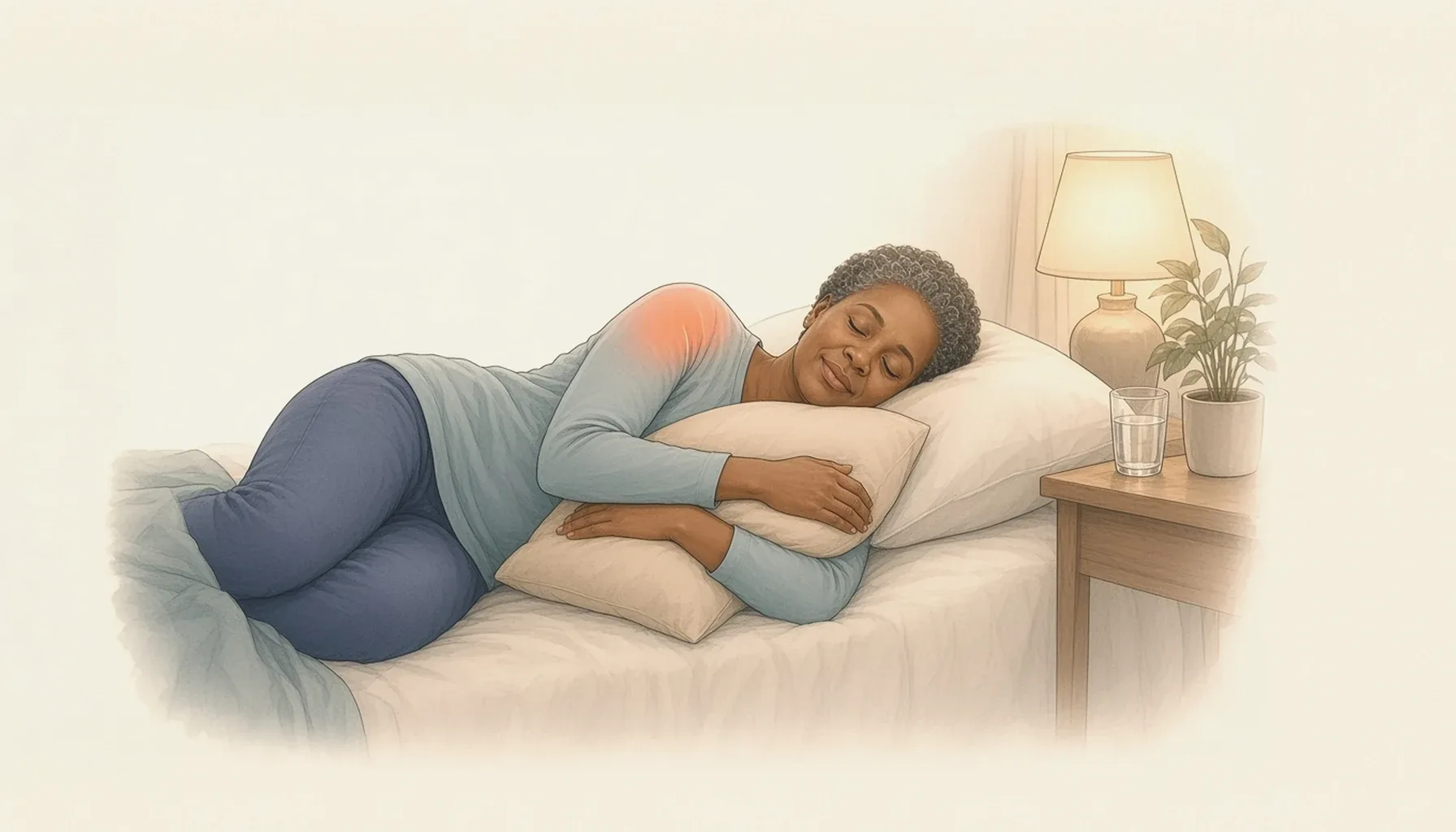
Frozen shoulder, also called adhesive capsulitis, often hurts more at night, and research has not yet shown exactly why. Studies do show that people with frozen shoulder sleep worse than people without it, and the American Academy of Orthopaedic Surgeons (AAOS) describes the joint lining as thick, tight and inflamed. The practical steps below can make nights easier while the shoulder works through its stages, and they can help you decide when to ask a clinician for more.
Key takeaways
- In a study of 76 people with frozen shoulder and 72 healthy controls, the frozen shoulder group had significantly higher pain scores and significantly lower sleep efficiency.
- We found no study that explains why frozen shoulder pain rises at night, so any single cause you read about online is an educated guess.
- Across shoulder conditions, a 2026 review reported that night pain appears to be a primary driver of sleep disturbance.
- In a study of 83 people with one sore shoulder, 67% of those who slept on a side lay on the painful one.
- In a long-term study of 223 patients, 59% had normal or near normal shoulders at a mean of 4.4 years after symptom onset.
- Pain that follows a fall, new weakness, fever, or numbness that spreads down the arm is a reason to call your clinician soon.
If you are still sorting out why your shoulder hurts after dark, start with our guide to why shoulder pain gets worse at night. This post covers frozen shoulder only.
What happens inside a frozen shoulder?
AAOS OrthoInfo explains that the shoulder capsule, the strong connective tissue around the joint, thickens and becomes stiff and tight. Thick bands of tissue called adhesions develop, and in many cases there is less lubricating fluid in the joint. The hallmark signs are severe pain and being unable to move the shoulder, either on your own or with someone else's help.
AAOS describes 3 stages:
- Freezing. Pain slowly builds and motion shrinks. This stage typically lasts 6 weeks to 9 months.
- Frozen. Painful symptoms may improve, and stiffness remains. This stage typically lasts 4 to 6 months.
- Thawing. Motion slowly returns. A return to normal or close to normal typically takes 6 months to 2 years.
AAOS says the pain is usually dull or aching, is typically worse early in the course and when you move the arm, and is usually felt over the outer shoulder and sometimes the upper arm. The AAOS page does not list night pain by name, so what follows comes from other studies.
Does frozen shoulder really hurt more at night?
Many people describe it that way, and the research supports a link between frozen shoulder, night pain and poor sleep, with some limits.
A 2019 study by Toprak and Erden compared 76 people with frozen shoulder with 72 healthy controls. The authors opened by proposing that nocturnal shoulder pain could play an essential role in frozen shoulder. The frozen shoulder group had significantly higher pain and anxiety scores, and significantly lower sleep efficiency and worse sleep disorder scores on the Pittsburgh Sleep Quality Index. The study compared groups at one point in time, so it cannot show that night pain caused the poor sleep.
A 2026 narrative review by Kunze and colleagues looked at sleep in people having shoulder surgery. It reported that sleep disturbance affects up to 80% to 90% of patients before surgery across several shoulder conditions, and that nocturnal pain appears to be a primary driver. The review was not specific to frozen shoulder and did not combine data.
Why might it hurt more at night?
Nobody has measured frozen shoulder pain hour by hour in a published trial that we could find, so the honest answer is that the cause is not settled. - The joint lining is inflamed. AAOS describes the capsule as thick, stiff and inflamed. That fits an aching joint, though no study links it to the night pattern.
- Lying on the sore side is common. A 2012 study by Kempf and Kongsted of 83 people with one sore shoulder found that 67% of those who slept on a side lay on the painful one. That study covered shoulder pain of many kinds, so it says little about frozen shoulder alone.
Does poor sleep make frozen shoulder worse?
The evidence is mixed, which is useful to know if you are worried that bad nights will slow your recovery.
- A 2025 study by Fonseca and colleagues of 96 people with frozen shoulder found that sleep quality was not significantly associated with activity related pain or disability. Higher pain self-efficacy was linked to lower pain and disability, while higher anxiety and kinesiophobia, a fear of movement, were linked to worse scores.
- A 2026 cohort study by Brindisino and colleagues followed 80 people through 3 months of standard conservative care. Insomnia did not show a significant link with pain or disability at 3 months. Anxiety did.
- A 2026 study by Lu and colleagues of people having manipulation under anesthesia found that clinical insomnia went with worse shoulder scores beforehand. At 3 and 6 months after the procedure, there were no meaningful differences between the groups.
- A small 2025 randomized trial by Guzmán-García and colleagues of 34 people added sleep and circadian rhythm instructions to manual therapy and exercise for one group. After 6 weeks, sleep scores improved by 4 points in that group and 2 points in the other. The authors called for longer studies.
Taken together, these studies suggest that tough nights are common and that they do not by themselves predict a worse outcome. If sleep or worry feel heavy, mention them to your clinician.
How can you sleep better with frozen shoulder?
No trial has tested sleeping positions in frozen shoulder, so these steps draw on the studies above and on general comfort. Change one thing at a time and keep what helps.
- Stay off the sore shoulder. Lie on your back or on your pain-free side. Our post on the best sleeping position for shoulder pain walks through both setups, and our post on side sleeping and shoulder pain explains why the sore side matters.
- Hug a pillow. On your pain-free side, hold a firm pillow against your chest so the sore arm rests forward and level.
- Support the forearm on your back. Place a folded pillow under the sore arm so the shoulder does not sag backward.
- Raise your upper body a little. Some people feel better semi-reclined. Kunze and colleagues reported that sleeping semi-reclined may ease pain and sleep disturbance after shoulder surgery, and no study has tested it in frozen shoulder. Our posts on choosing a pillow for shoulder pain and on wedge pillows cover the setup.
- Ask about timing of pain relief. Ask your clinician about pain relief options and whether dose timing might help your evenings.
- Keep stretching gentle. AAOS says physical therapy focused on shoulder flexibility is the primary treatment, and notes that heat is sometimes used to loosen the shoulder before stretching. Our guide to moving a painful frozen shoulder is a good place to start, and your therapist can tailor the details.
What does treatment research say?
If nights stay hard, treatment is a conversation to have with your clinician. A 2020 systematic review and meta-analysis by Challoumas and colleagues covered 65 studies with 4,097 participants. In the short term, only an injection of corticosteroid into the joint showed both statistical and clinical advantages for pain and function over other options. The authors suggested early use in people with frozen shoulder of less than 1 year, together with a home exercise program.
How long does frozen shoulder last?
AAOS says a frozen shoulder tends to get better after a period of worsening symptoms, although full recovery may take up to 3 years. A 2008 study by Hand and colleagues followed 269 shoulders in 223 patients for a mean of 4.4 years from symptom onset. In the long term, 59% had normal or near normal shoulders and 41% reported some ongoing symptoms. Most of those ongoing symptoms were mild (94%), and 6% of the group had severe symptoms.
How can you tell frozen shoulder from other night pain?
A rotator cuff tear or bursitis can also ache at night. AAOS says people with frozen shoulder have limited range of motion both actively and passively, so the shoulder is stiff even when someone else moves your arm. Our post on shoulder pain vs frozen shoulder lays out the differences. A clinician can examine the shoulder and order imaging if needed.
Can a shoulder support help at night?
We found no trial of a sleep pillow or shoulder support in people with frozen shoulder, so the case for one rests on what it is designed to do. The Shoulder Sleeper Pillow is designed to support the arm at night with a waist strap, arm strap and wrist strap, and it can help limit unwanted arm rotation while you sleep. It is built for back and side sleepers, comes in Small/Medium and Large/XL sizes, and has left and right versions, so the sore side matters when you order. Check with your clinician or therapist that the position it holds suits your stage.
During the day, the BlueRanger Shoulder Pulley is designed to help with gentle range of motion stretching your therapist recommends. Ask your therapist whether it belongs in your program.
A support does not diagnose or treat frozen shoulder. Ask your clinician whether it suits your condition and treatment plan.
When should you call a clinician?
Call your doctor or care team if you notice:
- Shoulder pain and stiffness that limit daily tasks, or night pain that wakes you most nights for more than a couple of weeks
- Sudden pain or loss of strength after a fall or a lift
- Numbness, tingling, or weakness that spreads down the arm, which our guide to shoulder pain and numbness in the arm explains in more detail
- Fever, redness, or swelling around the shoulder
Chest pain, shortness of breath, or pain that spreads to the jaw or left arm needs emergency care right away.
Related reading
- Why does shoulder pain get worse at night?
- Shoulder pain vs frozen shoulder
- How to move that painful frozen shoulder
- What is the best sleeping position for shoulder pain?
- How to choose a pillow for shoulder pain
- Does a wedge pillow help shoulder pain?
Your next step
Tonight, lie on your back or your pain-free side with a pillow supporting the sore arm, and write down how you slept and how the shoulder felt in the morning. After a week, keep what helped and bring your notes to your next visit. If you want a strap based arm support to try, take a look at the Shoulder Sleeper Pillow.
Common questions
Why does frozen shoulder hurt more at night?
No study has settled the reason. People with frozen shoulder report higher pain and worse sleep than people without it, and AAOS describes the joint capsule as thick, stiff and inflamed. Lying on the sore side and the lack of daytime distractions may play a part.
Does frozen shoulder pain get better at night as it heals?
For many people it does. AAOS says frozen shoulder tends to improve over time, and painful symptoms may ease in the frozen stage while stiffness remains.
What is the best sleeping position for frozen shoulder?
No trial has compared positions. Many people are more comfortable on their back or on the pain-free side with a pillow supporting the sore arm. Avoid lying on the sore shoulder.
Will poor sleep slow my frozen shoulder recovery?
The studies we found were mixed. Sleep quality and insomnia did not show a significant link with pain or disability in two cohorts, while anxiety did in both.
Medical disclaimer
The information in this article is for general education only. It is not medical advice, diagnosis, or treatment, and reading it does not create a provider-patient relationship with RangeMaster. Recovery plans differ from person to person. Talk with your surgeon, physician, or physical therapist before you start, stop, or change any exercise, product, or treatment, and follow their instructions when they differ from anything you read here.
If you think you are having a medical emergency, call 911 or your local emergency number right away.
RangeMaster makes and sells the products linked in this article. Full medical disclaimer.
Sources
- American Academy of Orthopaedic Surgeons. Frozen Shoulder. OrthoInfo https://orthoinfo.aaos.org/en/diseases--conditions/frozen-shoulder/
- Toprak M, Erden M. Sleep quality, pain, anxiety, depression and quality of life in patients with frozen shoulder. J Back Musculoskelet Rehabil. 2019;32(2):287-291. doi:10.3233/BMR-171010 https://pubmed.ncbi.nlm.nih.gov/30347591/
- Kunze KN, Sardesai KS, Barton K, Jesse JE, Caplan BE, Alfonsi SP 3rd, Shinn D, Cole BJ. Sleep disturbance in patients undergoing shoulder surgery: a current concepts review. JSES Rev Rep Tech. 2026;6(4):100820. doi:10.1016/j.xrrt.2026.100820 https://pubmed.ncbi.nlm.nih.gov/42668460/
- Kempf B, Kongsted A. Association between the side of unilateral shoulder pain and preferred sleeping position: a cross-sectional study of 83 Danish patients. J Manipulative Physiol Ther. 2012;35(5):407-412. doi:10.1016/j.jmpt.2012.04.015 https://pubmed.ncbi.nlm.nih.gov/22608285/
- Fonseca RNS, Policastro PO, Medeiros Filho JF, Lucena EMF, Kamonseki DH, Barbosa GM. Association of psychological factors and sleep quality with activity-related pain and disability in individuals with frozen shoulder. Musculoskelet Sci Pract. 2025;78:103366. doi:10.1016/j.msksp.2025.103366 https://pubmed.ncbi.nlm.nih.gov/40570573/
- Brindisino F, Silvestri E, Fioretti A, Pulina F, Conteduca J, Navarro Ledesma S, Barbosa GM, Struyf F. Psychological factors, central sensitization, and insomnia as potential prognostic factors for short-term pain and disability in patients with frozen shoulder: a multicentric prospective single-cohort study. Pain Res Manag. 2026;2026(1):e6298409. doi:10.1155/prm/6298409 https://pubmed.ncbi.nlm.nih.gov/41972303/
- Lu F, Hu Z, Shen L, Hu Y, Wang X, Wang X, Ruan D, Liu H, Cai H, Shen W. Effects of insomnia, anxiety and depression on clinical outcomes of frozen shoulder after manipulation under anesthesia. Physiother Res Int. 2026;31(3):e70264. doi:10.1002/pri.70264 https://pubmed.ncbi.nlm.nih.gov/42339703/
- Guzmán-García R, Pérez-Montalbán M, Pruimboom L, Navarro-Ledesma S. Impact of a multimodal intervention combining manual therapy, exercise, reduced methylxanthine intake, and nocturnal light avoidance on inflammatory and metabolic profiles, pain, functionality, and sleep quality in patients with frozen shoulder: a single-blind randomized controlled trial. J Clin Med. 2025;14(13):4539. doi:10.3390/jcm14134539 https://pubmed.ncbi.nlm.nih.gov/40648913/
- Challoumas D, Biddle M, McLean M, Millar NL. Comparison of treatments for frozen shoulder: a systematic review and meta-analysis. JAMA Netw Open. 2020;3(12):e2029581. doi:10.1001/jamanetworkopen.2020.29581 https://pubmed.ncbi.nlm.nih.gov/33326025/
- Hand C, Clipsham K, Rees JL, Carr AJ. Long-term outcome of frozen shoulder. J Shoulder Elbow Surg. 2008;17(2):231-236. doi:10.1016/j.jse.2007.05.009 https://pubmed.ncbi.nlm.nih.gov/17993282/