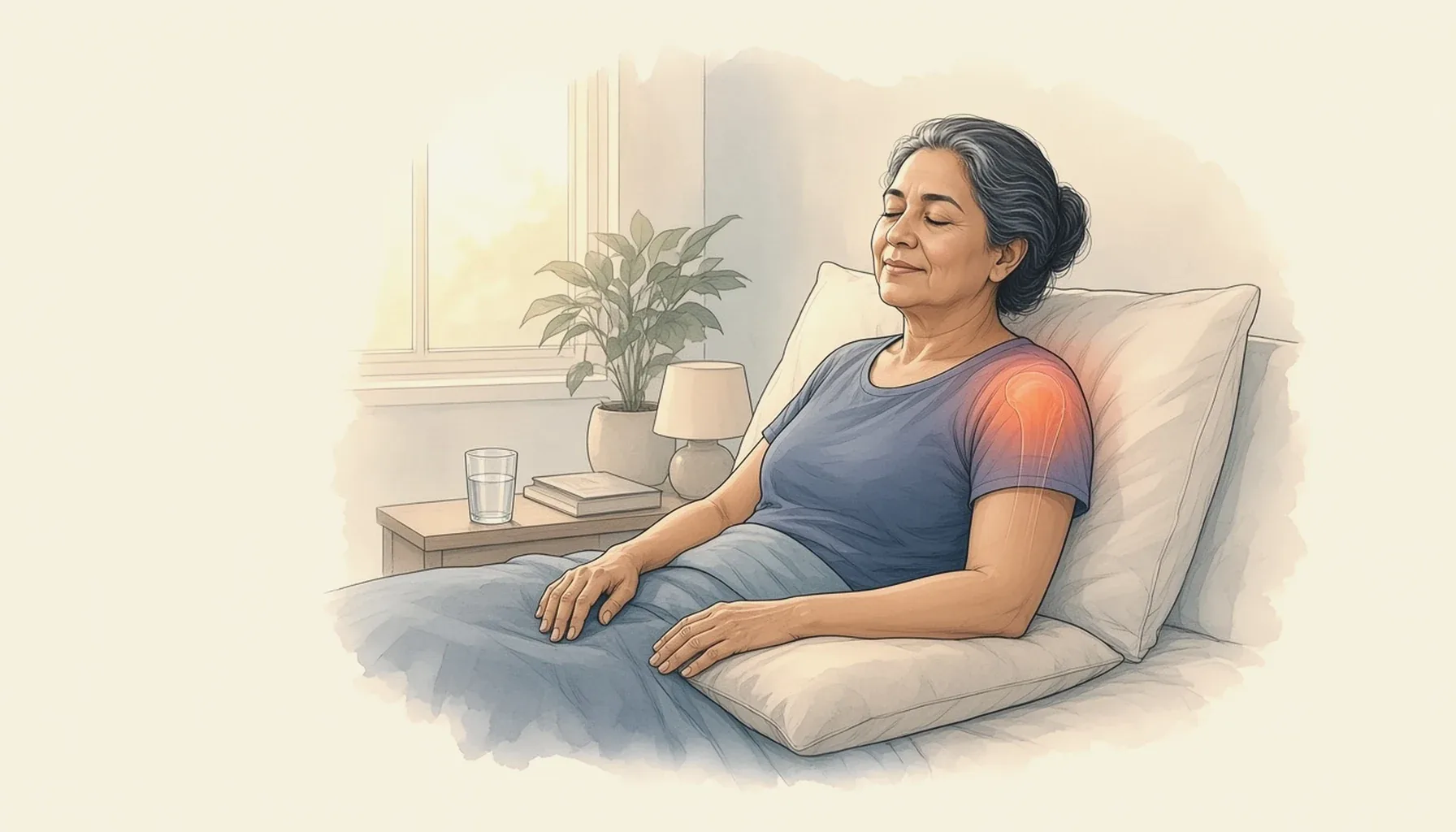
Many people with a rotator cuff tear sleep better by keeping weight off the sore shoulder and supporting the arm with pillows. No trial has tested sleeping positions in people who are not having surgery, so the setups below are practical comfort ideas and not proven treatments. What the research does show is that nighttime pain is common with these tears, and that many people improve with a physical therapy program over a few months.
Key takeaways
- Night pain affected 91% to 93% of patients in a systematic review of 10 studies of rotator cuff problems.
- The American Academy of Orthopaedic Surgeons (AAOS) lists pain at rest and at night, especially when lying on the affected shoulder, among the most common symptoms of a tear.
- In a cohort study of 452 people with atraumatic full-thickness tears, a physical therapy program was effective in approximately 75% of those followed for 2 years.
- Long-term trials of small to medium tears found better results after repair at 10 and 15 years, so ask your clinician how often your tear should be rechecked.
- Back sleeping, or lying on the pain-free side with a pillow supporting the sore arm, keeps weight off the tear.
- Pain after a fall, new weakness, or numbness that spreads down the arm is a reason to call your clinician soon.
If you are still working out why the pain is worse after dark, start with our post on why shoulder pain gets worse at night. This post covers one situation: you have a tear, you are not having surgery right now, and you want to sleep.
How common is night pain with a rotator cuff tear?
Very common. A 2022 systematic review by Castro-Contreras and Valdez-Pardo pooled 10 studies with 1,516 patients and reported nighttime pain in 91% to 93% of them, with an average intensity of 5.5 on a 10 point scale. A 2019 systematic review by Longo and colleagues found that most people with rotator cuff tears had a sleep disturbance, that sleep quality tracked with pain, and that being unable to change position at night may play a role.
AAOS OrthoInfo says pain when lying on the affected shoulder is one of the most common symptoms of a tear. The same page notes that some tears cause no pain at all, so how a shoulder feels at night does not tell you the size of the tear.
Is it common to manage a rotator cuff tear without surgery?
Yes. AAOS reports that in about 80 to 85% of patients, nonsurgical treatment relieves pain and improves function. The options it lists include activity changes, anti-inflammatory medicine, physical therapy and exercise, and in some cases a steroid injection. The page also says most tears cannot heal on their own, yet people can often function well because other muscles and tendons help move the arm.
Three studies give a closer look at how people do without surgery:
- A 2013 multicenter cohort study by Kuhn and colleagues followed 452 people with atraumatic full-thickness tears who began a structured physical therapy program. Patient-reported outcomes improved significantly at 6 and 12 weeks. Fewer than 25% chose surgery, and the authors concluded the program was effective in approximately 75% of patients followed for 2 years. A 10-year follow-up in 2024 reported that therapy was effective for over 70% of patients and that their scores did not decline over 10 years.
- A 2015 randomized trial by Kukkonen and colleagues assigned 180 shoulders with nontraumatic supraspinatus tears to physiotherapy only, acromioplasty plus physiotherapy, or repair plus acromioplasty and physiotherapy. At 2 years there was no significant difference in Constant score change, pain or satisfaction. A 2021 follow-up of the same trial found no significant differences after a mean of 6.2 years in patients with a mean age of 71, although 8 shoulders in the physiotherapy group had crossed over to repair.
- A 2019 randomized trial by Moosmayer and colleagues of 103 patients with tears up to 3 cm found better results after tendon repair at 10 years, by 9.6 points on the Constant score and 1.8 cm on a 10 cm pain scale. Its 15-year report in 2024 found the advantage for repair remained, and the average tear size in 26 shoulders treated with physiotherapy only grew from 16.2 mm to 31.6 mm.
These studies enrolled different people, so they do not contradict each other. Together they suggest that many people, especially older adults with small tears, do well at first with nonsurgical care, and that tears treated without surgery can grow over time. Our post on when rotator cuff surgery is necessary goes through the questions to bring to your surgeon.
What can you do tonight to sleep with a tear?
We found no trial that compares sleep setups for people with a tear who are not having surgery. These ideas come from how the pain behaves and from common clinical advice, so adjust them to what works for you.
- Start on your back. Lying on your back keeps body weight off both shoulders. Place a thin pillow under the sore arm so the upper arm and forearm rest level and the shoulder is not pulled backward.
- Raise your head and trunk a little. Some people with night pain find a slightly reclined position more comfortable. Extra pillows or a wedge can help build a gentle slope.
- If you side sleep, choose the pain-free side. AAOS notes that pain often occurs when lying on the affected shoulder, so keep that shoulder on top.
- Hug a pillow. A firm pillow against your chest gives the top arm a place to rest slightly forward, so the arm does not fall across the body.
- Support your neck. Choose a pillow height that keeps your head level with your spine. Our post on pillows for side sleepers with neck and shoulder pain covers height and firmness.
- Block the roll. A pillow behind your back can make it harder to turn onto the sore side while you are asleep.
Our guide to the best sleeping position for shoulder pain walks through back, side and semi-reclined setups in more detail.
Does side sleeping make a tear worse?
Not enough is known to say. In a 2024 case series by Richards and colleagues, 52 of 58 patients with a significant partial or full thickness tear were side sleepers, and the authors concluded there appeared to be a relationship. The series had no comparison group, so it cannot show that side sleeping came first or caused the tear. Our post on whether sleeping on your side can cause shoulder pain looks at that evidence in full.
AAOS also says that a tear can get larger with repetitive use or re-injury. For that reason, keeping pressure and awkward arm positions to a minimum at night is a reasonable comfort goal, even though no study has tested it.
Can a shoulder support pillow help?
A pillow cannot heal a tear, and we found no trial of a strap based sleep pillow. What it may support is a steady arm position, which can make it easier to stay off the sore side. The Shoulder Sleeper Pillow is designed to support the arm at night with a waist strap, arm strap and wrist strap, and it can help limit unwanted arm rotation while you sleep. It is built for back and side sleepers, comes in Small/Medium and Large/XL sizes, and has left and right versions. Ask your clinician whether a support suits your tear and your treatment plan.
When should you call a clinician?
Call your doctor or care team if you notice:
- Sudden pain or a pop after a fall or a lift, or a new loss of strength when raising the arm
- Pain that wakes you most nights for more than a couple of weeks despite pillow changes
- Pain that keeps increasing, or a tear that has not been rechecked in a long time
- Numbness, tingling, or weakness that spreads down the arm, which our guide to shoulder pain and numbness in the arm explains in more detail
- Fever, redness, or swelling around the shoulder
Chest pain, shortness of breath, or pain that spreads to the jaw or left arm needs emergency care right away.
Related reading
- Why does shoulder pain get worse at night?
- What is the best sleeping position for shoulder pain?
- Can sleeping on your side cause shoulder pain?
- When is rotator cuff surgery necessary?
Your next step
Tonight, try lying on your back with a thin pillow under the sore arm, and keep a second pillow beside you to hug if you roll to the pain-free side. Write down how you slept and when the pain woke you. Bring those notes to your next visit so your clinician can see how your tear behaves at night. If you want a steadier arm position, take a look at the Shoulder Sleeper Pillow.
Common questions
How do you sleep with a rotator cuff tear?
Most people are more comfortable on their back with a pillow under the sore arm, or on the pain-free side hugging a pillow. No trial has compared positions in people with tears, so choose the setup that lets you sleep with the least pain.
Can a rotator cuff tear heal without surgery?
AAOS says most tears cannot heal on their own, but many people still function well without surgery because other muscles and tendons help move the arm. Nonsurgical treatment relieved pain and improved function in about 80 to 85% of patients, according to AAOS.
Does a rotator cuff tear hurt more at night?
Often. Night pain was reported in 91% to 93% of patients in a systematic review of rotator cuff problems.
Will a tear get bigger if I do not have surgery?
It can. In the 15-year Moosmayer trial, the average tear size in 26 shoulders treated with physiotherapy only grew from 16.2 mm to 31.6 mm. Ask your clinician how often your tear should be rechecked.
Is it safe to sleep on the side of a rotator cuff tear?
No study has tested this. AAOS lists pain when lying on the affected shoulder as common, so many people choose the other side or their back.
Medical disclaimer
The information in this article is for general education only. It is not medical advice, diagnosis, or treatment, and reading it does not create a provider-patient relationship with RangeMaster. Recovery plans differ from person to person. Talk with your surgeon, physician, or physical therapist before you start, stop, or change any exercise, product, or treatment, and follow their instructions when they differ from anything you read here.
If you think you are having a medical emergency, call 911 or your local emergency number right away.
RangeMaster makes and sells the products linked in this article. Full medical disclaimer.
Sources
- American Academy of Orthopaedic Surgeons. Rotator Cuff Tears. OrthoInfo https://orthoinfo.aaos.org/en/diseases--conditions/rotator-cuff-tears/
- Castro-Contreras E, Valdez-Pardo ME. Rotator cuff injuries with nighttime pain and sleep quality before and after treatment: a systematic review. Acta Ortop Mex. 2022;36(1):33-38 https://pubmed.ncbi.nlm.nih.gov/36099571/
- Longo UG, Facchinetti G, Marchetti A, Candela V, Risi Ambrogioni L, Faldetta A, De Marinis MG, Denaro V. Sleep disturbance and rotator cuff tears: a systematic review. Medicina (Kaunas). 2019;55(8):453. doi:10.3390/medicina55080453 https://pubmed.ncbi.nlm.nih.gov/31398952/
- Kuhn JE, Dunn WR, Sanders R, An Q, Baumgarten KM, Bishop JY, Brophy RH, Carey JL, Holloway BG, Jones GL, Ma CB, Marx RG, McCarty EC, Poddar SK, Smith MV, Spencer EE, Vidal AF, Wolf BR, Wright RW; MOON Shoulder Group. Effectiveness of physical therapy in treating atraumatic full-thickness rotator cuff tears: a multicenter prospective cohort study. J Shoulder Elbow Surg. 2013;22(10):1371-1379. doi:10.1016/j.jse.2013.01.026 https://pubmed.ncbi.nlm.nih.gov/23540577/
- Kuhn JE, Dunn WR, Sanders R, Baumgarten KM, Bishop JY, Brophy RH, Carey JL, Holloway BG, Jones GL, Ma CB, Marx RG, McCarty EC, Poddar SK, Smith MV, Spencer EE, Vidal AF, Wolf BR, Wright RW; MOON Shoulder Group. Nonsurgical treatment of symptomatic, atraumatic full-thickness rotator cuff tears: a prospective multicenter cohort study with 10-year follow-up. J Am Acad Orthop Surg. 2024;32(23):1061-1073. doi:10.5435/JAAOS-D-24-00841 https://pubmed.ncbi.nlm.nih.gov/39325825/
- Kukkonen J, Joukainen A, Lehtinen J, Mattila KT, Tuominen EK, Kauko T, Aarimaa V. Treatment of nontraumatic rotator cuff tears: a randomized controlled trial with two years of clinical and imaging follow-up. J Bone Joint Surg Am. 2015;97(21):1729-1737. doi:10.2106/JBJS.N.01051 https://pubmed.ncbi.nlm.nih.gov/26537160/
- Kukkonen J, Ryosa A, Joukainen A, Lehtinen J, Kauko T, Mattila K, Aarimaa V. Operative versus conservative treatment of small, nontraumatic supraspinatus tears in patients older than 55 years: over 5-year follow-up of a randomized controlled trial. J Shoulder Elbow Surg. 2021;30(11):2455-2464. doi:10.1016/j.jse.2021.03.133 https://pubmed.ncbi.nlm.nih.gov/33774172/
- Moosmayer S, Lund G, Seljom US, Haldorsen B, Svege IC, Hennig T, Pripp AH, Smith HJ. At a 10-year follow-up, tendon repair is superior to physiotherapy in the treatment of small and medium-sized rotator cuff tears. J Bone Joint Surg Am. 2019;101(12):1050-1060. doi:10.2106/JBJS.18.01373 https://pubmed.ncbi.nlm.nih.gov/31220021/
- Moosmayer S, Lund G, Seljom US, Haldorsen B, Svege IC, Hennig T, Pripp AH, Smith HJ. Fifteen-year results of a comparative analysis of tendon repair versus physiotherapy for small-to-medium-sized rotator cuff tears: a concise follow-up of previous reports. J Bone Joint Surg Am. 2024;106(19):1785-1796. doi:10.2106/JBJS.24.00065 https://pubmed.ncbi.nlm.nih.gov/39197154/
- Richards DP, Miller DL, MacDonald ED, Stewart QF, Miller SD. Rotator cuff tears are related to the side sleeping position. Arthrosc Sports Med Rehabil. 2024;6(2):100886. doi:10.1016/j.asmr.2024.100886 https://pubmed.ncbi.nlm.nih.gov/38328528/