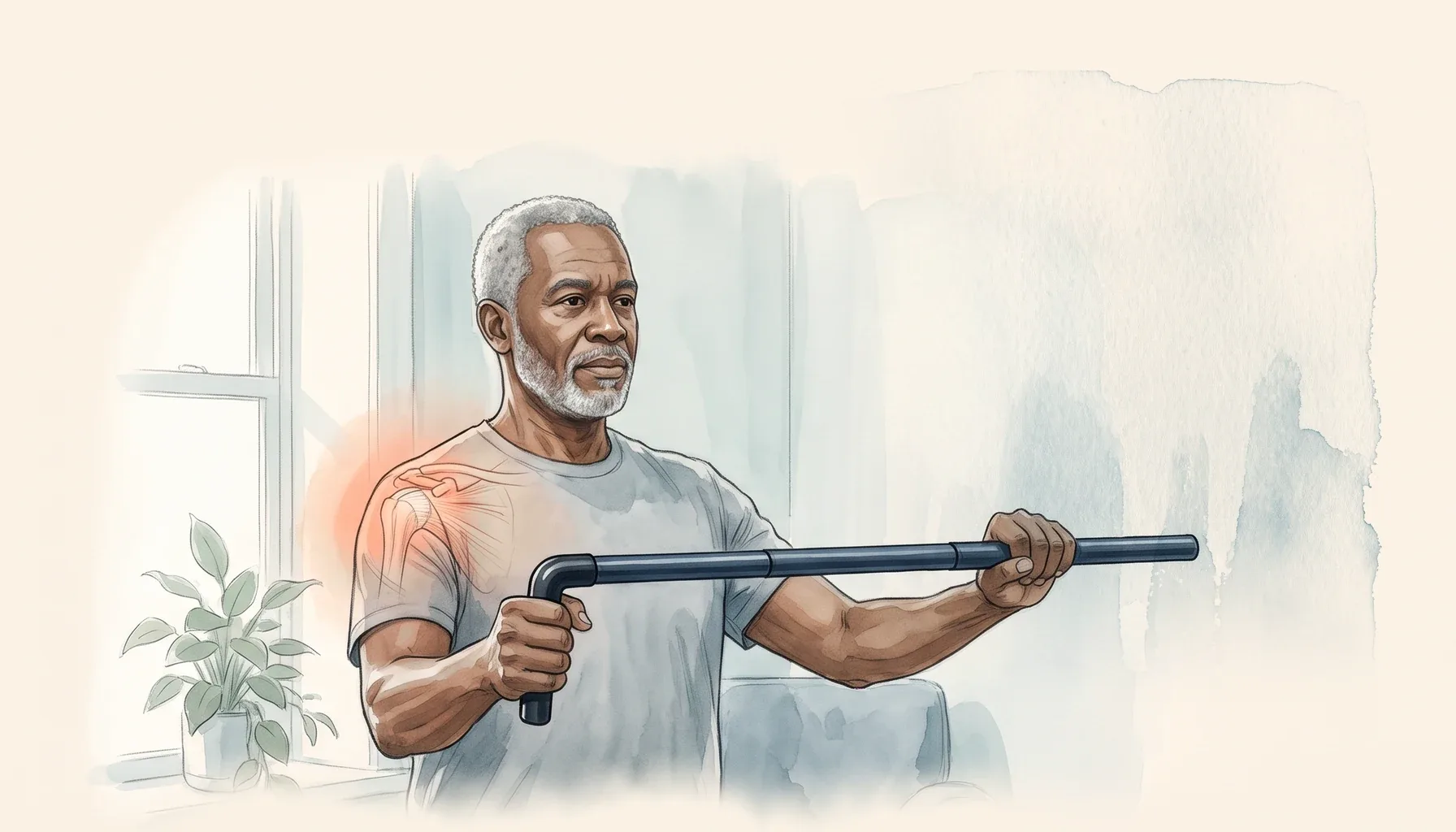
Rotator cuff surgery recovery usually moves through stages. Most people wear a sling for 4 to 6 weeks, start gentle passive motion in the early weeks, move the arm on their own after about 4 to 6 weeks, and begin strengthening around 8 to 12 weeks. Most reach good motion and strength by 4 to 6 months, and some measures keep improving for up to 2 years.
Key takeaways
- Recovery runs in phases: protection, passive motion, active motion, strengthening and return to full activity.
- The repaired tendon needs months to heal back to the bone, so timing matters at every step.
- Your tear size, tissue quality and type of repair shape your surgeon's plan.
- Sleep is often hardest around week 2 and tends to improve by week 6.
- Most people drive again around 2 months, and return to work depends heavily on the job.
What happens during rotator cuff repair?
During repair, the surgeon reattaches the torn tendon to the upper arm bone, and the rest of recovery protects that tendon while it heals.
The rotator cuff is a group of four muscles and tendons that hold the ball of the shoulder in its socket and help you lift and turn your arm. AAOS explains that the goal of repair is for the tendon to heal back to the bone, and that healing takes time. Stitches and small anchors hold the tendon in place at first. New tissue slowly forms the lasting bond over the following months.
That is why the early weeks feel so cautious. A shoulder can feel better long before the tendon is strong enough for lifting. If you are still deciding on surgery, our post on when rotator cuff surgery is necessary covers the decision itself, and our common questions before and after shoulder surgery can help you prepare your home.
What happens in the first week after surgery?
The first week is about rest, pain control, wound care and protecting the repair. Most people wear a sling full time and move only the hand, wrist and elbow as instructed.
Common goals for this week include:
- Taking pain medicine as prescribed, and opioids only as directed. AAOS advises stopping opioids as soon as pain improves.
- Using cold therapy as your care team recommends, with a cloth layer between the cold pack and your skin.
- Keeping the dressing clean and dry until your surgeon says otherwise.
- Gently opening and closing the hand and bending the elbow to ease stiffness below the shoulder.
Even small tasks can load the repair. A 2010 study by Long and colleagues found that drinking from a cup activated the supraspinatus, the cuff muscle most often repaired, at more than 15% of its maximum effort in healthy volunteers. Large pendulum swings did the same. Follow the exact movements your therapist gives you. Our post on the rest of the arm after shoulder surgery explains why hand and elbow movement still matters.
What happens in weeks 1 to 6?
Weeks 1 to 6 are the protection phase. The sling stays on most of the time, and therapy focuses on gentle passive motion, where the arm is moved for you while the repaired muscles stay relaxed.
How long will I wear the sling?
Most people wear a sling for about 4 to 6 weeks. AAOS describes 4 to 6 weeks in a sling, and the exact time depends on the severity of the tear, the quality of the tissue and the type of repair.
The American Society of Shoulder and Elbow Therapists' consensus statement describes 2 weeks of strict immobilization, then protected passive motion from weeks 2 to 6. Some surgeons use shorter sling times after small repairs. In a 2019 trial by Tirefort and colleagues, 80 patients with small or medium tears either wore a sling or went without one. The no-sling group had better motion at 6 weeks and better elevation at 3 months, and tendon integrity was similar at 6 months. For tips on fit and comfort, read how to use a shoulder sling the right way and our look at sling or no sling after shoulder surgery.
When does physical therapy start?
Physical therapy often starts within the first few weeks, with passive motion guided by a therapist. Some surgeons start it within days, and others wait longer after large repairs.
Several trials have compared early and delayed passive motion. A randomized trial by Cuff and Pupello started passive motion on day 2 for 33 patients and at 6 weeks for 35 patients. Outcomes and motion were very similar at 1 year, and healing was slightly higher in the delayed group, 91% compared with 85%. A trial by Keener and colleagues in 124 patients under 65 with small and medium tears found better motion at 3 months with early motion and similar results after that, with 92% of tears healed. A trial by Sheps and colleagues of 189 mini-open repairs found better motion at 6 weeks with early mobilization and similar results at 24 months.
Is early motion safe for every tear?
Early motion appears safe for many small and medium tears, and large tears may need more protection. That is one reason your surgeon's plan is personal.
A meta-analysis by Kluczynski and colleagues pooled 28 studies with 1,729 repairs. A meta-analysis combines the results of many studies into one estimate. For tears larger than 5 centimeters, retears happened in 52.2% of the early motion groups and 22.6% of the delayed groups. The authors concluded that evidence on the best timing is still lacking and that tear size may be influential.
What happens in weeks 6 to 12?
Weeks 6 to 12 are when most people leave the sling, start moving the arm on their own, and work toward a fuller range of motion. AAOS describes active exercise after 4 to 6 weeks.
Active assisted exercises often bridge this step. In these, your own muscles work while another force, such as your healthy arm, helps. A shoulder pulley is a common example. A 1998 study by Dockery and colleagues used electromyography, which records the electrical signal a working muscle makes. The supraspinatus worked at 17.6% of its maximum during pulley exercise and at 5.0% during a continuous passive motion machine. That difference is why many protocols wait until this phase for pulley work.
The research on timing is reassuring. In a 2016 randomized trial by Baumgarten and colleagues, patients who started pulleys 6 weeks after repair had no worse outcomes than patients on a program without pulleys, measured by patient scores, motion, strength and shoulder blade movement. The trial excluded large and massive tears. We reviewed it in our article on the pulley and Jackins exercise trial, and our guide on how to use a shoulder pulley covers setup.
Is pain at 8 weeks normal?
Some soreness at 8 weeks is common, especially as the arm starts moving on its own and therapy gets harder. Pain that keeps rising, or comes with new weakness, deserves a call to your surgeon. Our post on shoulder pain 8 weeks after rotator cuff surgery looks at this stage in detail, and our guide on when to use ice, heat and compression can help with soreness after sessions.
When does strengthening start?
Strengthening usually starts around 8 to 12 weeks, with light resistance first. AAOS places strengthening at 8 to 12 weeks, and the consensus statement starts progressive strengthening from about week 12.
From 3 to 6 months, therapy builds strength in the rotator cuff and the muscles around the shoulder blade, then moves toward tasks you need for daily life, work and sport. Bands, light weights and controlled movements are common tools. AAOS notes that most people reach functional range of motion and adequate strength by 4 to 6 months.
Progress often continues after that. In the Keener trial, most function scores leveled off at 6 or 12 months, and one shoulder function score, the relative Constant score, kept improving up to 24 months. For one exercise many therapists like at this stage, see our star exercise on rotator cuff strengthening.
How does sleep change during recovery?
Sleep is often hard in the first weeks, worst around week 2, and better by week 6, with steady gains over the next several months.
A 2026 study by Fiandeiro and colleagues followed sleep after rotator cuff repair. At 2 weeks, 85% of patients slept on their backs, up from 39.2% before surgery. Pain-related sleep trouble was worse at 2 weeks and better than before surgery by 6 weeks. Side sleeping partly returned by 6 weeks, sleep positions looked like they did before surgery by 24 weeks, and 55% reported no nighttime sleep disturbance at 24 weeks. Nicotine use and side sleeping before surgery were linked with more pain-related waking.
Sleep trouble often starts before surgery. In a 2015 study by Austin and colleagues, 89% of patients had sleep disturbance before repair. Sleep improved by 3 months and kept improving, and at 6 months 38% still had sleep disturbance. Narcotic pain medicine before and long after surgery was linked with worse sleep. Our post on why shoulder pain gets worse at night covers more on night pain.
When can I drive and go back to work?
Most people drive again around 2 months after repair. Desk workers often return to work within weeks, and physical jobs can take 6 months or more.
Driving
In a 2025 study by Antoni and colleagues of 128 patients, 23% were driving at 1 month, 70% at 2 months and 99% at 6 months. A simulator study by Hasan and colleagues found that drivers with a sling on their dominant arm had 73 collisions in total, compared with 36 without a sling. Wait until you are out of the sling, off opioids, and cleared by your surgeon.
Work
In a study of 383 working patients by Feltri and colleagues, return to work took 4.7 months on average, from 3.8 months in sedentary work to 5.8 months in very heavy work. A study of 83 patients by Kalejman and colleagues found a median return of 8 weeks, with heavy manual labor and workers' compensation linked with a later return. A meta-analysis by Haunschild and colleagues found that 62.3% returned to their previous level of work, at about 8 months on average. Plan early with your employer for light duty or remote work.
What can slow recovery?
Large tears, fragile tissue, smoking, and pushing past your restrictions can all slow healing or raise the chance of a retear. Some of these are within your control.
AAOS lists smoking, workers' compensation claims and not following postoperative restrictions among factors linked with less successful repairs. If you smoke, ask your care team for support to stop, and read our post on the effects of smoking on rotator cuff tear patients. Recovery can also differ between people for other reasons, which our post on male and female differences in rotator cuff repair recovery explores.
Habits that can help you stay on track:
- Doing your home exercises as prescribed, and no more
- Keeping to your sling, lifting and reaching limits
- Asking questions at every visit so you know the next step
- Getting help with chores that load the shoulder
If you fall or feel a sudden pop, read what to do if you injure your shoulder after surgery and call your surgeon.
When to call your doctor
Call your surgeon or care team if you notice:
- Fever, chills, or redness, warmth or drainage at an incision
- Pain that keeps getting worse, or pain your medicine does not control
- A fall, a sudden pop, or a new loss of strength or motion
- Numbness, tingling or color change in the hand
- Calf pain or swelling, or shortness of breath, which need urgent care
How RangeMaster products fit
The Rotator Cuff Repair Program is designed to support home rehab across each phase. It includes the Shoulder Kit Pro with a pulley, ShoulderWand and light resistance tools, a compression wrap with a gel pack, and 30 lessons across surgical and non-surgical pathways with 12 months of access. You follow the lessons that match the phase your therapist has cleared you for.
The Shoulder Sleeper Pillow is designed to help support the arm at night with a waist strap, arm strap and wrist strap, so the arm stays steady without a sling strap pressing on the neck. It may support more comfortable rest during the weeks when sleep is hardest. RangeMaster surveyed over 300 patients about our pulleys, and 97% of our patients who use a shoulder pulley say that they're feeling better. That is a survey of our own customers about how they felt, and it does not measure tendon healing.
Related reading
- Shoulder pain 8 weeks after rotator cuff surgery
- How to recover from shoulder surgery faster
- Shoulder pain 1 year after surgery
- Best pillows for side sleepers with neck and shoulder pain
Your next step
If you want a phase by phase plan to follow at home alongside your therapist, explore the Rotator Cuff Repair Program.
Common questions
How long is recovery from rotator cuff surgery?
Most people reach good motion and strength by 4 to 6 months, according to AAOS. Some measures keep improving for up to 2 years, and large tears often take longer.
How long do you wear a sling after rotator cuff surgery?
Most people wear a sling for about 4 to 6 weeks. Your surgeon sets the timeline based on your tear, tissue quality and repair.
When can I lift my arm overhead?
Raising the arm with your own muscles usually starts after 4 to 6 weeks, and lifting objects overhead waits until strengthening is well along. Ask your therapist when overhead tasks fit your plan.
When can I sleep on my side?
In one study, side sleeping partly returned by 6 weeks and sleep positions were back to normal for most people by 24 weeks. Ask your surgeon when the surgical side is safe.
Is pain 2 months after surgery normal?
Some soreness at 2 months is common as therapy progresses. Pain that is getting worse, or new weakness, should be checked by your surgeon.
Can I tear my rotator cuff again after surgery?
Yes, retears can happen. In one large review, early motion after tears larger than 5 centimeters was linked with more retears, and AAOS links smoking and not following restrictions with less successful repairs.
Medical disclaimer
The information in this article is for general education only. It is not medical advice, diagnosis, or treatment, and reading it does not create a provider-patient relationship with RangeMaster. Recovery plans differ from person to person. Talk with your surgeon, physician, or physical therapist before you start, stop, or change any exercise, product, or treatment, and follow their instructions when they differ from anything you read here.
If you think you are having a medical emergency, call 911 or your local emergency number right away.
RangeMaster makes and sells the products linked in this article. Full medical disclaimer.
Sources
- American Academy of Orthopaedic Surgeons. Rotator Cuff Tears: Surgical Treatment Options. OrthoInfo https://orthoinfo.aaos.org/en/treatment/rotator-cuff-tears-surgical-treatment-options/
- Thigpen CA, Shaffer MA, Gaunt BW, Leggin BG, Williams GR, Wilcox RB 3rd. The American Society of Shoulder and Elbow Therapists' consensus statement on rehabilitation following arthroscopic rotator cuff repair. J Shoulder Elbow Surg. 2016;25(4):521-535. doi:10.1016/j.jse.2015.12.018 https://pubmed.ncbi.nlm.nih.gov/26995456/
- Long JL, Ruberte Thiele RA, Skendzel JG, et al. Activation of the shoulder musculature during pendulum exercises and light activities. J Orthop Sports Phys Ther. 2010;40(4):230-237. doi:10.2519/jospt.2010.3095 https://pubmed.ncbi.nlm.nih.gov/20200451/
- Tirefort J, Schwitzguebel AJ, Collin P, Nowak A, Plomb-Holmes C, Lädermann A. Postoperative mobilization after superior rotator cuff repair: sling versus no sling: a randomized prospective study. J Bone Joint Surg Am. 2019;101(6):494-503. doi:10.2106/JBJS.18.00773 https://pubmed.ncbi.nlm.nih.gov/30893230/
- Cuff DJ, Pupello DR. Prospective randomized study of arthroscopic rotator cuff repair using an early versus delayed postoperative physical therapy protocol. J Shoulder Elbow Surg. 2012;21(11):1450-1455. doi:10.1016/j.jse.2012.01.025 https://pubmed.ncbi.nlm.nih.gov/22554876/
- Keener JD, Galatz LM, Stobbs-Cucchi G, Patton R, Yamaguchi K. Rehabilitation following arthroscopic rotator cuff repair: a prospective randomized trial of immobilization compared with early motion. J Bone Joint Surg Am. 2014;96(1):11-19. doi:10.2106/JBJS.M.00034 https://pubmed.ncbi.nlm.nih.gov/24382719/
- Sheps DM, Bouliane M, Styles-Tripp F, et al. Early mobilisation following mini-open rotator cuff repair: a randomised control trial. Bone Joint J. 2015;97-B(9):1257-1263. doi:10.1302/0301-620X.97B9.35250 https://pubmed.ncbi.nlm.nih.gov/26330594/
- Kluczynski MA, Nayyar S, Marzo JM, Bisson LJ. Early versus delayed passive range of motion after rotator cuff repair: a systematic review and meta-analysis. Am J Sports Med. 2015;43(8):2057-2063. doi:10.1177/0363546514552802 https://pubmed.ncbi.nlm.nih.gov/25296646/
- Dockery ML, Wright TW, LaStayo PC. Electromyography of the shoulder: an analysis of passive modes of exercise. Orthopedics. 1998;21(11):1181-1184. doi:10.3928/0147-7447-19981101-05 https://pubmed.ncbi.nlm.nih.gov/9845449/
- Baumgarten KM, Osborn R, Schweinle WE Jr, Zens MJ, Helsper EA. Are pulley exercises initiated 6 weeks after rotator cuff repair a safe and effective rehabilitative treatment? A randomized controlled trial. Am J Sports Med. 2016;44(7):1844-1851. doi:10.1177/0363546516640763 https://pubmed.ncbi.nlm.nih.gov/27159310/
- Fiandeiro M, Rizk AA, Levin JM, et al. How patients sleep after rotator cuff repair: a prospective analysis of pain, position, and recovery. J Shoulder Elbow Surg. 2026;35(8):1965-1972. doi:10.1016/j.jse.2026.02.011 https://pubmed.ncbi.nlm.nih.gov/41720245/
- Austin L, Pepe M, Tucker B, Ong A, Nugent R, Eck B, Tjoumakaris F. Sleep disturbance associated with rotator cuff tear: correction with arthroscopic rotator cuff repair. Am J Sports Med. 2015;43(6):1455-1459. doi:10.1177/0363546515572769 https://pubmed.ncbi.nlm.nih.gov/25776185/
- Antoni M, Zaibi M, ReSurg, Baldairon F. Return to driving following rotator cuff repair: 23%, 70% and 99% at 1, 2 and 6 months. J Exp Orthop. 2025;12(2):e70201. doi:10.1002/jeo2.70201 https://pubmed.ncbi.nlm.nih.gov/40242188/
- Hasan S, Chay E, Atanda A, McGee AW Jr, Jazrawi LM, Zuckerman JD. The effect of shoulder immobilization on driving performance. J Shoulder Elbow Surg. 2015;24(2):273-279. doi:10.1016/j.jse.2014.06.046 https://pubmed.ncbi.nlm.nih.gov/25217988/
- Feltri P, Monteleone AS, Marbach F, Filardo G, Candrian C. Arthroscopic rotator cuff repair: patients with physically demanding work have significantly worse time to return to work, level of employment, and job loss. Knee Surg Sports Traumatol Arthrosc. 2023;31(1):153-160. doi:10.1007/s00167-022-07172-3 https://pubmed.ncbi.nlm.nih.gov/36163511/
- Kalejman IP, Pasqualini I, Larrague C, Gallego F, Tanoira I, Ranalletta M, Rossi LA. Factors affecting return to work following arthroscopic rotator cuff repair. Shoulder Elbow. 2025;17(4):407-413. doi:10.1177/17585732241255947 https://pubmed.ncbi.nlm.nih.gov/39552665/
- Haunschild ED, Gilat R, Lavoie-Gagne O, Fu MC, Tauro T, Forsythe B, Cole BJ. Return to work after primary rotator cuff repair: a systematic review and meta-analysis. Am J Sports Med. 2021;49(8):2238-2247. doi:10.1177/0363546520975426 https://pubmed.ncbi.nlm.nih.gov/33395315/