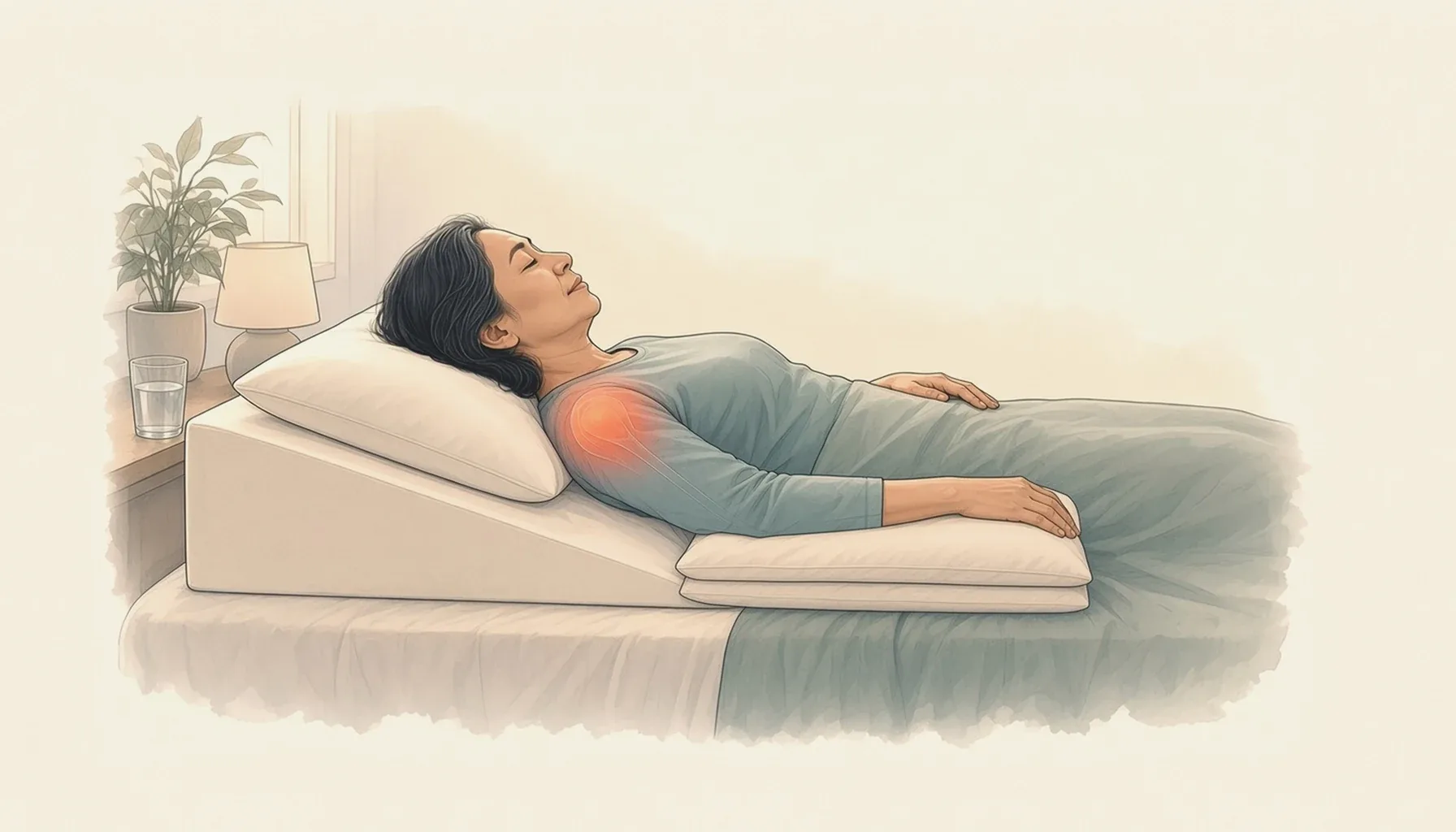
A good setup for shoulder pain pairs a head pillow whose height fills the gap between your ear and the mattress with a second support that holds the sore arm steady and slightly forward. No trial has tested pillows in people with shoulder pain, so the guidance below draws on neck pillow research and biomechanics studies. Keep the setup that lets you sleep with the least pain.
Key takeaways
- A systematic review of 35 articles found that pillow use reduced neck pain, waking pain and disability in adults with chronic neck pain, and that pillow shape and height influenced cervical alignment.
- A 2025 systematic review of 5 studies with 239 participants found no pillow type, whether latex, foam or standard, clearly better than another.
- In a lab study of 9 side sleepers, pillow height that matched shoulder width gave the neck a more natural curve.
- A review of pillow height research concluded that firm recommendations for the best height in back and side positions cannot yet be made.
- Night pain affected 91% to 93% of patients in a systematic review of rotator cuff problems, so a setup that keeps you off the sore side matters.
- Pain after a fall, new weakness, or numbness that spreads down the arm is a reason to call your clinician soon.
If you are still working out why your shoulder hurts after dark, start with our post on why shoulder pain gets worse at night. This post covers one decision: which pillows to buy or arrange once you know you need better support.
Why does the pillow matter for a sore shoulder?
Two things happen at night. Your head and neck need support so the neck stays level, and your shoulder needs a position that avoids pressure and pulling. A 2022 systematic review by Castro-Contreras and Valdez-Pardo pooled 10 studies with 1,516 patients and reported nighttime pain in 91% to 93% of them. A 2019 systematic review by Longo and colleagues found that most people with rotator cuff tears had sleep disturbance and that sleep quality tracked with pain.
AAOS OrthoInfo lists pain when lying on the affected shoulder among the most common symptoms of a rotator cuff tear. A pillow setup that keeps weight off that shoulder is therefore a reasonable first step, even though no study has measured how much it helps.
What does the research say about pillows?
The evidence is narrow. Most of it comes from neck pain, so read it as a guide to pillow features that may matter for the shoulder.
- A 2021 systematic review and meta-analysis by Chun-Yiu and colleagues included 35 articles, with 9 high quality studies and 555 participants. Pillow use reduced neck pain, waking pain and neck disability and raised satisfaction in adults with chronic neck pain. Pillow design did not change sleep quality. The authors noted that cervical alignment in side lying may depend more on the shape and height of the pillow than on whether it is rubber or feather.
- A 2025 systematic review by Ghosh and colleagues screened 29,091 records and included 5 studies with 239 participants. It found limited support for specific pillows as an add on treatment for chronic neck pain, with no type of latex, foam or standard pillow clearly better, and it called for more high quality trials.
- A 2025 laboratory study by Tian and colleagues had 9 healthy side sleepers lie on foam latex pillows at 8, 10, 12 and 14 cm. Cervical curve was predicted well by a value that combined pillow height and shoulder width. A medium individualized height with neck support gave the curve closest to natural standing and the lowest simulated muscle load, while a slightly lower height with neck support was rated most comfortable. Only 9 healthy people took part, so the numbers do not apply directly to people with a painful shoulder.
- A 2021 review by Lei and colleagues looked at studies since 1997 and concluded that the best pillow height for back and side positions cannot yet be identified from the evidence. They listed cervical alignment, body dimensions, contact pressure and muscle activity as the factors worth weighing together.
- A 2023 study by Cine followed 72 people operated on for a herniated disc in the neck who had shoulder or arm pain. Pain scores were significantly lower in the group that used orthopedic pillows. Because these were neck surgery patients, the result does not show what a pillow does for a rotator cuff problem.
Taken together, the studies suggest that height and shape matter more than the filling, that comfort and measured alignment are not always the same, and that personal fit counts.
How do you choose the right pillow height?
Height is the feature with the most support. These steps can help you test it at home.
- Measure the gap. Lie on your side with your head on the mattress and have someone measure from the outer edge of the shoulder to the side of your neck. A wider shoulder usually needs a taller pillow, which fits the shoulder width finding in the Tian study.
- Check your neck line. With a helper looking from behind, your nose and breastbone should line up with your head level, without the head tipping toward the mattress or the ceiling.
- Test for an hour, then for a night. Comfort in the first minutes can change once your muscles relax.
- Adjust with layers. A folded towel under the pillow or a removable insert lets you fine tune the height without buying a new one.
- Recheck over time. Pillows lose loft, and your shoulder may change as it heals.
Does pillow firmness or filling matter?
The Ghosh review found no filling type clearly better, and the Chun-Yiu review pointed to shape and height as the main influence on alignment. A firmer pillow tends to keep its height through the night, while a softer one can compress and let the head sink. If you wake with neck pain, check whether your pillow has flattened. Our post on pillows for side sleepers with neck and shoulder pain goes through height and firmness in more detail.
What other supports can help the shoulder itself?
A head pillow handles the neck. The shoulder and arm often need their own support, and the options differ by sleeping position.
- Back sleepers: A thin pillow or folded towel under the sore upper arm and forearm lets the arm rest level so the shoulder is not pulled backward.
- Side sleepers on the pain-free side: Hug a firm pillow against your chest so the top arm rests slightly forward and does not fall across the body. A pillow between the knees can keep the hips level.
- Slightly reclined sleepers: Extra pillows or a wedge can build a gentle slope. This can help people who find a flat bed uncomfortable.
- People who roll in their sleep: A pillow behind the back can make it harder to roll onto the sore side.
Our guide to the best sleeping position for shoulder pain shows these setups in more detail, and our post on whether sleeping on your side can cause shoulder pain covers the evidence on side sleeping.
Can a strap based shoulder pillow help?
We found no trial of a strap based sleep pillow, so the case for one rests on what it is designed to do. The Shoulder Sleeper Pillow is designed to support the arm at night with a waist strap, arm strap and wrist strap, and it can help limit unwanted arm rotation while you sleep. It is built for back and side sleepers, comes in Small/Medium and Large/XL sizes, and has left and right versions, so the sore side matters when you order. If you are comparing a wedge style system with a strap based pillow, our post on MedCline vs Shoulder Sleeper Pillow lays out the differences in position, size and footprint.
A pillow does not diagnose or treat a shoulder problem. Ask your clinician whether a support suits your condition and treatment plan, especially after surgery.
A simple checklist before you buy
- Which side hurts, and which position do you sleep in most nights?
- Does the head pillow keep your neck level when you lie on your side and on your back?
- Does something support the sore arm so it rests level or slightly forward?
- Can you adjust the height, or return the pillow if it does not fit?
- Does the setup keep you from rolling onto the sore shoulder?
- Have you written down how you slept for a week, so you can compare setups?
When should you call a clinician?
Call your doctor or care team if you notice:
- Sudden pain or a pop after a fall or a lift, or a new loss of strength when raising the arm
- Pain that wakes you most nights for more than a couple of weeks despite pillow changes
- Pain that keeps increasing or limits daily tasks
- Numbness, tingling, or weakness that spreads down the arm, which our guide to shoulder pain and numbness in the arm explains in more detail
- Fever, redness, or swelling around the shoulder
Chest pain, shortness of breath, or pain that spreads to the jaw or left arm needs emergency care right away.
Related reading
- Why does shoulder pain get worse at night?
- What is the best sleeping position for shoulder pain?
- Can sleeping on your side cause shoulder pain?
- Best pillows for side sleepers with neck and shoulder pain
- MedCline vs Shoulder Sleeper Pillow
Your next step
Tonight, lie on your side and check whether your head pillow keeps your neck level. Then add one arm support, such as a pillow to hug or a thin pillow under the sore arm, and write down how you slept. After a week, keep what helped. If you want a steadier arm position, take a look at the Shoulder Sleeper Pillow.
Common questions
What kind of pillow is best for shoulder pain?
No trial has tested pillows in people with shoulder pain. Research on neck pain suggests that pillow height and shape matter for alignment, so look for a head pillow that keeps your neck level and an arm support that holds the sore shoulder in a steady position.
What pillow height is best for a side sleeper?
It depends on shoulder width. In a lab study of 9 side sleepers, a height matched to shoulder width, with neck support, gave the most natural neck curve. A review of pillow height research concluded that firm height ranges cannot yet be set, so test and adjust.
Is a firm or soft pillow better for shoulder pain?
A 2025 systematic review found no pillow filling clearly better than another. Choose the firmness that keeps your head level through the night.
Should I put a pillow under my sore arm?
Many people find it comfortable. A pillow under the arm can hold it level and keep it from falling backward or across the body. No study has measured the effect on shoulder pain, so judge it by how you sleep.
Can a pillow fix shoulder pain?
A pillow can support a position, and it cannot treat the cause of the pain. If pain is new, severe or lasts for weeks, have it checked.
Medical disclaimer
The information in this article is for general education only. It is not medical advice, diagnosis, or treatment, and reading it does not create a provider-patient relationship with RangeMaster. Recovery plans differ from person to person. Talk with your surgeon, physician, or physical therapist before you start, stop, or change any exercise, product, or treatment, and follow their instructions when they differ from anything you read here.
If you think you are having a medical emergency, call 911 or your local emergency number right away.
RangeMaster makes and sells the products linked in this article. Full medical disclaimer.
Sources
- American Academy of Orthopaedic Surgeons. Rotator Cuff Tears. OrthoInfo https://orthoinfo.aaos.org/en/diseases--conditions/rotator-cuff-tears/
- Castro-Contreras E, Valdez-Pardo ME. Rotator cuff injuries with nighttime pain and sleep quality before and after treatment: a systematic review. Acta Ortop Mex. 2022;36(1):33-38 https://pubmed.ncbi.nlm.nih.gov/36099571/
- Longo UG, Facchinetti G, Marchetti A, Candela V, Risi Ambrogioni L, Faldetta A, De Marinis MG, Denaro V. Sleep disturbance and rotator cuff tears: a systematic review. Medicina (Kaunas). 2019;55(8):453. doi:10.3390/medicina55080453 https://pubmed.ncbi.nlm.nih.gov/31398952/
- Chun-Yiu JP, Man-Ha ST, Chak-Lun AF. The effects of pillow designs on neck pain, waking symptoms, neck disability, sleep quality and spinal alignment in adults: a systematic review and meta-analysis. Clin Biomech (Bristol). 2021;85:105353. doi:10.1016/j.clinbiomech.2021.105353 https://pubmed.ncbi.nlm.nih.gov/33895703/
- Ghosh S, Goyal M, Goyal K. Effect of pillow on pain, disability and sleep quality in patients with chronic neck pain: a systematic review. Rehabilitacion (Madr). 2025;59(3):100922. doi:10.1016/j.rh.2025.100922 https://pubmed.ncbi.nlm.nih.gov/40633255/
- Tian S, Yao C, Wang Y, Cao X, Sun Y, Wang L, Fan Y. The individualized optimal pillow height and neck support design for side sleepers. Med Biol Eng Comput. 2025;63(2):535-544. doi:10.1007/s11517-024-03204-x https://pubmed.ncbi.nlm.nih.gov/39412632/
- Lei JX, Yang PF, Yang AL, Gong YF, Shang P, Yuan XC. Ergonomic consideration in pillow height determinants and evaluation. Healthcare (Basel). 2021;9(10):1333. doi:10.3390/healthcare9101333 https://pubmed.ncbi.nlm.nih.gov/34683013/
- Cine HS. Coexistence of cervical disc herniation and shoulder soft tissue pathologies and the effect of sleeping positions and orthopedic pillows. Cureus. 2023;15(9):e44510. doi:10.7759/cureus.44510 https://pubmed.ncbi.nlm.nih.gov/37662509/