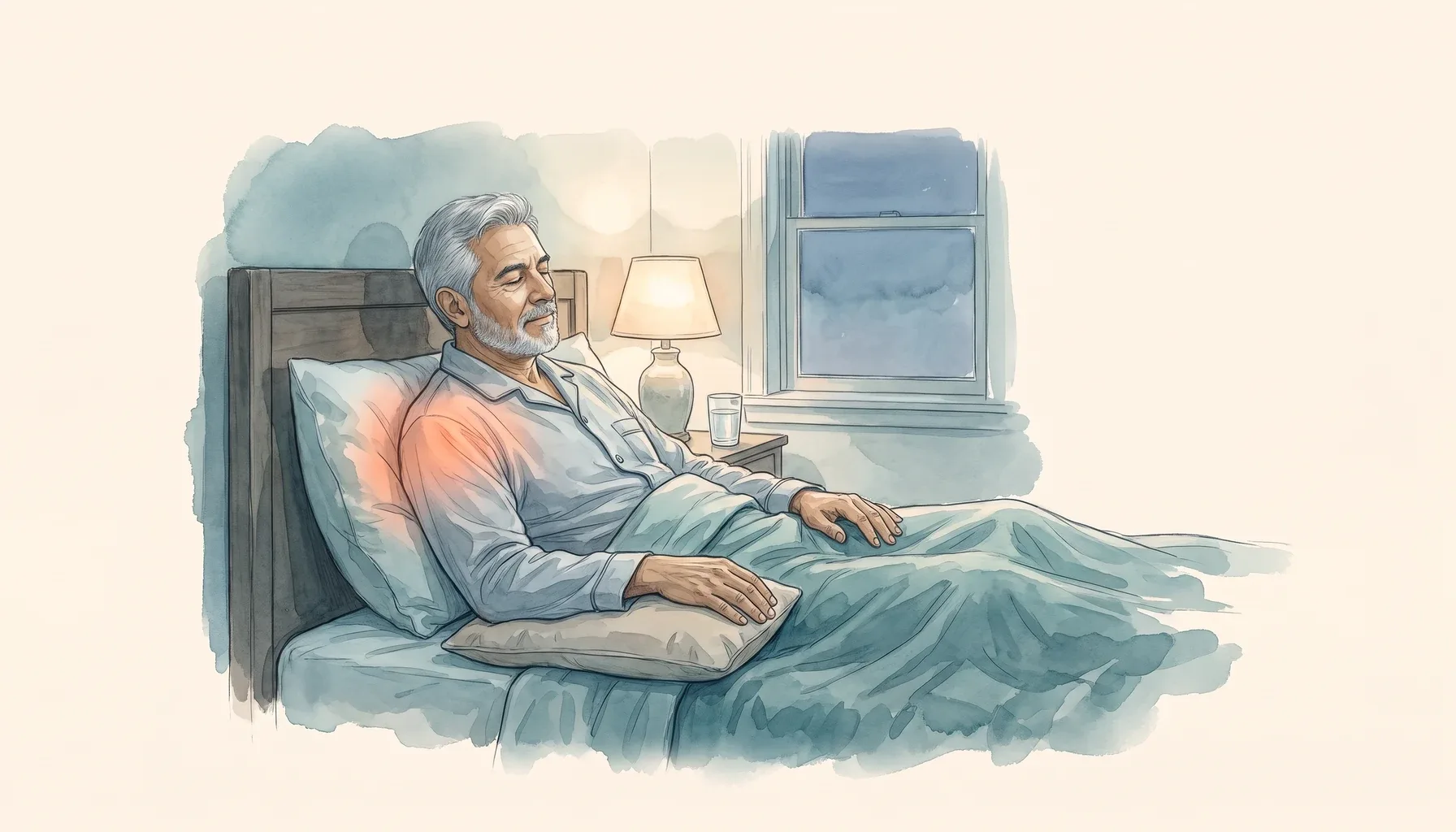
Most people sleep on their back, with the upper body raised and the repaired arm supported on a pillow, for the first few weeks after rotator cuff repair. In a 2026 study of patients after rotator cuff repair, 85% were sleeping on their back at 2 weeks, up from 39% before surgery. Sleep is often hardest in the first two weeks and usually improves by about 6 weeks. Your surgeon sets your sling and position rules.
Key takeaways
- Back sleeping with the upper body raised is the most common setup in the early weeks.
- Support the repaired arm so it rests slightly forward of your body and does not drop backward.
- Wear your sling at night if your surgeon asks you to.
- Studies show sleep often gets worse in the first 2 weeks, then improves by 6 weeks and keeps improving through 6 months.
- Most people return to their usual sleep position by about 6 months.
Sleep is one part of a longer recovery. For the full timeline, see our week by week rotator cuff surgery recovery guide.
Why is sleep so hard after rotator cuff surgery?
Sleep is hard after rotator cuff repair because the shoulder is sore, the arm is held in a sling, and the positions most people rely on, such as lying on the side, press on or twist the repaired shoulder. Pain is the main driver. A 2019 systematic review by Longo and colleagues found that sleep quality in people with rotator cuff tears was linked to pain, and that the required position at night, other health conditions, opioid use and mental health factors may also play a part.
Many people already sleep poorly before surgery. In a 2015 study by Austin and colleagues, 89% of patients had scores that showed sleep disturbance before their repair. A large Swiss cohort of 973 patients found a similar figure, with 88% reporting disturbed sleep before surgery and 59% reporting it every night. If you have been waking with shoulder pain for months, the first weeks after surgery can feel like more of the same. That pattern is common, and it usually improves.
If night pain was part of what brought you to surgery, our article on why shoulder pain gets worse at night explains the usual causes.
What is the best sleeping position after rotator cuff surgery?
The most common position in the early weeks is on your back with your upper body raised and the repaired arm supported, so the shoulder sits in a relaxed, slightly forward position. Lying flat can let the arm drift backward, which pulls on the front of the shoulder and can be uncomfortable.
Here is a setup many people use:
- Raise your upper body with a wedge, a stack of firm pillows, or a positioning support, so you are partly upright.
- Place a pillow under the forearm and elbow of the repaired side, so the arm rests slightly in front of your body.
- Keep the elbow from sliding behind the line of your torso.
- Put a pillow under your knees if it helps you stay in place and eases your lower back.
- Keep your phone, water and medicine within reach of your good hand.
The 2026 study by Fiandeiro and colleagues tracked how people actually slept. At 2 weeks after surgery, back sleeping had risen to 85% and side sleeping had fallen to 27.5%, from about 65% before surgery. Side sleeping partly came back by 6 weeks, and by 24 weeks most people had returned to the positions they used before surgery.
Should you sleep in a recliner after shoulder surgery?
A recliner can work well in the early weeks because it holds you partly upright and makes it harder to roll onto the repaired shoulder. A well supported bed can work too. What matters most is that the upper body is raised, the arm is supported, and you stay in position through the night. If you would rather sleep in your own bed, a firm wedge or a foam positioning support can recreate the incline of a recliner. Ask your surgeon or physical therapist which setup fits your repair.
Do you have to sleep in your sling?
Your surgeon may ask you to wear the sling at night during the protection phase, because the arm can move in ways you do not control while you sleep. The American Academy of Orthopaedic Surgeons (AAOS) notes that the arm is usually protected in a sling for about 4 to 6 weeks after repair, and your surgeon decides how strict that rule is at night.
Follow your surgeon's instructions exactly. If the sling strap makes your neck ache through the night, tell your care team, since padding the strap or changing how weight is carried may help. Our guide on how long you wear a sling after rotator cuff surgery covers what sets your sling timeline and how to wear it comfortably.
When can you sleep on your side again?
Most people go back to side sleeping gradually over the first few months, and by about 6 months most have returned to their usual position. In the Fiandeiro study, side sleeping had partly recovered by 6 weeks, and positions looked like they did before surgery by 24 weeks.
Lying on the side opposite the repair often comes first. A pillow hugged in front of the chest can hold the repaired arm forward and keep you from rolling. Lying directly on the repaired shoulder usually comes last. The same study found that people who were side sleepers before surgery reported more pain related waking during recovery, so side sleepers may need extra support and patience. Ask your surgeon before you lie on the repaired side.
How long does poor sleep last after rotator cuff surgery?
Sleep usually gets worse in the first 2 weeks, then improves by about 6 weeks, with steady gains through 3 and 6 months. Several studies show the same pattern:
- Fiandeiro and colleagues, 2026. Pain related sleep scores were worse at 2 weeks, better than before surgery by 6 weeks, and better again at 12 and 24 weeks. By 24 weeks, 55% of patients reported no night waking from pain.
- Austin and colleagues, 2015. Sleep quality improved significantly by 3 months and kept improving through 6 months. At 6 months, 38% of patients still had sleep disturbance, down from 89% before surgery.
- O'Donnell and colleagues, 2025. In a comparison of three shoulder operations, sleep after rotator cuff repair trended worse at 2 weeks and improved by 3 months. Sleep improved sooner after shoulder replacement.
- Feltri and colleagues, 2025. In 973 patients, sleep disturbance fell from 88% before surgery to 37% at 6 months and 22% at 12 months.
A rough first two weeks is common and does not by itself mean something is wrong with the repair.
What can help you sleep better after rotator cuff surgery?
Steady pain control, a supported position, and a calm bedtime routine are the most practical ways to improve sleep in the early weeks.
Plan your pain medicine around bedtime. Take your medicine as prescribed, and ask your care team whether to time a dose before bed. Austin and colleagues found that opioid use before surgery and prolonged opioid use after surgery were linked to worse sleep. Talk with your surgeon about a plan to taper.
Use cold therapy if your surgeon allows it. Follow their instructions on timing and skin protection.
Ask about sleep aids. In a 2024 randomized trial by Perez and colleagues, 80 patients took either 5 mg of melatonin an hour before bed for 6 weeks or followed standard sleep habits. The melatonin group had better sleep scores at 6 weeks and used less opioid medicine at 4 months. Check with your doctor before starting melatonin or any other sleep aid, since it can interact with other medicines.
Keep a steady routine. Keep regular sleep and wake times, limit late caffeine, and keep naps short.
Avoid nicotine. Fiandeiro and colleagues found that nicotine use was linked to more pain related waking after repair.
Set up the room before surgery. Arrange pillows, a wedge or a positioning support, and a bedside table on your good side before the day of surgery, so the first night home is easier. Our article on what you can do 2 weeks after rotator cuff surgery covers other daily tasks in the early weeks.
When to call your doctor
Call your surgeon or care team promptly if you notice:
- Fever, chills, or redness, warmth or drainage at the incisions
- Pain that keeps getting worse at night and does not ease with your prescribed plan
- Numbness, tingling, color change or coldness in the hand or fingers
- Swelling in the arm or hand that does not go down with elevation
- A sudden pop, tearing feeling or new loss of strength, especially after rolling onto the shoulder or a fall
- Calf pain or swelling, chest pain or shortness of breath, which need emergency care
Talk with your clinician before you change your sling routine or start a new medicine or supplement.
How RangeMaster products fit
The Shoulder Sleeper Pillow is designed to support the arm at night with a waist strap, arm strap and wrist strap, so the arm is held steady without a sling strap pressing on the neck. It can help limit unwanted rotation while you sleep. It comes in Small/Medium and Large/XL sizes and in left or right versions for the side that needs support. Our MedCline and Shoulder Sleeper Pillow comparison can help you choose a setup.
If you want to sleep in your own bed instead of a recliner, the Restore You Therapeutic Support is a full size foam support that sits on your mattress and holds the upper body at a 30 degree incline, with contoured channels for the arms. It sets up in under a minute.
When your surgeon clears you for exercise, the Rotator Cuff Repair Program pairs a home exercise kit with 30 lessons to follow along with the plan your therapist sets. Neither product replaces the sling or the position your surgeon prescribes.
Related reading
- Rotator cuff surgery recovery guide
- How long do you wear a sling after rotator cuff surgery?
- Best pillows for side sleepers with neck and shoulder pain
- Why does my shoulder hurt worse at night?
Your next step
Before your surgery date, set up your bed or recliner with a raised backrest and an arm pillow, and ask your surgeon how to handle your sling at night. If you want a steadier setup in your own bed, take a look at the Shoulder Sleeper Pillow.
Common questions
How long do you have to sleep upright after rotator cuff surgery?
Many people sleep partly upright for the first few weeks, often while they are still in the sling. Your surgeon and therapist will tell you when lying flatter is fine. Most people are back to their usual positions by about 6 months.
Can I sleep on my stomach after rotator cuff surgery?
Stomach sleeping usually puts the shoulder in a stretched, rotated position, so most people avoid it during the early months. Ask your surgeon when it is safe for you.
Why is my shoulder pain worse at night after surgery?
Lying down changes how the arm rests, there are fewer distractions, and pain medicine may wear off overnight. Raising the upper body and supporting the arm often helps. Tell your care team if night pain keeps getting worse.
Is it normal to sleep badly for weeks after rotator cuff surgery?
Yes. Studies show sleep often gets worse in the first 2 weeks after repair and improves by about 6 weeks, with further gains at 3 and 6 months.
Should I put a pillow under my arm at night?
A pillow under the forearm and elbow of the repaired side can keep the arm resting slightly forward of the body. Check with your care team that this fits your sling plan.
Medical disclaimer
The information in this article is for general education only. It is not medical advice, diagnosis, or treatment, and reading it does not create a provider-patient relationship with RangeMaster. Recovery plans differ from person to person. Talk with your surgeon, physician, or physical therapist before you start, stop, or change any exercise, product, or treatment, and follow their instructions when they differ from anything you read here.
If you think you are having a medical emergency, call 911 or your local emergency number right away.
RangeMaster makes and sells the products linked in this article. Full medical disclaimer.
Sources
- Fiandeiro M, Rizk AA, Levin JM, et al. How patients sleep after rotator cuff repair: a prospective analysis of pain, position, and recovery. J Shoulder Elbow Surg. 2026;35(8):1965-1972. doi:10.1016/j.jse.2026.02.011 https://pubmed.ncbi.nlm.nih.gov/41720245/
- Austin L, Pepe M, Tucker B, et al. Sleep disturbance associated with rotator cuff tear: correction with arthroscopic rotator cuff repair. Am J Sports Med. 2015;43(6):1455-1459. doi:10.1177/0363546515572769 https://pubmed.ncbi.nlm.nih.gov/25776185/
- Longo UG, Facchinetti G, Marchetti A, et al. Sleep disturbance and rotator cuff tears: a systematic review. Medicina (Kaunas). 2019;55(8):453. doi:10.3390/medicina55080453 https://pubmed.ncbi.nlm.nih.gov/31398952/
- Feltri P, Audigé L, Candrian C, Mueller AM, Fritz Y; ARCR_Pred Study Group; Filardo G. Rotator cuff repair: sleep disturbance significantly improves after arthroscopic tendon repair. Knee Surg Sports Traumatol Arthrosc. 2025;33(4):1459-1471. doi:10.1002/ksa.12420 https://pubmed.ncbi.nlm.nih.gov/39189149/
- O'Donnell EA, Jo S, Grubhofer F, et al. Sleep quality and response after rotator cuff repair, total shoulder arthroplasty, and reverse shoulder arthroplasty. JSES Int. 2025;9(5):1739-1744. doi:10.1016/j.jseint.2025.05.034 https://pubmed.ncbi.nlm.nih.gov/41049644/
- Perez AR, Destiné H, Patel NK, et al. Effects of melatonin on sleep quality and patient-reported outcomes after arthroscopic rotator cuff surgery: a prospective randomized controlled trial. Am J Sports Med. 2024;52(12):3075-3083. doi:10.1177/03635465241272076 https://pubmed.ncbi.nlm.nih.gov/39279257/
- American Academy of Orthopaedic Surgeons. Rotator Cuff Tears: Surgical Treatment Options. OrthoInfo https://orthoinfo.aaos.org/en/treatment/rotator-cuff-tears-surgical-treatment-options/