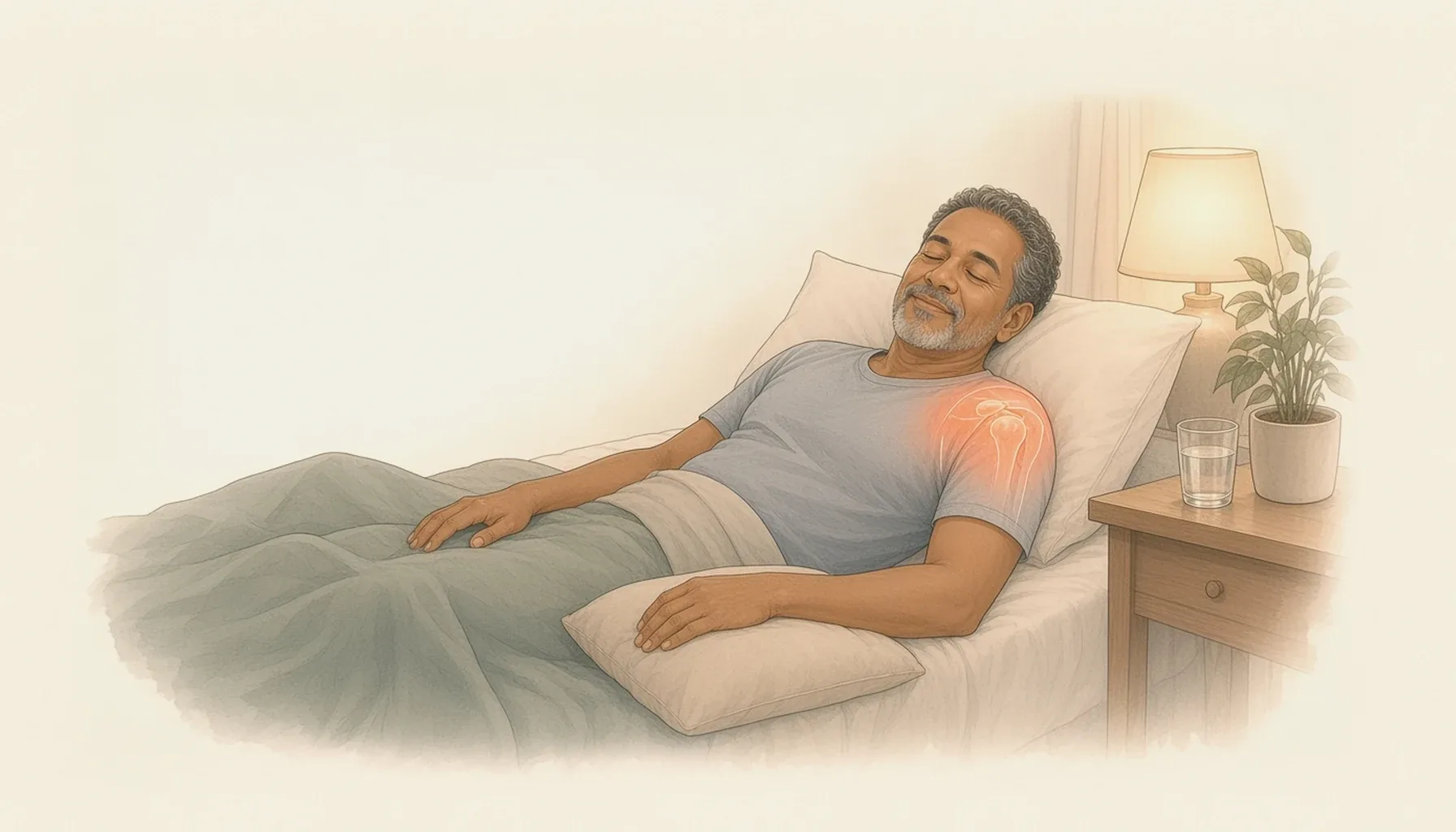
Shoulder bursitis, inflammation of the small fluid-filled cushion above the rotator cuff, often hurts most at night. The American Academy of Orthopaedic Surgeons (AAOS) says rotator cuff related pain is typically at its worst at night, and no study we found has pinned down exactly why. The steps below draw on the research that exists and can help you set up easier nights while you work with a clinician on the cause.
Key takeaways
- The AAOS says pain from the rotator cuff, which includes bursitis, is typically at its worst at night, and that it can progress to severe night pain that affects sleep.
- Bursitis rarely stands alone. A 2011 review describes a spectrum from subacromial bursitis to rotator cuff tendinopathy and full-thickness tears, so the label on your shoulder may cover more than one problem.
- In a study of 83 people with one sore shoulder, 67% of those who slept on a side lay on the painful one.
- In a UK trial of 708 adults with rotator cuff disorders, a corticosteroid injection gave no long-term benefit over 12 months.
- In a trial of 111 people with chronic subacromial bursitis, injections gave better early results than exercise, and exercise had the lowest recurrence.
- Pain after a fall, new weakness, fever, or numbness that spreads down the arm is a reason to call your clinician soon.
If you are still sorting out why your shoulder hurts after dark, start with our guide to why shoulder pain gets worse at night. This post focuses on bursitis and the closely related impingement and rotator cuff tendinitis group.
What is shoulder bursitis?
A bursa is a small sac of fluid that cushions the space between bone and the soft tissue that glides over it. In the shoulder, the subacromial bursa sits between the rotator cuff tendons and the acromion, the bony roof at the top of the shoulder blade. AAOS OrthoInfo describes bursitis as inflammation of the bursa, and says the acromion can rub against the tendon and the bursa below when you raise your arm, causing irritation and pain.
A 2011 review by Harrison and Flatow describes subacromial impingement syndrome as a spectrum of pathology that runs from subacromial bursitis to rotator cuff tendinopathy and full-thickness rotator cuff tears. A 2023 review by Horowitz and Aibinder calls "shoulder impingement" a vague umbrella term and suggests it is better divided into subacromial, internal and subcoracoid types. In everyday terms, a diagnosis of bursitis, impingement or rotator cuff tendinitis can describe overlapping problems in the same neighborhood, and the treatment ideas below apply across all of them.
Why does shoulder bursitis hurt at night?
The AAOS lists pain at night among the typical symptoms of rotator cuff pain, and says that as the problem progresses, the pain can become severe at night and may affect your ability to sleep. A 2026 narrative review by Kunze and colleagues of sleep in people having shoulder surgery reported that sleep disturbance affects up to 80% to 90% of patients before surgery across several shoulder conditions, and that nocturnal pain appears to be a primary driver. That review was not limited to bursitis, and it did not combine data.
We found no study that explains the night pattern in bursitis itself, so the points below are possibilities that fit the research on neighboring conditions.
- Lying on the sore side. A 2012 study by Kempf and Kongsted of 83 people with one sore shoulder found that 67% of those who slept on a side lay on the painful one. That study covered shoulder pain of many kinds. When you lie on that side, your body weight presses on the shoulder for hours.
- Arm position. Sleeping with the arm raised over a pillow or tucked under your head is similar to the overhead position that the AAOS says narrows the space where the bursa and tendons sit. That link is a reasonable idea, and we found no trial that tested it.
- Fewer distractions. With the house quiet and your attention free, an ache you ignored during the day can be easier to notice. That is a common explanation, and no study of bursitis confirms it.
How is bursitis diagnosed?
The AAOS says a doctor will press on different parts of the shoulder to find tender spots, ask you to move the arm in several directions, test strength, and may examine your neck to make sure the pain is not coming from a pinched nerve. Plain X-rays do not show soft tissue, though they can show a bone spur. MRI and ultrasound can show fluid or inflammation in the bursa or rotator cuff, and in some cases tears in the tendons. The Horowitz and Aibinder review lists a history, a focused exam and standard X-rays as the first steps, with MRI or ultrasound as optional extras.
If your shoulder pain is new, severe or not improving, a proper exam matters. Bursitis, a rotator cuff tear, frozen shoulder and a neck problem can all ache at night, and they are managed differently.
What does treatment research say?
The AAOS says that in most cases initial treatment is nonsurgical, and that many patients gradually improve, although complete recovery can take several weeks to months. Options include rest and activity changes, anti-inflammatory medicines such as ibuprofen, physical therapy, and a steroid injection into the bursa if other measures do not help. Here is what a few studies found.
- Exercise and advice. The GRASP trial, published in The Lancet in 2021 by Hopewell and colleagues, randomly assigned 708 adults with a recent rotator cuff disorder to progressive exercise, a single session of best practice advice, or either one after a corticosteroid injection. Over 12 months, the researchers found no evidence of a difference in pain and function scores between progressive exercise and the advice session. They found no evidence of a difference between injection and no injection, and they concluded the injection provided no long-term benefit. No serious adverse events were reported.
- Injection, exercise or both. A 2023 trial by Hsieh and colleagues compared corticosteroid injections, 8 weeks of physiotherapy and a combination in 111 people with chronic subacromial bursitis. The injection and combined groups did better than the physiotherapy group on several measures, including pain over time and shoulder flexion. Symptoms came back in 36.1% of the injection group, 7.5% of the physiotherapy group and 17.1% of the combined group.
- Which exercises. A 2025 network meta-analysis by Zhang and colleagues pooled 15 trials with 913 people for pain. Concentric strengthening ranked highest for pain and for function, though most pain comparisons between exercise types were not significant. An older 2014 review by Gebremariam and colleagues found moderate evidence that exercise therapy gave the best midterm results compared with placebo or controls.
Taken together, the studies suggest that the trial results vary with the group studied and the follow-up time, and that exercise supervised by a therapist is a common and reasonable core of care. Ask your clinician which approach fits your shoulder.
How can you sleep better with shoulder bursitis?
No trial has tested sleeping positions in bursitis, so these steps draw on the studies above and on general comfort. Change one thing at a time and keep what helps.
- Stay off the sore shoulder. Lie on your back or on your pain-free side. Our post on the best sleeping position for shoulder pain walks through both setups, and our post on side sleeping and shoulder pain explains why the sore side matters.
- Support the sore arm. Rest it on a folded pillow beside your torso, or hug a firm pillow if you sleep on your pain-free side. The goal is to keep the upper arm from dropping forward or rising overhead.
- Keep your head pillow level with your neck. Our guide to how to choose a pillow for shoulder pain covers height and firmness.
- Try a slight incline. Some people are more comfortable semi-reclined, and our post on whether a wedge pillow helps shoulder pain reviews the evidence we found.
- Plan your evening. Take any medicine your clinician has recommended at the time they advise, and avoid long stretches of overhead reaching late in the day. Keep a short note of what helped.
- Think about cold or warmth. Many people use a cold or warm pack before bed. Our guide to when to use ice, heat and compression explains the basics. Ask your clinician what suits you, and never sleep with an ice pack on your skin.
Can a shoulder support help at night?
We found no trial of a sleep pillow or shoulder wrap in people with bursitis, so the case for either rests on what it is designed to do. The Shoulder Sleeper Pillow is designed to support the arm at night with a waist strap, arm strap and wrist strap, and it can help limit unwanted arm rotation while you sleep. It is built for back and side sleepers, comes in Small/Medium and Large/XL sizes, and has left and right versions, so the sore side matters when you order.
The Shoulder Compression Wrap is designed to hold a cold or warm pack around the shoulder, which can help when your clinician recommends one at home. Use it while you are awake and able to check your skin.
A support does not diagnose or treat bursitis. Ask your clinician whether it suits your condition and treatment plan.
When should you call a clinician?
Call your doctor or care team if you notice:
- Shoulder pain that limits daily tasks, or night pain that wakes you most nights for more than a couple of weeks
- Sudden pain or loss of strength after a fall or a lift
- Numbness, tingling, or weakness that spreads down the arm, which our guide to shoulder pain and numbness in the arm explains in more detail
- Fever, redness, warmth, or swelling around the shoulder
Chest pain, shortness of breath, or pain that spreads to the jaw or left arm needs emergency care right away.
Related reading
- Why does shoulder pain get worse at night?
- Shoulder impingement
- What is the best sleeping position for shoulder pain?
- How to choose a pillow for shoulder pain
- Does a wedge pillow help shoulder pain?
- When to use ice, heat and compression
Your next step
Tonight, lie on your back or your pain-free side with a pillow supporting the sore arm, and write down how you slept and how the shoulder felt in the morning. After a week, keep what helped and bring your notes to your next visit. If you want a strap based arm support to try, take a look at the Shoulder Sleeper Pillow.
Common questions
Why does shoulder bursitis hurt more at night?
No study has settled the reason. The AAOS says rotator cuff pain is typically at its worst at night. Lying on the sore side, arm position and fewer daytime distractions may all play a part.
What is the best sleeping position for shoulder bursitis?
No trial has compared positions. Many people are more comfortable on their back or on the pain-free side with a pillow supporting the sore arm. Avoid lying on the sore shoulder.
Does a cortisone shot help bursitis?
The studies we found disagree. In a trial of 708 adults with rotator cuff disorders, injection gave no long-term benefit over 12 months. In a smaller trial of chronic subacromial bursitis, injection gave better early results than physiotherapy alone, and symptoms returned more often. Your clinician can talk through your options.
Can shoulder bursitis go away on its own?
The AAOS says many people improve gradually with nonsurgical care over several weeks to months. If pain is severe, or does not ease, ask for an exam.
Medical disclaimer
The information in this article is for general education only. It is not medical advice, diagnosis, or treatment, and reading it does not create a provider-patient relationship with RangeMaster. Recovery plans differ from person to person. Talk with your surgeon, physician, or physical therapist before you start, stop, or change any exercise, product, or treatment, and follow their instructions when they differ from anything you read here.
If you think you are having a medical emergency, call 911 or your local emergency number right away.
RangeMaster makes and sells the products linked in this article. Full medical disclaimer.
Sources
- American Academy of Orthopaedic Surgeons. Shoulder Impingement/Rotator Cuff Tendinitis. OrthoInfo https://www.orthoinfo.org/en/diseases--conditions/shoulder-impingementrotator-cuff-tendinitis/
- Harrison AK, Flatow EL. Subacromial impingement syndrome. J Am Acad Orthop Surg. 2011;19(11):701-708. doi:10.5435/00124635-201111000-00006 https://pubmed.ncbi.nlm.nih.gov/22052646/
- Horowitz EH, Aibinder WR. Shoulder impingement syndrome. Phys Med Rehabil Clin N Am. 2023;34(2):311-334. doi:10.1016/j.pmr.2022.12.001 https://pubmed.ncbi.nlm.nih.gov/37003655/
- Kunze KN, Sardesai KS, Barton K, Jesse JE, Caplan BE, Alfonsi SP 3rd, Shinn D, Cole BJ. Sleep disturbance in patients undergoing shoulder surgery: a current concepts review. JSES Rev Rep Tech. 2026;6(4):100820. doi:10.1016/j.xrrt.2026.100820 https://pubmed.ncbi.nlm.nih.gov/42668460/
- Kempf B, Kongsted A. Association between the side of unilateral shoulder pain and preferred sleeping position: a cross-sectional study of 83 Danish patients. J Manipulative Physiol Ther. 2012;35(5):407-412. doi:10.1016/j.jmpt.2012.04.015 https://pubmed.ncbi.nlm.nih.gov/22608285/
- Hopewell S, Keene DJ, Marian IR, Dritsaki M, Heine P, Cureton L, Dutton SJ, Dakin H, Carr A, Hamilton W, Hansen Z, Jaggi A, Littlewood C, Barker KL, Gray A, Lamb SE. Progressive exercise compared with best practice advice, with or without corticosteroid injection, for the treatment of patients with rotator cuff disorders (GRASP): a multicentre, pragmatic, 2 x 2 factorial, randomised controlled trial. Lancet. 2021;398(10298):416-428. doi:10.1016/S0140-6736(21)00846-1 https://pubmed.ncbi.nlm.nih.gov/34265255/
- Hsieh LF, Kuo YC, Huang YH, Liu YF, Hsieh TL. Comparison of corticosteroid injection, physiotherapy and combined treatment for patients with chronic subacromial bursitis: a randomised controlled trial. Clin Rehabil. 2023;37(9):1189-1200. doi:10.1177/02692155231166220 https://pubmed.ncbi.nlm.nih.gov/37021475/
- Zhang W, Du M, Xia L, Hao F, Tian M. Effects of seven types of exercise in the treatment of rotator cuff-related shoulder pain (RCRSP): a systematic review and Bayesian network meta-analysis. J Orthop Surg Res. 2025;20:1075. doi:10.1186/s13018-025-06514-4 https://pubmed.ncbi.nlm.nih.gov/41276811/
- Gebremariam L, Hay EM, van der Sande R, Rinkel WD, Koes BW, Huisstede BM. Subacromial impingement syndrome: effectiveness of physiotherapy and manual therapy. Br J Sports Med. 2014;48(16):1202-1208. doi:10.1136/bjsports-2012-091802 https://pubmed.ncbi.nlm.nih.gov/24217037/