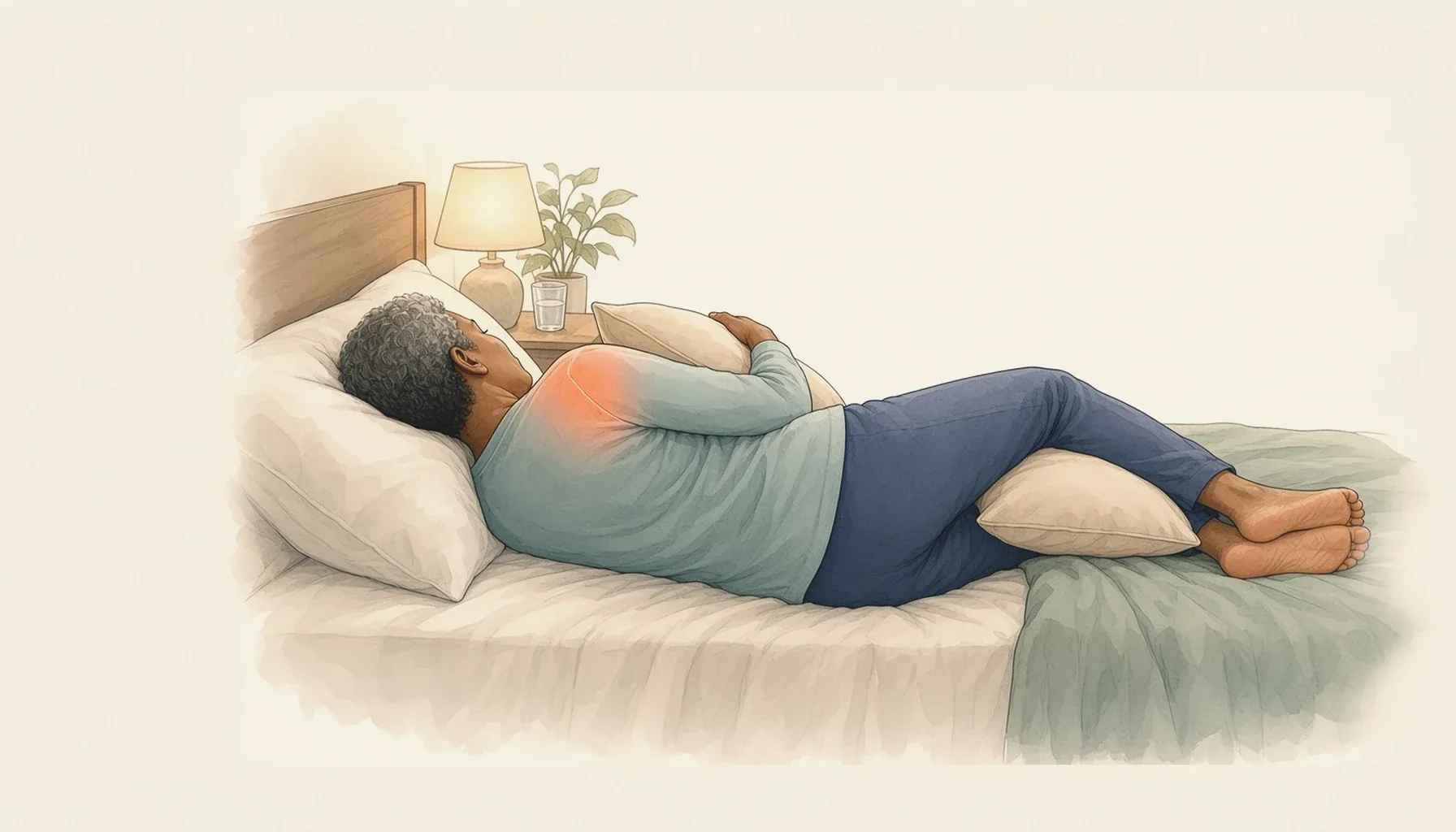
Side sleeping is closely linked with shoulder pain, but studies show an association and have not proven that it causes the pain. People with shoulder pain often lie on the sore side, and most people in one clinic series of rotator cuff tears were side sleepers. Whether the position contributes to the pain has not been tested in a trial, so the practical goal is to keep pressure off a tender shoulder.
Key takeaways
- In a Danish study of 83 adults with pain in one shoulder, 67% of those who slept on one side lay on the painful shoulder.
- In a series of 58 people with significant rotator cuff tears, 52 were side sleepers.
- Both findings show a link. Neither study can say which came first, the sleeping position or the pain.
- A systematic review of 10 studies reported nighttime pain in 91% to 93% of people with rotator cuff problems.
- A pillow under the arm or a pain-free-side setup can help keep pressure off a sore shoulder.
- Pain that wakes you most nights, follows an injury, or comes with numbness or weakness is a reason to call your clinician.
If your pain is mostly at night, our post on why shoulder pain gets worse at night explains the likely causes. This post looks at one question: what role does side sleeping play?
What does the research say about side sleeping and shoulder pain?
Three pieces of evidence come up most often, and each has limits.
A 2012 cross-sectional study by Kempf and Kongsted asked 83 adults with pain in one shoulder, recruited from 10 chiropractic clinics, about their sleeping position. The side of the pain was associated with the side they slept on, and 67% of those who slept on one side lay on the painful shoulder. The authors wrote that it is unknown whether the association is causal and that it is worth investigating whether a change in sleeping position helps.
A 2024 case series by Richards and colleagues looked at 58 patients seen in clinic with a significant partial thickness tear (more than 50%) or a full thickness tear. Of these, 52 were side sleepers, 4 were stomach sleepers, 1 was a back sleeper, and 1 preferred all three positions. The authors concluded that tears were most often seen in side sleepers. The series had no comparison group, and the patients were asked about their preferred position after the tear was found, so it cannot show that side sleeping came first.
A 2010 paper by Zenian in Medical Hypotheses proposed that shoulder pain may come from staying still in a side position during sleep, because the weight of the chest can press on the shoulder for hours. The author compared how often people sleep on each side with which shoulder hurts and found the ratios were similar. The paper presents this as a hypothesis, and the author called for more studies of the sleep habits of people with shoulder pain.
Put together, these studies show that side sleeping and shoulder pain often go together. They leave open whether the position contributes to the pain, whether pain changes the position people choose, or whether both are true.
Why might lying on your side hurt a sore shoulder?
The studies above do not explain the mechanism, so the following are reasonable possibilities and not proven causes.
- Direct pressure. Lying on the shoulder places body weight on the joint and the tissue around it. If the area is already irritated, that pressure can be uncomfortable.
- Arm position. In side sleeping the top arm often falls across the body or the bottom arm gets pushed forward or under the pillow. A shoulder held in an awkward position for hours may feel stiff or sore in the morning.
- Fewer position changes. When a shoulder hurts, many people lie still to avoid the sore spot. Zenian's hypothesis points to long periods in one position as a possible factor.
- Less distraction at night. Daytime activity gives your mind other things to focus on. In bed, a steady ache can feel stronger.
AAOS OrthoInfo lists pain at rest and at night, especially when lying on the affected shoulder, among the most common symptoms of a rotator cuff tear. The same page notes that some tears do not hurt at all, so pain is an imperfect guide to what is happening inside the shoulder.
How common is night pain in shoulder problems?
Night pain is very common. A 2022 systematic review by Castro-Contreras and Valdez-Pardo pooled 10 studies with 1,516 patients and reported that nighttime pain affected 91% to 93% of them, with an average intensity of 5.5 on a 10 point scale. Every included study reported changes in sleep quality.
A 2019 systematic review by Longo and colleagues found that most people with rotator cuff tears had a sleep disturbance and that sleep quality followed pain levels. Among people having arthroscopic rotator cuff repair, a 2022 prospective study by Dolan and colleagues of 326 patients found that 89% reported sleep disturbance before surgery. Because night pain is so widespread, many people with shoulder pain end up wondering about their sleeping position.
Does side sleeping change after shoulder surgery?
It often does for a while. In a 2026 prospective study by Fiandeiro and colleagues of 63 patients after rotator cuff repair, side sleeping fell from 64.7% before surgery to 27.5% at 2 weeks, while back sleeping rose from 39.2% to 85%. By 6 weeks side sleeping had partly returned, and by 24 weeks sleep positions looked like they did before surgery. The study also found that patients who were side sleepers before surgery had more pain related waking during recovery. Our guide on how to sleep after rotator cuff surgery covers that stage in detail, and the rotator cuff surgery recovery guide shows how sleep changes across the recovery timeline.
How can you side sleep more comfortably with a sore shoulder?
These are practical comfort ideas. We found no trial testing them against each other, so adjust them to what works for you.
- Choose the pain-free side. Lie on the side opposite the sore shoulder, so no weight rests on it.
- Hug a pillow. Place a firm pillow against your chest and rest the painful arm on top, so the arm stays slightly forward and does not hang across the body.
- Support the neck. Pick a pillow height that keeps your head level with your spine. Our post on the best pillows for side sleepers with neck and shoulder pain explains height and firmness.
- Add a pillow between the knees. This can keep the hips level and make it easier to stay comfortable.
- Place a pillow behind your back. It can make it harder to roll onto the sore side without noticing.
- Try the back. Lying on your back keeps weight off both shoulders. Our post on the best sleeping position for shoulder pain walks through back, side and semi-reclined setups.
If you wake up on the sore side, roll back, reset your pillows, and try again. Changing a lifelong habit can take a few weeks.
Can a shoulder support pillow help you stay off the sore side?
A support cannot diagnose or treat a shoulder problem, and we found no trial of a strap based sleep pillow. What it can do is hold the arm in a steady position and make rolling onto the sore side less likely. The Shoulder Sleeper Pillow is designed to support the arm at night with a waist strap, arm strap and wrist strap, and it can help limit unwanted arm rotation while you sleep. It is built for back and side sleepers, comes in Small/Medium and Large/XL sizes, and has left and right versions. If you are comparing a wedge style system with a strap based pillow, our post on MedCline vs Shoulder Sleeper Pillow lays out the differences in position, size and footprint.
When should you call a clinician?
Call your doctor or care team if you notice:
- Shoulder pain that wakes you most nights for more than a couple of weeks
- Pain that follows a fall or injury, or a new loss of strength when lifting the arm
- Numbness, tingling, or weakness that spreads down the arm, which our guide to shoulder pain and numbness in the arm explains in more detail
- Fever, redness, or swelling around the shoulder
- Pain that is steady and does not change with position
Chest pain, shortness of breath, or pain that spreads to the jaw or left arm needs emergency care right away.
Related reading
- Why does shoulder pain get worse at night?
- What is the best sleeping position for shoulder pain?
- Best pillows for side sleepers with neck and shoulder pain
- How do you sleep after rotator cuff surgery?
Your next step
Tonight, lie on your pain-free side with a pillow against your chest and your sore arm resting on top of it. Write down how you slept and which position you woke up in. If you want a steadier setup for the arm, take a look at the Shoulder Sleeper Pillow.
Common questions
Can sleeping on your side cause shoulder pain?
Side sleeping and shoulder pain are linked in several small studies, but none of them proves cause and effect. Pressure on the shoulder is a plausible factor, and a pillow can help take some of that pressure off.
Which side should I sleep on with shoulder pain?
Most people find the pain-free side more comfortable. Hug a pillow so the sore arm rests forward on top of it.
Can side sleeping cause a rotator cuff tear?
Most people in one clinic series of tears were side sleepers, but that series had no comparison group and cannot show that side sleeping causes tears. Ask your clinician if you are concerned about a tear.
Should I stop sleeping on my side?
You do not have to. If side sleeping is your habit, try the pain-free side with pillow support. If that does not settle your pain, try your back, and mention the problem at your next visit.
How long does it take to get used to a new sleeping position?
It varies. In the Fiandeiro study, side sleeping partly returned within 6 weeks of surgery, and positions matched pre surgery habits by 24 weeks.
Medical disclaimer
The information in this article is for general education only. It is not medical advice, diagnosis, or treatment, and reading it does not create a provider-patient relationship with RangeMaster. Recovery plans differ from person to person. Talk with your surgeon, physician, or physical therapist before you start, stop, or change any exercise, product, or treatment, and follow their instructions when they differ from anything you read here.
If you think you are having a medical emergency, call 911 or your local emergency number right away.
RangeMaster makes and sells the products linked in this article. Full medical disclaimer.
Sources
- American Academy of Orthopaedic Surgeons. Rotator Cuff Tears. OrthoInfo https://orthoinfo.aaos.org/en/diseases--conditions/rotator-cuff-tears/
- Kempf B, Kongsted A. Association between the side of unilateral shoulder pain and preferred sleeping position: a cross-sectional study of 83 Danish patients. J Manipulative Physiol Ther. 2012;35(5):407-412. doi:10.1016/j.jmpt.2012.04.015 https://pubmed.ncbi.nlm.nih.gov/22608285/
- Richards DP, Miller DL, MacDonald ED, Stewart QF, Miller SD. Rotator cuff tears are related to the side sleeping position. Arthrosc Sports Med Rehabil. 2024;6(2):100886. doi:10.1016/j.asmr.2024.100886 https://pubmed.ncbi.nlm.nih.gov/38328528/
- Zenian J. Sleep position and shoulder pain. Med Hypotheses. 2010;74(4):639-643. doi:10.1016/j.mehy.2009.11.013 https://pubmed.ncbi.nlm.nih.gov/20036076/
- Castro-Contreras E, Valdez-Pardo ME. Rotator cuff injuries with nighttime pain and sleep quality before and after treatment: a systematic review. Acta Ortop Mex. 2022;36(1):33-38 https://pubmed.ncbi.nlm.nih.gov/36099571/
- Longo UG, Facchinetti G, Marchetti A, Candela V, Risi Ambrogioni L, Faldetta A, De Marinis MG, Denaro V. Sleep disturbance and rotator cuff tears: a systematic review. Medicina (Kaunas). 2019;55(8):453. doi:10.3390/medicina55080453 https://pubmed.ncbi.nlm.nih.gov/31398952/
- Dolan MT, Lowenstein NA, Collins JE, Matzkin EG. Majority of patients find sleep patterns return to normal 6 months following rotator cuff repair. J Shoulder Elbow Surg. 2022;31(8):1687-1695. doi:10.1016/j.jse.2022.01.122 https://pubmed.ncbi.nlm.nih.gov/35219845/
- Fiandeiro M, Rizk AA, Levin JM, Danziger M, Lopez R, Vaughan A, Austin L, Namdari S. How patients sleep after rotator cuff repair: a prospective analysis of pain, position, and recovery. J Shoulder Elbow Surg. 2026;35(8):1965-1972. doi:10.1016/j.jse.2026.02.011 https://pubmed.ncbi.nlm.nih.gov/41720245/