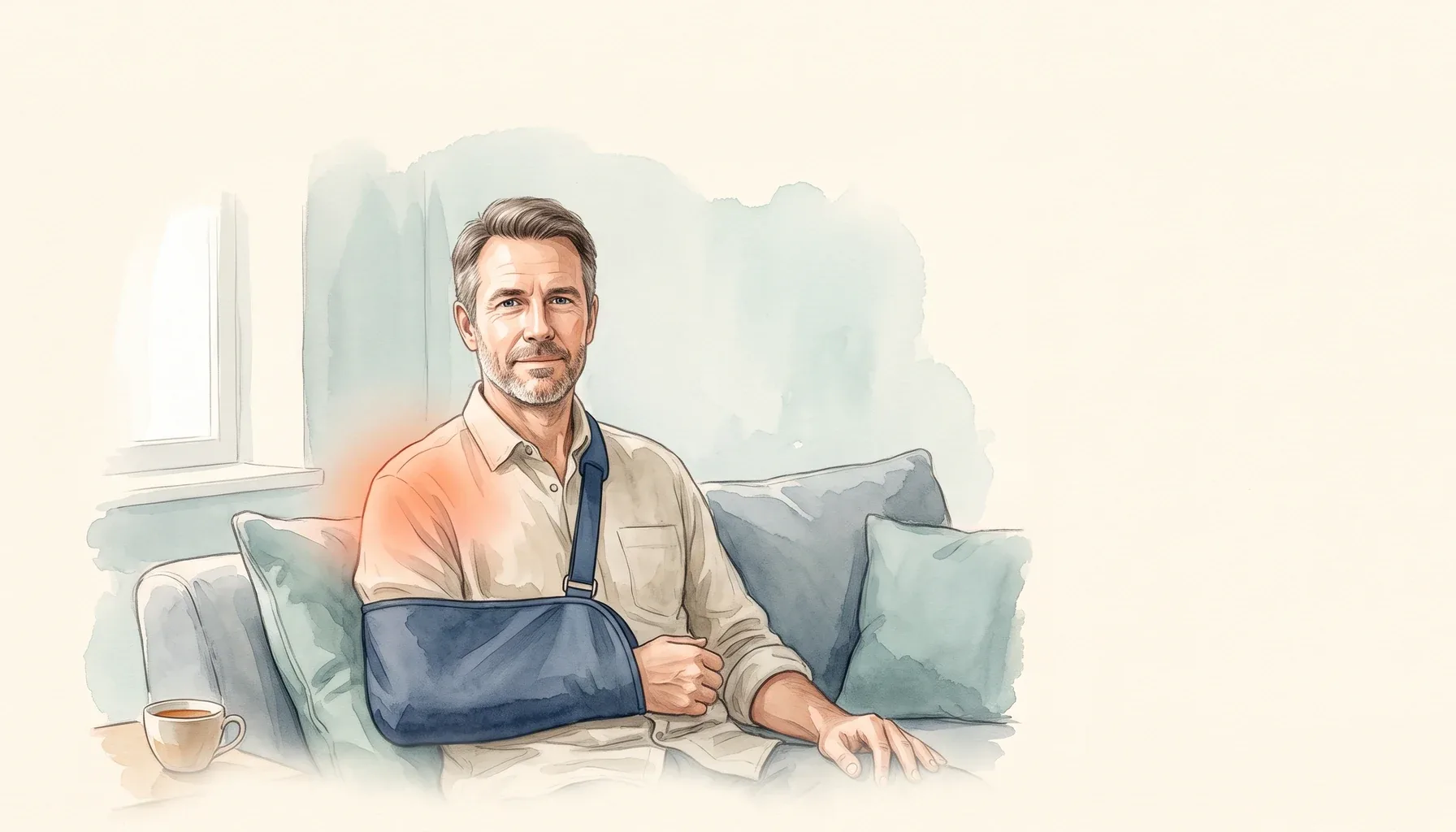
Most people wear a sling for about 4 to 6 weeks after rotator cuff repair, according to the American Academy of Orthopaedic Surgeons (AAOS). Your surgeon sets the exact length based on the size of your tear, the quality of your tendon tissue, and the type of repair. Small tears may come out of the sling sooner. Large or complex repairs often stay protected longer.
Key takeaways
- The usual range is 4 to 6 weeks, and your surgeon decides your number.
- Bigger tears and repairs with fragile tissue tend to need longer protection.
- Research on small and medium tears shows that earlier motion can speed early range of motion without hurting tendon healing.
- A sling protects the repair, so wear it exactly as prescribed, including at night if your surgeon asks.
- Comfort matters, because a sore neck can make it harder to wear the sling as long as you need to.
The sling is one part of a bigger recovery plan. For the full picture of the first year, see our week by week rotator cuff surgery recovery guide.
Why do you need a sling after rotator cuff repair?
A sling keeps the repaired tendon from being stretched or loaded while it starts to heal back onto the bone. During surgery, the torn tendon is stitched back to its attachment point on the upper arm bone, called the humerus, and the goal of every repair technique is to get that tendon to heal back to bone.
The rotator cuff is a group of four muscles and their tendons that wrap around the ball of the shoulder joint. They help you lift and rotate your arm. After repair, the stitches and anchors hold the tendon in place, and the body slowly builds new tissue that connects tendon to bone. That process takes weeks to months. In the early weeks, the connection is weakest, so the sling limits how far and how hard the arm can move.
The sling also reminds you, and the people around you, that the arm is off limits for lifting, pushing and reaching. Many people find that this reminder matters as much as the physical support.
What decides how long you wear the sling?
Your tear size, tissue quality and type of repair decide most of your sling timeline, along with your surgeon's own protocol. AAOS notes that how long you require a sling depends on the severity of your injury, your tissue quality, and the type of repair you had.
Tear size matters because larger repairs carry more risk of the tendon pulling away again, which is called a retear. A 2015 meta-analysis by Kluczynski and colleagues pooled 28 studies with 1,729 repairs. For tears larger than 5 centimeters, early passive motion was linked with a higher retear rate (52.2% compared with 22.6% for delayed motion). For smaller tears, the picture was mixed, and the authors concluded that tear size may be influential.
Other factors your surgeon may weigh include:
- Extra procedures done at the same time, such as a biceps tenodesis
- Your age, general health and smoking status
- How secure the repair felt during surgery
- Whether you had a previous repair on the same shoulder
The American Society of Shoulder and Elbow Therapists' consensus statement describes a common framework with 2 weeks of strict immobilization, then protected passive motion from weeks 2 to 6, followed by active motion and, later, strengthening from week 12. Passive motion means the arm is moved for you, by a therapist or by your other arm, while the repaired muscles stay relaxed.
Is a shorter time in the sling safe?
For small and medium tears, several randomized trials suggest that earlier motion is safe and may help early range of motion. Larger tears still tend to need longer protection, and the decision belongs to your surgeon.
In a 2019 randomized trial by Tirefort and colleagues, 80 patients with small or medium tears were split into sling and no sling groups. The no sling group had better external rotation and arm elevation at 6 weeks and better elevation at 3 months. Ultrasound at 6 months showed no difference in repair integrity between groups.
A 2014 trial by Keener and colleagues compared early motion with 6 weeks of immobilization in 124 patients under 65 with tears smaller than 30 millimeters. Early motion gave better elevation and rotation at 3 months, and the groups were similar after that. Ninety-two percent of tears healed, with no difference between the groups.
A 2015 trial by Sheps and colleagues in 189 patients after mini-open repair found the same pattern. Early mobilization helped motion at 6 weeks, and outcomes were similar by 24 months.
These studies help explain why sling advice varies from surgeon to surgeon. They do not mean you should take your sling off early on your own. If you are curious, our older post on the sling or no sling research walks through the Tirefort trial in more detail.
Do you wear the sling while sleeping?
Sling instructions often include night wear during the protection phase, because people move without meaning to while asleep. Follow the exact instruction you were given, since some surgeons allow the sling off at night once early healing is under way.
Sleep is often hard in the first weeks. A 2026 study by Fiandeiro and colleagues followed patients after rotator cuff repair and found that 85% were sleeping on their backs at 2 weeks, compared with 39.2% before surgery. Pain-related sleep trouble was worse at 2 weeks and improved past baseline by 6 weeks.
Many people sleep partly upright in a recliner or on a stack of pillows in the first weeks. A pillow under the forearm and elbow can keep the arm from sliding back behind the body, which tends to pull on the front of the shoulder.
How do you wear a sling comfortably?
A well fitted sling holds the elbow at about a right angle, keeps the wrist level with or a little above the elbow, and spreads weight so that the neck strap is not doing all the work. Our guide on how to use a shoulder sling the right way shows the basics with photos.
A few habits help:
- Keep your hand and wrist supported so your fingers do not hang and swell.
- Pad the neck strap or move its pressure point if it rubs.
- Open and close your hand and move your wrist and elbow as your care team allows, which helps circulation.
- Keep your shoulder blades relaxed. Shrugging all day can make the neck and upper back ache.
- Check the skin under the strap and in the armpit each day for redness or rubbing.
Neck soreness is one of the most common complaints during sling weeks, and it can tempt people to loosen or remove the sling. Addressing comfort early makes it easier to wear the sling as long as your surgeon wants.
What happens when the sling comes off?
When the sling comes off, you move into a phase of gentle active motion, where you start lifting the arm with your own muscles, followed later by strengthening. AAOS describes active exercise starting after 4 to 6 weeks and strengthening at 8 to 12 weeks, with most patients reaching functional motion and strength by 4 to 6 months.
The first days out of the sling can feel strange. The arm may feel heavy and the shoulder stiff. That is common, and your physical therapist will guide the pace. Many people also ask about driving around this time. A sling on your driving arm is a safety concern, so ask your surgeon before you get behind the wheel. For the exercises that often come next, see our guide on how to use a shoulder pulley.
When to call your doctor
Call your surgeon or care team promptly if you notice:
- Fever, chills, or redness, warmth or drainage at the incisions
- Pain that keeps getting worse and does not ease with your prescribed plan
- Numbness, tingling, color change or coldness in the hand or fingers
- Swelling in the arm or hand that does not go down with elevation
- A sudden pop, tearing feeling, or new loss of strength, especially after a fall
- Calf pain or swelling, chest pain or shortness of breath, which need emergency care
Talk with your clinician before changing anything about your sling routine.
How RangeMaster products fit
The SlingThing v2 Off-The-Neck Arm Sling Adapter is designed to redirect sling weight across the torso and away from the neck. It attaches to a standard sling, so you keep using the sling your surgeon prescribed. It comes in S/M and L/XL sizes. It does not replace medical guidance or the immobilization equipment your surgeon requires.
When you are ready for the next phase, the Rotator Cuff Repair Program pairs a home exercise kit with 30 lessons across surgical and non-surgical pathways, so you can follow along with the plan your therapist sets.
Related reading
- Rotator cuff surgery recovery guide
- Shoulder pain 8 weeks after rotator cuff surgery
- How to recover from shoulder surgery faster
- How to use a shoulder sling the right way
Your next step
If the neck strap is the hardest part of sling weeks, take a look at the SlingThing v2 and bring it to your next appointment to check the fit with your care team.
Common questions
Can I take my sling off to shower?
Ask your surgeon first. Some allow the sling off for a short shower while the arm hangs relaxed at your side or rests on a support. Keep the arm still and close to the body while it is out.
Is 6 weeks in a sling normal?
Yes. Six weeks sits at the upper end of the common 4 to 6 week range, and it is often used for medium to large tears or repairs with fragile tissue.
Can I type or use my phone in a sling?
Light hand and wrist use while the elbow stays supported is often allowed. A 2010 study by Long and colleagues found that drinking from a cup activated the supraspinatus, one of the cuff muscles that is often repaired, at more than 15% of its maximum effort in healthy volunteers. Ask your therapist which tasks are safe for you.
Why does my neck hurt from the sling?
Most slings hang the weight of the arm from a strap around the neck, which loads the muscles on that side. Padding, adjusting the strap, or using an adapter that moves weight off the neck may help.
What if I take the sling off too early?
Repeated unprotected use can strain the repair. Tell your surgeon if you have been using the arm without the sling, had a fall, or felt a pop, so they can decide whether you need a check.
Medical disclaimer
The information in this article is for general education only. It is not medical advice, diagnosis, or treatment, and reading it does not create a provider-patient relationship with RangeMaster. Recovery plans differ from person to person. Talk with your surgeon, physician, or physical therapist before you start, stop, or change any exercise, product, or treatment, and follow their instructions when they differ from anything you read here.
If you think you are having a medical emergency, call 911 or your local emergency number right away.
RangeMaster makes and sells the products linked in this article. Full medical disclaimer.
Sources
- American Academy of Orthopaedic Surgeons. Rotator Cuff Tears: Surgical Treatment Options. OrthoInfo https://orthoinfo.aaos.org/en/treatment/rotator-cuff-tears-surgical-treatment-options/
- Thigpen CA, Shaffer MA, Gaunt BW, Leggin BG, Williams GR, Wilcox RB 3rd. The American Society of Shoulder and Elbow Therapists' consensus statement on rehabilitation following arthroscopic rotator cuff repair. J Shoulder Elbow Surg. 2016;25(4):521-535. doi:10.1016/j.jse.2015.12.018 https://pubmed.ncbi.nlm.nih.gov/26995456/
- Kluczynski MA, Nayyar S, Marzo JM, Bisson LJ. Early versus delayed passive range of motion after rotator cuff repair: a systematic review and meta-analysis. Am J Sports Med. 2015;43(8):2057-2063. doi:10.1177/0363546514552802 https://pubmed.ncbi.nlm.nih.gov/25296646/
- Tirefort J, Schwitzguebel AJ, Collin P, Nowak A, Plomb-Holmes C, Lädermann A. Postoperative mobilization after superior rotator cuff repair: sling versus no sling: a randomized prospective study. J Bone Joint Surg Am. 2019;101(6):494-503. doi:10.2106/JBJS.18.00773 https://pubmed.ncbi.nlm.nih.gov/30893230/
- Keener JD, Galatz LM, Stobbs-Cucchi G, Patton R, Yamaguchi K. Rehabilitation following arthroscopic rotator cuff repair: a prospective randomized trial of immobilization compared with early motion. J Bone Joint Surg Am. 2014;96(1):11-19. doi:10.2106/JBJS.M.00034 https://pubmed.ncbi.nlm.nih.gov/24382719/
- Sheps DM, Bouliane M, Styles-Tripp F, et al. Early mobilisation following mini-open rotator cuff repair: a randomised control trial. Bone Joint J. 2015;97-B(9):1257-1263. doi:10.1302/0301-620X.97B9.35250 https://pubmed.ncbi.nlm.nih.gov/26330594/
- Fiandeiro M, Rizk AA, Levin JM, et al. How patients sleep after rotator cuff repair: a prospective analysis of pain, position, and recovery. J Shoulder Elbow Surg. 2026;35(8):1965-1972. doi:10.1016/j.jse.2026.02.011 https://pubmed.ncbi.nlm.nih.gov/41720245/
- Long JL, Ruberte Thiele RA, Skendzel JG, et al. Activation of the shoulder musculature during pendulum exercises and light activities. J Orthop Sports Phys Ther. 2010;40(4):230-237. doi:10.2519/jospt.2010.3095 https://pubmed.ncbi.nlm.nih.gov/20200451/