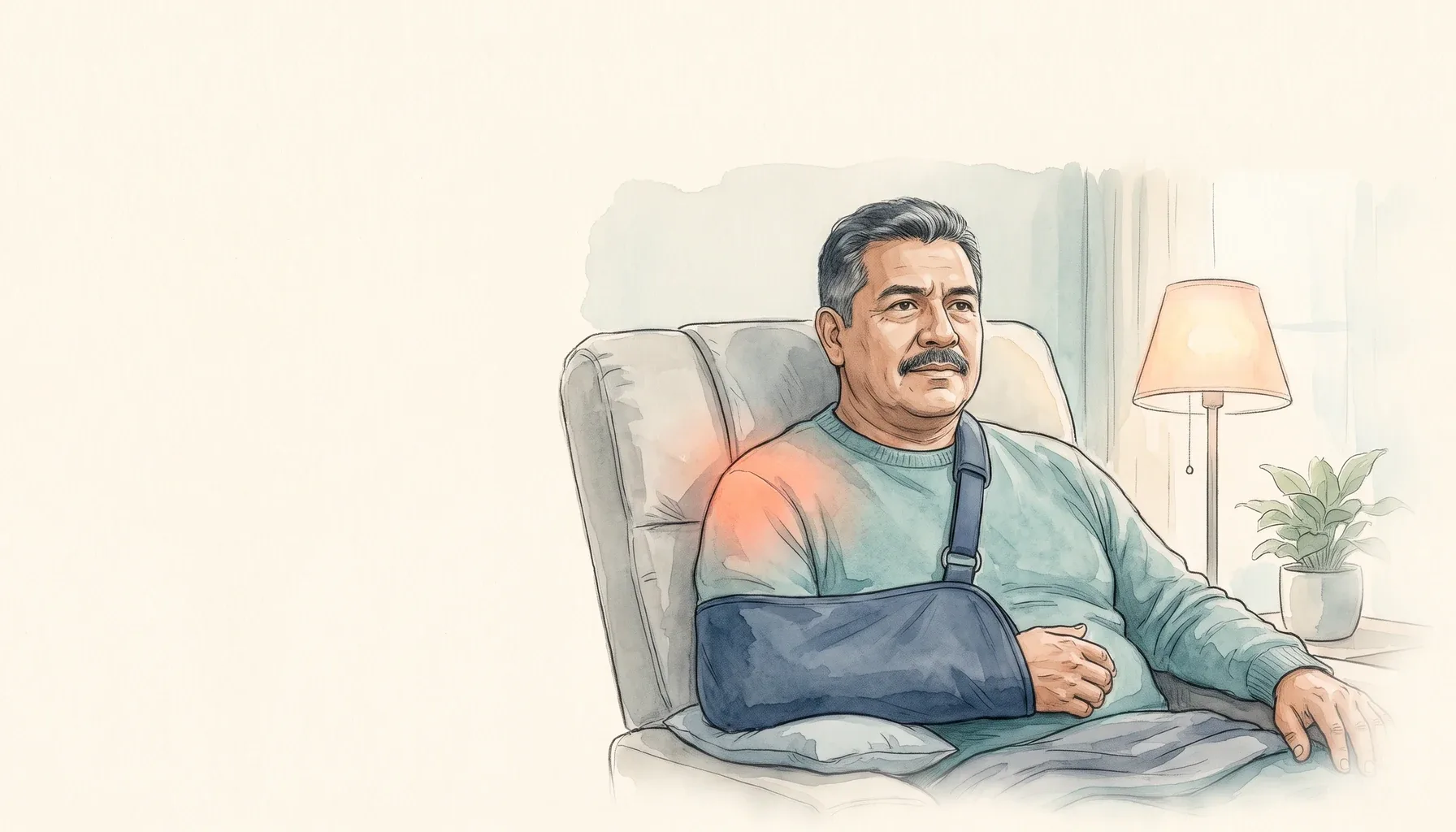
Two weeks after rotator cuff surgery, most people are still in a sling and in the protection phase of recovery. You can usually walk, care for yourself with some help, move your hand, wrist and elbow, and begin gentle passive shoulder motion if your surgeon allows it. Lifting, pushing, pulling, reaching and raising the arm on your own are usually still off limits.
Key takeaways
- Week 2 is still early. The tendon is only beginning to heal back to bone.
- Gentle passive motion often starts around this point, guided by your therapist.
- Hand, wrist and elbow movement can help with stiffness and swelling below the shoulder.
- Sleep is often hardest around week 2 and tends to improve by week 6.
- Lifting, reaching and driving usually wait.
Week 2 is one stop on a longer road. See our week by week rotator cuff surgery recovery guide for what comes next.
What is happening in your shoulder at 2 weeks?
At 2 weeks, the repaired tendon is held to the bone mostly by stitches and anchors, and the body is only starting to lay down new connecting tissue. That is why the arm still needs protection even if it feels a little better.
The rotator cuff is a set of four muscles and tendons that steady the ball of the shoulder in its socket and help you lift and turn your arm. During repair, the torn tendon is sewn back onto the upper arm bone. AAOS explains that the goal is for the tendon to heal back to the bone, and that most people use a sling and avoid using the arm for the first 4 to 6 weeks.
The American Society of Shoulder and Elbow Therapists' consensus statement describes a common rehab framework. It recommends 2 weeks of strict immobilization, then protected passive range of motion from weeks 2 to 6. Passive range of motion means the arm is moved for you, by a therapist or by your other arm, while the repaired muscles stay relaxed.
What activities are usually allowed at 2 weeks?
Light daily tasks with the sling on, walking, and movement of the hand, wrist and elbow are usually allowed. Your surgeon's written instructions are the final word.
Common activities at this stage include:
- Walking. Short, regular walks help general circulation and mood.
- Hand, wrist and elbow motion. Opening and closing the hand, bending the wrist, and gently bending and straightening the elbow while the upper arm stays still. Our post on not forgetting the rest of the arm after shoulder surgery shows examples.
- Light hand tasks. Typing or using a phone with the elbow supported, eating with the other hand or with help.
- Washing and dressing with care. Many people put the surgical arm into a shirt first and take it out last.
- Gentle neck and posture work. Relaxing the shoulders and keeping the upper back from rounding.
Be aware that some everyday tasks ask more of the shoulder than they seem to. A 2010 EMG study by Long and colleagues measured muscle activity in 13 healthy volunteers. Drinking from a cup, along with large pendulum circles, activated the supraspinatus and infraspinatus at more than 15% of their maximum effort. EMG, or electromyography, records the electrical signal of a working muscle.
Can you start exercises at 2 weeks?
Many people start gentle passive exercises around 2 weeks, often with a physical therapist leading. The type and range depend on your repair.
Passive exercises at this stage may include therapist-assisted arm raises while you lie on your back, gentle outward rotation of the arm with a stick or wand moved by the other hand, and small pendulums. In the Long study above, large pendulums produced more supraspinatus activity than small ones, and the authors concluded that larger pendulums may need more force than is desirable early in rehabilitation. If pendulums are part of your plan, keep the circles small and let the arm hang loose.
Research on timing is reassuring for small and medium tears. In a randomized trial by Keener and colleagues with 124 patients, early motion and 6 weeks of immobilization led to similar results after 3 months, and tendon healing rates were the same. For large tears, a meta-analysis by Kluczynski and colleagues linked early passive motion with more retears, which is one reason surgeons protect larger repairs longer.
Pulley exercises usually come later, once active assisted motion is allowed. Our guide on how to use a shoulder pulley shows the basic setup for when that time comes.
What should you avoid at 2 weeks?
Avoid lifting, pushing, pulling, reaching overhead or behind your back, and raising the arm with its own muscles. These motions load the healing tendon.
Other things that usually wait:
- Carrying bags, pets or children with the surgical arm
- Leaning on the arm to get out of bed or a chair
- Sleeping on the surgical side
- Driving, especially while wearing a sling on your driving arm
- Returning to physical work, such as lifting, carrying or overhead tasks
AAOS lists not following postoperative restrictions, along with smoking, as factors linked with less successful repairs. If you smoke, ask your care team about support to stop.
Why is sleep so hard at 2 weeks?
Sleep is often at its worst around 2 weeks, because pain is still present and most people cannot sleep in their usual position. It tends to improve over the following weeks.
A 2026 study by Fiandeiro and colleagues tracked how patients slept after rotator cuff repair. At 2 weeks, 85% were sleeping on their backs, up from 39.2% before surgery, and side sleeping had dropped from 64.7% to 27.5%. Sleep disturbance was worse at 2 weeks and better than baseline by 6 weeks. People who used nicotine or who slept on their side before surgery had a harder time.
An earlier study by Austin and colleagues found that 89% of patients reported sleep disturbance before surgery. Sleep improved by 3 months and kept improving through 6 months. Narcotic pain medicine was linked with worse sleep, so ask your care team about your pain plan if sleep is a struggle.
Many people sleep partly upright in a recliner or propped on pillows, with a pillow under the forearm so the arm does not slide back.
How do you manage pain and swelling at 2 weeks?
Use your prescribed pain plan, take opioids only as directed, and use cold therapy as your care team recommends. Pain often eases week by week, with some soreness after therapy sessions.
AAOS advises using opioids only as directed by your doctor and stopping them as soon as your pain improves. Cold packs are commonly used to calm soreness after exercises. Keep a cloth layer between the cold pack and your skin, and keep incisions dry and covered as instructed. Our post on when to use ice, heat and compression explains the differences.
When to call your doctor
Call your surgeon promptly if you notice:
- Fever, chills, or redness, warmth, drainage or opening at the incisions
- Pain that keeps getting worse and does not ease with your prescribed plan
- Numbness, tingling, color change or coldness in the hand
- A sudden pop, tearing feeling or new weakness, especially after a fall
- Calf pain or swelling, chest pain or shortness of breath, which need emergency care
Talk with your clinician before you add any new activity or exercise.
How RangeMaster products fit
The Rotator Cuff Repair Program is designed for people moving through recovery at home. It includes the Shoulder Kit Pro with a pulley, ShoulderWand and light resistance tools, a Shoulder Compression Wrap with a gel pack, and 30 lessons across surgical and non-surgical pathways with 12 months of access. You can follow the lessons that match the phase your therapist has cleared you for.
The wrap combines cold or warm therapy with light compression and may support comfort after exercise sessions.
Related reading
- Rotator cuff surgery recovery guide
- How to use a shoulder sling the right way
- Common questions before and after shoulder surgery
- How to recover from shoulder surgery faster
Your next step
If you want a guided, phase by phase plan to follow at home with your therapist, explore the Rotator Cuff Repair Program.
Common questions
Is it normal to still have a lot of pain at 2 weeks?
Some pain at 2 weeks is common, and many people find sleep especially hard at this point. Pain that keeps rising, or comes with fever or wound changes, needs a call to your surgeon.
Can I take the sling off at 2 weeks?
Most people still wear the sling at 2 weeks. AAOS notes that most people use a sling for the first 4 to 6 weeks, and your surgeon decides your exact timeline based on your tear and repair.
Can I shower at 2 weeks?
Many people can shower by now with incisions protected or once stitches are out. Follow your surgeon's wound care advice.
Can I work from home at 2 weeks?
Some people return to desk tasks at home with the elbow supported, as their pain and medicine allow. Physical work takes much longer.
Should I be doing exercises on my own at 2 weeks?
Do only the exercises your surgeon or therapist has given you, in the range they set.
Medical disclaimer
The information in this article is for general education only. It is not medical advice, diagnosis, or treatment, and reading it does not create a provider-patient relationship with RangeMaster. Recovery plans differ from person to person. Talk with your surgeon, physician, or physical therapist before you start, stop, or change any exercise, product, or treatment, and follow their instructions when they differ from anything you read here.
If you think you are having a medical emergency, call 911 or your local emergency number right away.
RangeMaster makes and sells the products linked in this article. Full medical disclaimer.
Sources
- American Academy of Orthopaedic Surgeons. Rotator Cuff Tears: Surgical Treatment Options. OrthoInfo https://orthoinfo.aaos.org/en/treatment/rotator-cuff-tears-surgical-treatment-options/
- Thigpen CA, Shaffer MA, Gaunt BW, Leggin BG, Williams GR, Wilcox RB 3rd. The American Society of Shoulder and Elbow Therapists' consensus statement on rehabilitation following arthroscopic rotator cuff repair. J Shoulder Elbow Surg. 2016;25(4):521-535. doi:10.1016/j.jse.2015.12.018 https://pubmed.ncbi.nlm.nih.gov/26995456/
- Long JL, Ruberte Thiele RA, Skendzel JG, et al. Activation of the shoulder musculature during pendulum exercises and light activities. J Orthop Sports Phys Ther. 2010;40(4):230-237. doi:10.2519/jospt.2010.3095 https://pubmed.ncbi.nlm.nih.gov/20200451/
- Keener JD, Galatz LM, Stobbs-Cucchi G, Patton R, Yamaguchi K. Rehabilitation following arthroscopic rotator cuff repair: a prospective randomized trial of immobilization compared with early motion. J Bone Joint Surg Am. 2014;96(1):11-19. doi:10.2106/JBJS.M.00034 https://pubmed.ncbi.nlm.nih.gov/24382719/
- Kluczynski MA, Nayyar S, Marzo JM, Bisson LJ. Early versus delayed passive range of motion after rotator cuff repair: a systematic review and meta-analysis. Am J Sports Med. 2015;43(8):2057-2063. doi:10.1177/0363546514552802 https://pubmed.ncbi.nlm.nih.gov/25296646/
- Fiandeiro M, Rizk AA, Levin JM, et al. How patients sleep after rotator cuff repair: a prospective analysis of pain, position, and recovery. J Shoulder Elbow Surg. 2026;35(8):1965-1972. doi:10.1016/j.jse.2026.02.011 https://pubmed.ncbi.nlm.nih.gov/41720245/
- Austin L, Pepe M, Tucker B, Ong A, Nugent R, Eck B, Tjoumakaris F. Sleep disturbance associated with rotator cuff tear: correction with arthroscopic rotator cuff repair. Am J Sports Med. 2015;43(6):1455-1459. doi:10.1177/0363546515572769 https://pubmed.ncbi.nlm.nih.gov/25776185/