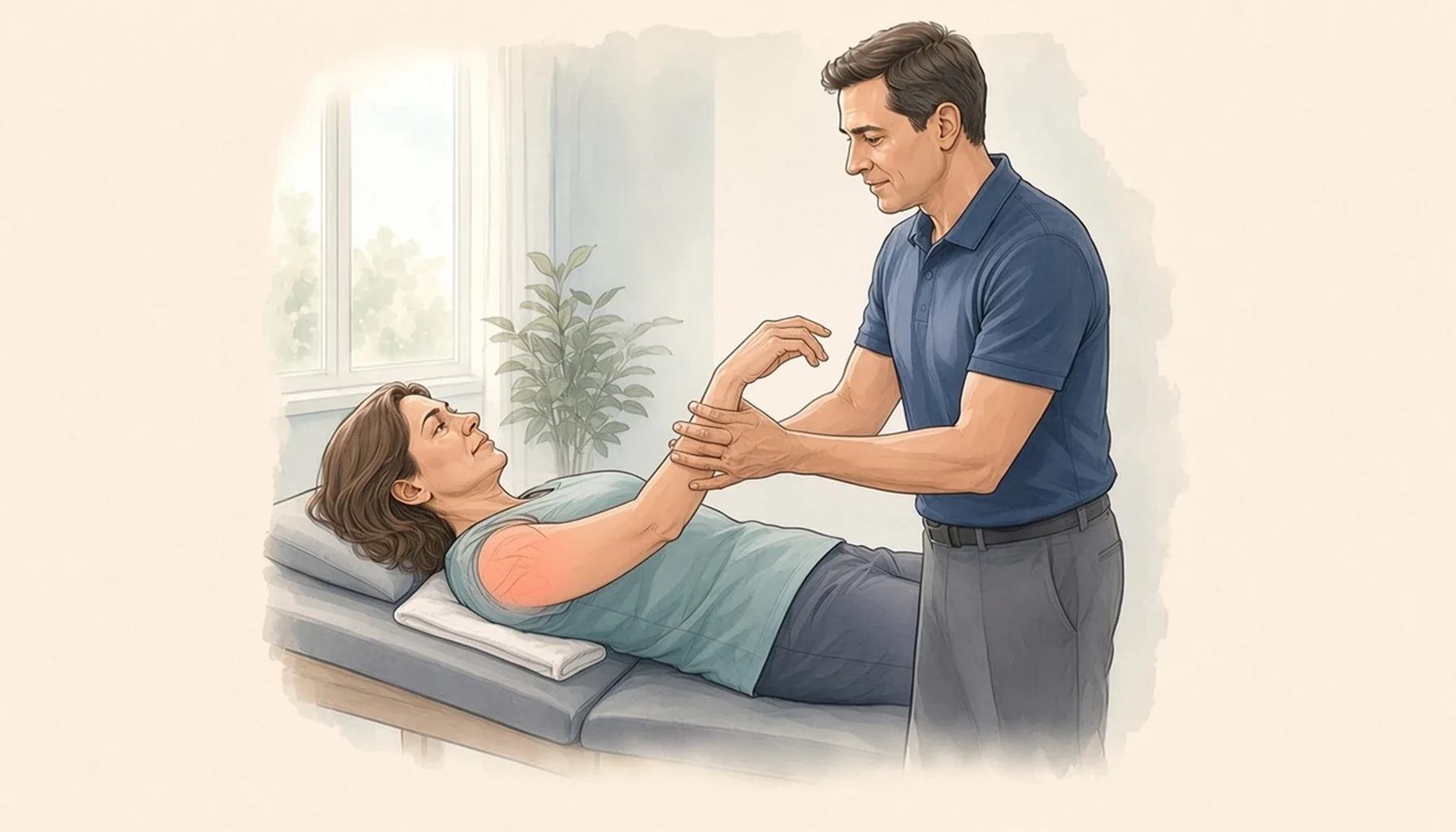
After rotator cuff repair, many programs begin with passive motion, where the arm is moved while the repaired muscles stay relaxed, then add active motion once the tendon has had more time to heal. Randomized trials comparing early and delayed motion show similar long term function and healing for many small and medium tears, with an early gain in motion that often fades by a few months. Larger tears may need a slower start. Your surgeon's protocol comes first.
Key takeaways
- Passive motion means another person or device moves your arm while the repaired cuff stays quiet. Active motion means you lift the arm yourself.
- A major therapist consensus statement describes about 2 weeks of protection, then protected passive motion, then active motion, with strengthening later.
- Trials of early versus delayed passive motion often find similar healing and function at 1 year, with better early motion when motion starts sooner.
- Early pain free active motion in some trials improved motion at 6 weeks without a clear long term edge, and with similar repair integrity.
- Tear size, tissue quality and the repair method shape how soon motion is safe. Follow the plan your surgeon wrote for you.
For the full week by week picture, see our rotator cuff surgery recovery guide.
What is the difference between passive and active motion?
Passive range of motion is movement done for you. A therapist, a helper, a continuous passive motion device or your healthy arm can move the surgical arm through a set range while the repaired rotator cuff muscles stay as relaxed as possible. The goal is to keep the joint from getting stiff without asking the new tendon attachment for much work.
Active range of motion is movement you create with your own shoulder muscles. You lift, reach or rotate the arm on your own. Active assisted motion sits between the two: you help a little, and another force (a pulley, a wand or your other arm) does part of the work. Our guide on when you can start pulley exercises after rotator cuff repair explains how pulleys fit into that middle stage.
Lab studies help show why the stages are ordered this way. A 1998 electromyography study by Dockery and colleagues measured muscle activity in 10 healthy volunteers. During continuous passive motion, the supraspinatus worked at about 5% of its maximum. During pulley exercise it worked at about 17.6%. A 1993 study by McCann and colleagues found muscle activity rose from passive exercises lying down, to active exercises, to resistive exercises. Early care usually starts closer to the quiet end of that scale.
What does a typical motion timeline look like?
Protocols vary, and your tear size and repair type matter. A widely used framework comes from the American Society of Shoulder and Elbow Therapists' consensus statement by Thigpen and colleagues, published in 2016. It describes about 2 weeks of strict immobilization, protected passive range of motion during weeks 2 to 6, restoration of active motion after that, and progressive strengthening beginning around week 12. The authors stress gradual loading based on tear size, tissue quality and patient factors.
AAOS OrthoInfo describes a similar arc for many patients: protection early on, then active exercise after about 4 to 6 weeks, and strengthening often starting around 8 to 12 weeks. Your printed protocol may move those dates earlier or later. Our posts on how long you wear a sling and what you can do at 2 weeks cover the early window in more detail.
What do trials say about early versus delayed passive motion?
Several randomized trials have compared starting passive motion within days of surgery with waiting about 6 weeks. For many small and medium tears, long term scores and healing look similar. Early motion often means more motion in the first months.
In a 2014 randomized trial by Keener and colleagues, 124 patients under age 65 had arthroscopic repair of a full thickness tear smaller than 30 millimeters. One group used a traditional program with early range of motion. The other was immobilized for 6 weeks. Active elevation and external rotation were better in the early motion group at 3 months. At later visits, function, motion and strength were similar. About 92% of tears had healed on ultrasound, with no difference between groups.
A 2012 randomized trial by Cuff and Pupello enrolled 68 patients after repair of a crescent shaped full thickness supraspinatus tear. One group began passive elevation and rotation on day 2. The other began the same plan at 6 weeks. At 1 year, patient scores and motion were very similar. Healing on ultrasound was 85% in the early group and 91% in the delayed group.
A 2015 meta-analysis by Kluczynski and colleagues pooled studies on early versus delayed passive motion. Among level 1 trials that compared the two approaches directly, retear rates were 13.7% with early motion and 10.5% with delayed motion, a difference that was not statistically significant. In a broader analysis, early motion was linked with a higher retear risk for tears larger than 5 centimeters. For some smaller tears repaired with certain methods, early motion looked safer. The takeaway is that tear size matters.
A 2015 meta-analysis of randomized trials by Chang and colleagues found no clear difference in overall shoulder function between early and delayed passive motion. Early motion improved forward flexion at 6 and 12 months by a few degrees. Recurrent tears tended to be more common with early motion, and that signal grew stronger when trials limited to small and medium tears were set aside. The authors advised balancing the risk of stiffness with the risk of retear, especially after large repairs.
What about starting active motion earlier?
Some trials have tested pain free active motion in the first 6 weeks, a step beyond early passive work.
In a 2019 randomized trial by Sheps and colleagues, 206 patients after arthroscopic rotator cuff repair were assigned to early mobilization or standard rehabilitation. The early group weaned from the sling as comfort allowed and used pain free active motion in the first 6 weeks. The standard group wore a sling for 6 weeks with no active motion. At 6 weeks, forward flexion and abduction were better in the early group. After that, motion, pain, strength and quality of life were similar through 24 months. Ultrasound at 12 months showed a full thickness defect in about 30% of the early group and 33% of the standard group, with no significant difference. The authors concluded that early pain free active motion did not compromise repair integrity in this cohort.
An earlier 2015 randomized trial by Sheps and colleagues after mini open repair found the same pattern: better early motion, then no lasting difference by later follow up.
A 2021 systematic review by Mazuquin and colleagues pooled 20 randomized trials with 1,841 patients. Early rehabilitation often improved motion at early and mid follow ups. Pain and function were mostly similar across time points. Repair integrity did not clearly worsen with early mobilization in the pooled analysis (odds ratio 1.05). The authors noted wide variation in how "early" was defined and that many trials had a high or unclear risk of bias.
A small 2017 randomized pilot by Raschhofer and colleagues compared early isometric loading with a primary passive program in 30 patients and found better Constant scores and less peak pain with early activation. The sample was small. These studies do not mean you should lift the arm on your own without clearance. Your surgeon may still keep a passive only phase for weeks after a large or complex repair.
How should you read these results for your own repair?
Put the findings next to your own case sheet. Small and medium tears in healthier tissue often tolerate earlier motion in trials. Larger tears, poorer tissue, revision repairs and some double row constructs have been linked with more caution around early loading in the meta analyses above. Age, smoking, diabetes and how well you can protect the arm at home also shape the plan.
If your protocol says passive only for 6 weeks, that matches an arm that did well in Keener and in Cuff. If it allows earlier guided motion, that matches early arms that also did well for many patients. The research supports a written plan that fits your tear and repair.
When therapy gets harder and the shoulder feels more sore after sessions, that can be a normal part of adding load. Our article on why the shoulder can hurt more after physical therapy covers that pattern, and our guide on ice or heat after rotator cuff surgery covers cold for comfort when your team recommends it.
How do home tools fit into passive and active stages?
In the passive stage, a therapist or helper often moves the arm for you. In the active assisted stage, an over the door pulley is a common tool so the healthy arm can help raise the surgical arm through a controlled range.
The BlueRanger Shoulder Pulley is designed for that assisted work once your clinician clears you for it. The Rotator Cuff Repair Program is designed to support home rehab across phases with lessons and tools that match the stage your therapist has cleared. Neither product sets your start date. Your surgeon and therapist do.
When should you call your surgeon?
Call your surgeon or care team if you notice:
- A sudden pop, giving way or sharp loss of strength
- Pain that keeps rising week after week
- New weakness when you try cleared motions
- Fever, spreading redness, warmth or drainage at the incision
- Numbness, tingling or color change in the hand that does not pass
- Calf pain or swelling, chest pain or shortness of breath, which need emergency care
Related reading
- Rotator cuff surgery recovery guide
- When can I start pulley exercises after rotator cuff repair?
- How long do you wear a sling after rotator cuff surgery?
- What can I do 2 weeks after rotator cuff surgery?
Your next step
Read the motion section of your surgeon's protocol and mark the week passive work starts and the week active work starts. Bring that sheet to therapy so every home exercise matches the stage you are in. When you are cleared for assisted motion, the BlueRanger Shoulder Pulley is designed for controlled home practice.
Common questions
Is passive motion the same as using a pulley?
No. Fully passive motion keeps the repaired muscles as quiet as possible. A pulley is usually active assisted motion, so it often starts later. Ask which category your exercises fall into.
Does early motion raise the risk of a retear?
For many small and medium tears in randomized trials, early and delayed programs had similar healing. Some pooled analyses link early motion with more retears after large tears. Your tear size helps set the pace.
When does active motion usually start?
Many protocols add active motion after the early protected weeks, often around 4 to 6 weeks, with strengthening later. Your printed plan is the one to follow.
Can I do pain free reaching in the first weeks?
Only if your surgeon's protocol allows it. Some study protocols permitted pain free early active motion. Many standard plans keep the first weeks passive and sling based.
Why do two patients with the same surgery get different timelines?
Tear size, tissue quality, repair technique and other health factors differ. Surgeons match the motion plan to those details.
Medical disclaimer
The information in this article is for general education only. It is not medical advice, diagnosis, or treatment, and reading it does not create a provider-patient relationship with RangeMaster. Recovery plans differ from person to person. Talk with your surgeon, physician, or physical therapist before you start, stop, or change any exercise, product, or treatment, and follow their instructions when they differ from anything you read here.
If you think you are having a medical emergency, call 911 or your local emergency number right away.
RangeMaster makes and sells the products linked in this article. Full medical disclaimer.
Sources
- Thigpen CA, Shaffer MA, Gaunt BW, Leggin BG, Williams GR, Wilcox RB 3rd. The American Society of Shoulder and Elbow Therapists' consensus statement on rehabilitation following arthroscopic rotator cuff repair. J Shoulder Elbow Surg. 2016;25(4):521-535. doi:10.1016/j.jse.2015.12.018 https://pubmed.ncbi.nlm.nih.gov/26995456/
- American Academy of Orthopaedic Surgeons. Rotator Cuff Tears: Surgical Treatment Options. OrthoInfo https://orthoinfo.aaos.org/en/treatment/rotator-cuff-tears-surgical-treatment-options/
- Dockery ML, Wright TW, LaStayo PC. Electromyography of the shoulder: an analysis of passive modes of exercise. Orthopedics. 1998;21(11):1181-1184 https://pubmed.ncbi.nlm.nih.gov/9845449/
- McCann PD, Wootten ME, Kadaba MP, Bigliani LU. A kinematic and electromyographic study of shoulder rehabilitation exercises. Clin Orthop Relat Res. 1993;(288):179-188 https://pubmed.ncbi.nlm.nih.gov/8458132/
- Keener JD, Galatz LM, Stobbs-Cucchi G, Patton R, Yamaguchi K. Rehabilitation following arthroscopic rotator cuff repair: a prospective randomized trial of immobilization compared with early motion. J Bone Joint Surg Am. 2014;96(1):11-19. doi:10.2106/JBJS.M.00034 https://pubmed.ncbi.nlm.nih.gov/24382719/
- Cuff DJ, Pupello DR. Prospective randomized study of arthroscopic rotator cuff repair using an early versus delayed postoperative physical therapy protocol. J Shoulder Elbow Surg. 2012;21(11):1450-1455. doi:10.1016/j.jse.2012.01.025 https://pubmed.ncbi.nlm.nih.gov/22554876/
- Kluczynski MA, Nayyar S, Marzo JM, Bisson LJ. Early versus delayed passive range of motion after rotator cuff repair: a systematic review and meta-analysis. Am J Sports Med. 2015;43(8):2057-2063. doi:10.1177/0363546514552802 https://pubmed.ncbi.nlm.nih.gov/25296646/
- Chang KV, Hung CY, Han DS, Chen WS, Wang TG, Chien KL. Early versus delayed passive range of motion exercise for arthroscopic rotator cuff repair: a meta-analysis of randomized controlled trials. Am J Sports Med. 2015;43(5):1265-1273. doi:10.1177/0363546514544698 https://pubmed.ncbi.nlm.nih.gov/25143489/
- Sheps DM, Silveira A, Beaupre L, et al. Early active motion versus sling immobilization after arthroscopic rotator cuff repair: a randomized controlled trial. Arthroscopy. 2019;35(3):749-760.e2. doi:10.1016/j.arthro.2018.10.139 https://pubmed.ncbi.nlm.nih.gov/30827428/
- Sheps DM, Bouliane M, Styles-Tripp F, et al. Early mobilisation following mini-open rotator cuff repair: a randomised control trial. Bone Joint J. 2015;97-B(9):1257-1263. doi:10.1302/0301-620X.97B9.35250 https://pubmed.ncbi.nlm.nih.gov/26330594/
- Mazuquin B, Moffatt M, Gill P, et al. Effectiveness of early versus delayed rehabilitation following rotator cuff repair: systematic review and meta-analyses. PLoS One. 2021;16(5):e0252137. doi:10.1371/journal.pone.0252137 https://pubmed.ncbi.nlm.nih.gov/34048450/
- Raschhofer R, Poulios N, Schimetta W, Kisling R, Mittermaier C. Early active rehabilitation after arthroscopic rotator cuff repair: a prospective randomized pilot study. Clin Rehabil. 2017;31(10):1332-1339. doi:10.1177/0269215517694931 https://pubmed.ncbi.nlm.nih.gov/28933605/