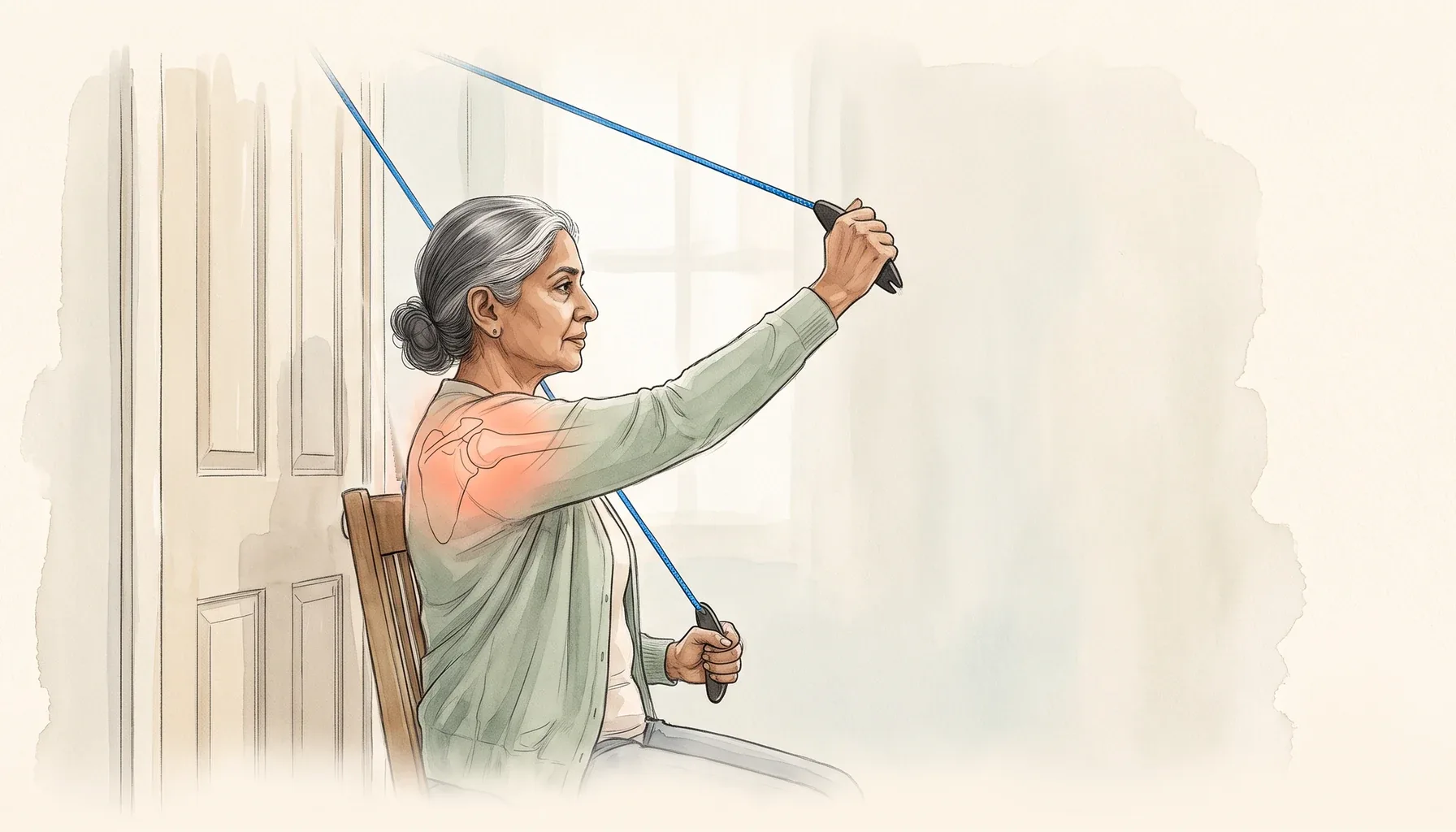
Many rotator cuff repair protocols add shoulder pulley exercises once the early passive motion phase ends, often around 4 to 6 weeks after surgery. A randomized trial by Baumgarten and colleagues started pulleys at 6 weeks and found no worse outcomes than a program without pulleys. Your surgeon and physical therapist set your start date based on your tear and repair.
Key takeaways
- Pulley work is usually an active assisted exercise, so it often starts after the first protected weeks.
- A 2016 randomized trial found pulleys started at 6 weeks were safe and as effective as a program without pulleys.
- Lab studies show pulleys ask more of the rotator cuff than fully passive motion, which is why timing matters.
- Smooth, slow, pain-free motion with relaxed shoulders is the goal.
- Your clinician's green light comes first.
Pulley exercises fit into a larger plan that runs from sling weeks to strengthening. Our rotator cuff surgery recovery guide maps the full timeline.
What does a shoulder pulley do after rotator cuff repair?
A shoulder pulley lets your healthy arm help lift your surgical arm, so the shoulder can move through a larger range with less effort from the repaired muscles. The pulley hangs over a door, and you hold a handle in each hand. As you pull down with the healthy arm, the surgical arm rises.
Therapists call this active assisted range of motion. Active means your own muscles are involved. Assisted means another force, here the healthy arm, does part of the work. This sits between two other stages:
- Passive range of motion, where the arm is moved for you and the repaired muscles stay relaxed.
- Active range of motion, where you lift the arm on your own.
Pulleys are popular because they are simple, inexpensive and easy to repeat at home many times a day. They can help you work on lifting the arm forward (flexion) and out to the side in the plane of the shoulder blade (scaption). For the basic setup, see our guide on how to use a shoulder pulley.
Why not start pulleys right after surgery?
Pulley exercises use the rotator cuff muscles more than fully passive motion, and the repair is most fragile in the first weeks. That is why many protocols hold pulleys until the early passive phase is complete.
A 1998 electromyography study by Dockery and colleagues measured muscle activity in 10 healthy volunteers. Electromyography, or EMG, records the electrical signal a muscle makes when it works. During pulley exercise, the supraspinatus, the cuff muscle most often repaired, worked at an average of 17.6% of its maximum. During a continuous passive motion machine, it worked at 5.0%. The authors concluded that more passive methods may give a larger safety margin early after repair.
An earlier 1993 EMG study by McCann and colleagues found a steady rise in muscle activity from passive exercises lying down, to active exercises, to resistive exercises. The authors suggested starting with passive exercises lying down in the early weeks and progressing as healing allows.
The American Society of Shoulder and Elbow Therapists' consensus statement describes 2 weeks of strict immobilization, protected passive motion during weeks 2 to 6, and then restoration of active motion. Pulleys usually fit at the start of that active phase, or late in the passive phase if your therapist uses them very gently.
What does the research say about pulleys at 6 weeks?
A randomized controlled trial found that pulley exercises started 6 weeks after rotator cuff repair did not lead to worse outcomes. Patients improved in both groups.
In the Baumgarten trial, published in the American Journal of Sports Medicine in 2016, 27 patients used pulleys starting 6 weeks after surgery and 26 followed a program without pulleys. The team worried that pulleys might cause scapular substitution, which is when the shoulder blade hikes up to make up for a stiff or weak shoulder. They measured patient-reported scores, range of motion, strength and scapular substitution at 6, 12, 18, 26 and 52 weeks.
Both groups improved over time, and there were no differences between groups in any measure. The trial excluded large and massive tears, revision repairs, arthritis and frozen shoulder, so the results apply best to small and medium first-time repairs. We covered this trial in more depth in our article review of the pulley and Jackins exercise study.
Can some people start pulleys earlier?
Some surgeons allow gentle pulley work before 6 weeks, especially after smaller repairs, and others wait longer after large repairs. Your surgeon's protocol decides.
Research on early motion helps explain the range. A meta-analysis by Kluczynski and colleagues found that early passive motion was linked with more retears in tears larger than 5 centimeters. Results for smaller tears were mixed. A randomized trial by Cuff and Pupello compared passive motion starting on day 2 with passive motion starting at 6 weeks in 68 patients. Both groups had very similar outcomes and motion at 1 year. Healing was slightly higher in the delayed group, 91% compared with 85%.
These numbers show why the decision depends on your repair. Ask your surgeon directly, "When can I add the pulley, and how high should I go?"
How do you do pulley exercises safely?
Start slowly, stay within a comfortable range, and let the healthy arm do the work while the surgical arm stays relaxed. A gentle stretch is fine. Sharp pain is a signal to stop.
Tips your therapist may share:
- Sit in a sturdy chair with your back to the door, or facing the door, as instructed.
- Keep your shoulders down and relaxed. Watch in a mirror for shrugging.
- Raise the surgical arm forward with the thumb up, then lower it slowly.
- Pause at the top for a breath, and avoid bouncing or jerking.
- Stop the movement where the stretch is mild. Height comes with time.
- Follow the number of repetitions and sessions your therapist gives you.
Our star exercise of the week on shoulder flexion with pulleys shows the forward raise step by step.
What comes after pulley exercises?
After pulley work, most programs move to lifting the arm on your own and then to light strengthening. AAOS describes active exercise after 4 to 6 weeks and strengthening starting at 8 to 12 weeks, with most patients reaching functional motion and adequate strength by 4 to 6 months.
Many people keep the pulley in their routine as a warm up even after they begin strengthening. A few easy repetitions can loosen the shoulder before wand stretches or band exercises. Your therapist will also watch how your shoulder blade moves as you lift, since smooth shoulder blade motion is part of getting full use of the arm back. If progress stalls for several weeks, tell your therapist so they can adjust the plan.
When to call your doctor
Stop pulley work and call your surgeon or therapist if you notice:
- A sudden pop, tearing feeling or new weakness in the arm
- Pain that is sharp, keeps increasing, or lasts for hours after exercise
- New swelling, redness, warmth or drainage at the incisions
- Fever or chills
- Numbness or tingling that does not go away
Talk with your clinician before you start or change any exercise.
How RangeMaster products fit
The BlueRanger Shoulder Pulley is an over-the-door pulley with an 85-inch adjustable cord, cleated handles, and a choice of metal door bracket or webbing door strap. It is designed for home range-of-motion work within the range your clinician recommends.
The Rotator Cuff Repair Program includes a full home kit with a pulley, a wand and light resistance tools, plus a shoulder compression wrap and 30 lessons across surgical and non-surgical pathways, so pulley work fits into a step by step plan.
RangeMaster surveyed over 300 patients about our pulleys, and 97% of our patients who use a shoulder pulley say that they're feeling better. That is a survey of our own customers about how they felt. It does not measure tendon healing.
Related reading
- Rotator cuff surgery recovery guide
- How to use a shoulder sling the right way
- Shoulder pain 8 weeks after rotator cuff surgery
- Are shoulder pulleys safe to use for shoulder injuries?
Your next step
When your therapist clears you for pulley work, the BlueRanger Shoulder Pulley gives you a simple way to keep those exercises going at home.
Common questions
Is a shoulder pulley passive or active exercise?
It is usually active assisted. Your healthy arm provides most of the force, and the surgical arm's muscles still do some work, which lab studies have measured with EMG.
Can pulley exercises tear my repair?
A randomized trial found no worse outcomes when pulleys started at 6 weeks after small and medium repairs. Using a pulley too early, too forcefully, or against your surgeon's instructions could put the repair at risk, so follow your protocol.
How high should I lift my arm with the pulley?
Lift only to the point of a mild stretch. Your therapist may set a target height, which often grows week by week.
How often should I do pulley exercises?
Your therapist will set the dose. Many home programs use short sessions several times a day.
Do I need a pulley if I already go to physical therapy?
A pulley can help you repeat your therapist's exercises at home between visits. Ask your therapist whether it fits your plan.
Medical disclaimer
The information in this article is for general education only. It is not medical advice, diagnosis, or treatment, and reading it does not create a provider-patient relationship with RangeMaster. Recovery plans differ from person to person. Talk with your surgeon, physician, or physical therapist before you start, stop, or change any exercise, product, or treatment, and follow their instructions when they differ from anything you read here.
If you think you are having a medical emergency, call 911 or your local emergency number right away.
RangeMaster makes and sells the products linked in this article. Full medical disclaimer.
Sources
- Baumgarten KM, Osborn R, Schweinle WE Jr, Zens MJ, Helsper EA. Are pulley exercises initiated 6 weeks after rotator cuff repair a safe and effective rehabilitative treatment? A randomized controlled trial. Am J Sports Med. 2016;44(7):1844-1851. doi:10.1177/0363546516640763 https://pubmed.ncbi.nlm.nih.gov/27159310/
- Dockery ML, Wright TW, LaStayo PC. Electromyography of the shoulder: an analysis of passive modes of exercise. Orthopedics. 1998;21(11):1181-1184. doi:10.3928/0147-7447-19981101-05 https://pubmed.ncbi.nlm.nih.gov/9845449/
- McCann PD, Wootten ME, Kadaba MP, Bigliani LU. A kinematic and electromyographic study of shoulder rehabilitation exercises. Clin Orthop Relat Res. 1993;(288):179-188 https://pubmed.ncbi.nlm.nih.gov/8458132/
- Thigpen CA, Shaffer MA, Gaunt BW, Leggin BG, Williams GR, Wilcox RB 3rd. The American Society of Shoulder and Elbow Therapists' consensus statement on rehabilitation following arthroscopic rotator cuff repair. J Shoulder Elbow Surg. 2016;25(4):521-535. doi:10.1016/j.jse.2015.12.018 https://pubmed.ncbi.nlm.nih.gov/26995456/
- Kluczynski MA, Nayyar S, Marzo JM, Bisson LJ. Early versus delayed passive range of motion after rotator cuff repair: a systematic review and meta-analysis. Am J Sports Med. 2015;43(8):2057-2063. doi:10.1177/0363546514552802 https://pubmed.ncbi.nlm.nih.gov/25296646/
- Cuff DJ, Pupello DR. Prospective randomized study of arthroscopic rotator cuff repair using an early versus delayed postoperative physical therapy protocol. J Shoulder Elbow Surg. 2012;21(11):1450-1455. doi:10.1016/j.jse.2012.01.025 https://pubmed.ncbi.nlm.nih.gov/22554876/
- American Academy of Orthopaedic Surgeons. Rotator Cuff Tears: Surgical Treatment Options. OrthoInfo https://orthoinfo.aaos.org/en/treatment/rotator-cuff-tears-surgical-treatment-options/
- RangeMaster. A Simple Tool Has 97% of Shoulder Pain Sufferers Feeling Better (patient survey) https://myrangemaster.com/a-simple-tool-has-97-of-patients-feeling-better