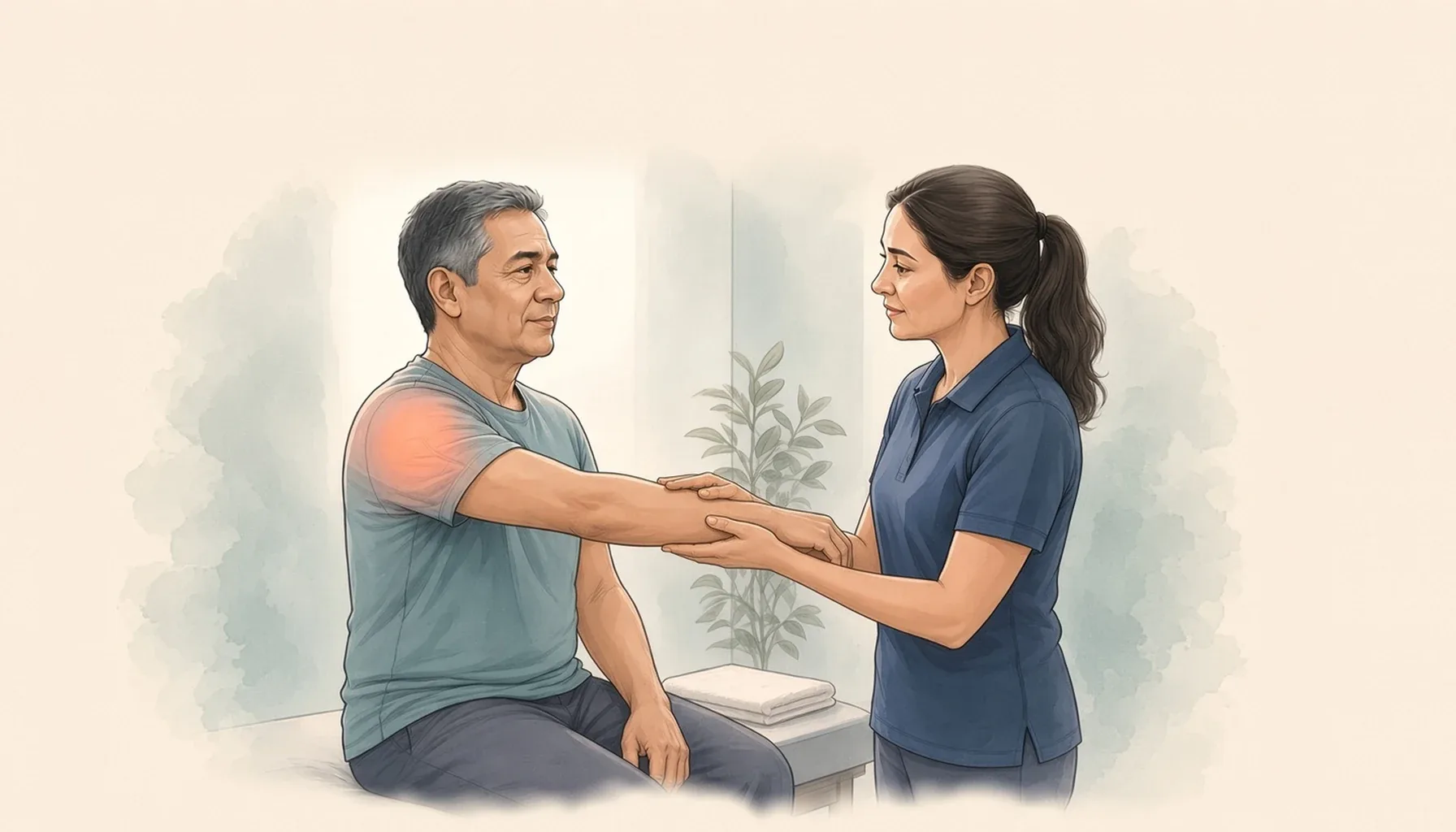
A re-torn rotator cuff after repair is confirmed on imaging, not by symptoms alone. Research on symptomatic retears points to intense pain, new or returning weakness on strength tests such as the Jobe test or an external rotation lag, and functional loss that keeps you from daily tasks. Many imaging defects stay quiet, so a sudden pop, rising pain after a good stretch of progress, or clear weakness is a reason to call your surgeon rather than to self diagnose.
Key takeaways
- A symptomatic retear is usually defined as a clear imaging defect plus intense pain and/or clear functional impairment on exam.
- Common clinical flags include rising pain, new weakness with lifting or rotation, and a sudden giving way or pop during use.
- Serial ultrasound studies of large repairs found most structural failures within the first 3 months, with few after 6 months.
- Imaging can show a gap even when pain and function are decent, so exam and imaging are read together.
- Infection signs, chest symptoms, or calf swelling need urgent care and are separate from a quiet retear.
For the week by week recovery picture, see our rotator cuff surgery recovery guide. If you think you reinjured the shoulder, our guide on what to do if you injure your shoulder after surgery covers the first steps.
What does "retear" mean after a repair?
Surgeons use several related terms. A recurrent defect or retear means the tendon is no longer attached the way it was at the end of surgery. That can happen if the repair fails to heal, if the tendon pulls away from the bone, or if tissue tears again next to the repair.
Not every imaging finding means the repair "failed" for you as a patient. A 2014 meta-analysis by Russell and colleagues pooled 14 higher level studies with 861 patients. About 78% had an intact repair on later imaging. Validated scores for pain and function improved whether the repair was intact or not. Intact repairs had slightly better Constant and UCLA scores and more forward elevation strength, but the score gaps were smaller than the clinically important differences for those tools. Strength was the clearest gap in favor of an intact tendon.
A classic 2004 series by Galatz and colleagues followed 18 patients after arthroscopic repair of large and massive tears. Ultrasound showed a recurrent tear in 17 of 18. Many still reported less pain and better daily function at 1 year, though scores slipped for some by 2 years. The lesson for patients is that imaging and how the shoulder feels both matter, and neither one alone tells the whole story.
What symptoms do studies treat as a symptomatic retear?
Teams that study "symptomatic" retears usually require both a clear imaging failure and clinical trouble.
In a 2021 study by Lobo-Escolar and colleagues, a symptomatic retear meant Sugaya type IV or V findings on MRI plus intense pain (visual analog scale 5 or higher) and/or functional impairment, defined as a positive Jobe test and/or an external rotation lag sign. In 158 patients after arthroscopic repair of a full thickness supraspinatus tear, the symptomatic retear rate was 9.5%. On multivariable analysis, massive tears, moderate to severe fatty infiltration, prior subacromial corticosteroid injections, and depression were linked with higher odds of that symptomatic pattern.
A 2020 study by Lee and colleagues looked at 98 patients who had a retear on imaging within 2 years of primary arthroscopic repair. Forty four went on to revision within 2 years. Fifty four lived with the retear and needed no further treatment for minimal discomfort. At the time of revision, the revision group had much lower American Shoulder and Elbow Surgeons and Constant scores (about 54 and 65) than the quiet retear group (about 87 and 84). Larger growth of the retear on MRI, especially in the front to back direction, and infraspinatus retear were more common in the group that needed revision.
Put simply, the research flags that matter for a patient conversation are:
- Pain that is intense or that climbs again after a period of improvement
- Clear weakness when you try to lift the arm forward (Jobe style testing) or hold the arm in external rotation
- Loss of function that blocks dressing, reaching, or work tasks you had regained
- A sudden pop, giving way, or sharp loss of strength during a lift or stretch
Soreness that settles after a hard therapy session can be part of normal loading. Our article on why the shoulder can hurt more after physical therapy covers that pattern. Cold for comfort, when your team recommends it, is covered in ice or heat after rotator cuff surgery.
When do structural failures tend to show up?
Timing helps set expectations for when to speak up.
A 2011 serial ultrasound study by Miller and colleagues followed 22 patients after arthroscopic repair of large tears greater than 3 centimeters. Nine of 22 (41%) showed a recurrent tear. Seven of those nine appeared within 3 months. The other two appeared between 3 and 6 months. No new retears appeared after 6 months in that series. Patients with intact repairs tended toward better Western Ontario Rotator Cuff scores at 24 months.
A 2023 imaging review by Sahu and colleagues notes that most recurrent tears happen within the first 3 months and that about 1 in 4 patients still report pain and dysfunction after surgery for several possible reasons, including retear, impingement, and postoperative inflammation. Ultrasound and MRI both play a role. Ultrasound is often used first because it is available, lower cost, and dynamic. MRI can better show the size of a large defect and other problems such as hardware issues.
Early protection still matters because that is when many structural failures appear. Our posts on passive versus active motion after rotator cuff repair and what you can do at 2 weeks explain how early loading is usually staged. The American Society of Shoulder and Elbow Therapists' consensus statement by Thigpen and colleagues describes about 2 weeks of protection, then protected passive motion, then active motion, with strengthening later, adjusted for tear size and tissue quality.
How do tear size and tissue quality change the odds?
Larger tears and poorer muscle quality raise the chance of a recurrent defect on imaging.
A 2010 systematic review by Duquin and colleagues pooled imaging based healing rates from 23 studies and 1,252 repairs. Retear rates rose with tear size. For double row repairs, reported retear rates ranged from about 7% for tears under 1 centimeter to about 41% for tears over 5 centimeters. Single row style repairs showed higher rates in the larger sizes. Surgical approach (open, mini open, or arthroscopic) did not clearly change retear rate for a given repair method in that review.
The Lobo-Escolar and Lee papers above also link massive tears and fatty infiltration of the cuff muscles with symptomatic failure patterns. Those factors are on your operative note and preoperative MRI. They help your surgeon set the protection plan and the follow up plan. They are not something you can change after the fact, but they explain why two people with "the same surgery" hear different caution levels.
What will your clinician look for on exam and imaging?
On exam, your surgeon or therapist checks strength and special tests. A Jobe test looks for weakness or pain when you resist elevation with the thumbs down, which stresses the supraspinatus. An external rotation lag sign looks for the arm dropping back when you try to hold it in external rotation, which can point to infraspinatus or teres minor trouble. These are the same tests named in the Lobo-Escolar definition of functional impairment.
On imaging, ultrasound or MRI may show a fluid filled gap in the tendon, thinning, retraction of the tendon edge, or an empty footprint at the bone. Sahu and colleagues note that irregular tendon tissue is common in the first year after a successful repair and should not be read as a retear by itself. Comparison with earlier postoperative images and the operative report helps separate a planned residual defect from a new failure.
AAOS OrthoInfo describes the overall recovery arc after repair and notes that healing takes months. Your printed protocol and your surgeon's exam remain the guide for when imaging is ordered.
How do home tools fit when you are protecting a repair?
Home tools do not diagnose a retear. They support the plan your surgeon already cleared.
The Rotator Cuff Repair Program is designed to support home rehab across phases with lessons and tools that match the stage your therapist has cleared. The BlueRanger Shoulder Pulley is designed for assisted motion once your clinician says that stage is safe. If pain or weakness suddenly changes, stop the session and contact your care team before you add load. Neither product replaces imaging, exam, or the timeline on your protocol.
When should you call your surgeon?
Call your surgeon or care team if you notice:
- A sudden pop, giving way, or sharp loss of strength
- Pain that climbs week after week after it had been settling
- New weakness when you try motions you had already regained
- Fever, spreading redness, warmth, or drainage at the incision
- Numbness, tingling, or color change in the hand that does not pass
- Calf pain or swelling, chest pain, or shortness of breath, which need emergency care
Bring notes on when the change started, what you were doing, and how the shoulder feels with dressing, reaching, and sleep. That history helps your team decide whether to examine you sooner and whether ultrasound or MRI is useful.
Related reading
- Rotator cuff surgery recovery guide
- What to do if I injure my shoulder after surgery
- Passive vs active motion after rotator cuff repair
- Why does my shoulder hurt more after physical therapy?
Your next step
Write down any new weakness, rising pain, or sudden change, including the date and what you were doing. Call your surgeon's office with that list rather than waiting for a routine visit if the change is clear. Keep following the motion limits on your printed protocol until you hear back. When you are cleared to keep working at home, the Rotator Cuff Repair Program is designed to support the stages your team has approved.
Common questions
Can my rotator cuff retear without much pain?
Yes. Imaging studies often find recurrent defects in people who still report usable function and modest pain. Russell and colleagues found that pain and many score based outcomes looked similar with or without an intact repair, while strength favored intact tendons. New weakness still deserves a call even if pain is mild.
Does a pop always mean the repair tore again?
No. A pop can come from scar tissue, adhesions releasing, or other soft tissue. A pop plus sudden weakness or a clear drop in what you can lift is more concerning. Your surgeon decides whether exam and imaging are needed.
How soon after surgery do retears usually appear?
In Miller's serial ultrasound series of large repairs, most retears appeared within 3 months and none after 6 months. Other reviews also place most recurrent tears in the early months. Later changes can still happen, so new symptoms at any stage are worth reporting.
Will I need another surgery if imaging shows a retear?
Not always. Lee and colleagues found that many people with an imaging retear lived with minimal discomfort and did not have revision within 2 years, while others with worse scores and growing defects went on to revision. The decision rests on pain, function, tear pattern, and your goals.
How is a retear different from normal therapy soreness?
Therapy soreness usually eases within a day or two and does not erase strength you already had. A symptomatic retear pattern in the studies above centers on intense or returning pain and clear weakness on strength tests. When you are unsure, pause added load and ask your therapist or surgeon.
Medical disclaimer
The information in this article is for general education only. It is not medical advice, diagnosis, or treatment, and reading it does not create a provider-patient relationship with RangeMaster. Recovery plans differ from person to person. Talk with your surgeon, physician, or physical therapist before you start, stop, or change any exercise, product, or treatment, and follow their instructions when they differ from anything you read here.
If you think you are having a medical emergency, call 911 or your local emergency number right away.
RangeMaster makes and sells the products linked in this article. Full medical disclaimer.
Sources
- Lobo-Escolar L, Ramazzini-Castro R, Codina-Grano D, Lobo E, Minguell-Monyart J, Ardevol J. Risk factors for symptomatic retears after arthroscopic repair of full-thickness rotator cuff tears. J Shoulder Elbow Surg. 2021;30(1):27-33. doi:10.1016/j.jse.2020.05.010 https://pubmed.ncbi.nlm.nih.gov/32862994/
- Lee S, Park I, Lee HA, Shin SJ. Factors related to symptomatic failed rotator cuff repair leading to revision surgeries after primary arthroscopic surgery. Arthroscopy. 2020;36(8):2080-2088. doi:10.1016/j.arthro.2020.04.016 https://pubmed.ncbi.nlm.nih.gov/32339635/
- Miller BS, Downie BK, Kohen RB, et al. When do rotator cuff repairs fail? Serial ultrasound examination after arthroscopic repair of large and massive rotator cuff tears. Am J Sports Med. 2011;39(10):2064-2070. doi:10.1177/0363546511413372 https://pubmed.ncbi.nlm.nih.gov/21737833/
- Galatz LM, Ball CM, Teefey SA, Middleton WD, Yamaguchi K. The outcome and repair integrity of completely arthroscopically repaired large and massive rotator cuff tears. J Bone Joint Surg Am. 2004;86(2):219-224. doi:10.2106/00004623-200402000-00002 https://pubmed.ncbi.nlm.nih.gov/14960664/
- Russell RD, Knight JR, Mulligan E, Khazzam MS. Structural integrity after rotator cuff repair does not correlate with patient function and pain: a meta-analysis. J Bone Joint Surg Am. 2014;96(4):265-271. doi:10.2106/JBJS.M.00265 https://pubmed.ncbi.nlm.nih.gov/24553881/
- Duquin TR, Buyea C, Bisson LJ. Which method of rotator cuff repair leads to the highest rate of structural healing? A systematic review. Am J Sports Med. 2010;38(4):835-841. doi:10.1177/0363546509359679 https://pubmed.ncbi.nlm.nih.gov/20357403/
- Sahu AK, Moran EK, Gandikota G. Role of ultrasound and MRI in the evaluation of postoperative rotator cuff. J Ultrason. 2023;23(95):e188-e201. doi:10.15557/jou.2023.0028 https://pubmed.ncbi.nlm.nih.gov/38020508/
- Thigpen CA, Shaffer MA, Gaunt BW, Leggin BG, Williams GR, Wilcox RB 3rd. The American Society of Shoulder and Elbow Therapists' consensus statement on rehabilitation following arthroscopic rotator cuff repair. J Shoulder Elbow Surg. 2016;25(4):521-535. doi:10.1016/j.jse.2015.12.018 https://pubmed.ncbi.nlm.nih.gov/26995456/
- American Academy of Orthopaedic Surgeons. Rotator Cuff Tears: Surgical Treatment Options. OrthoInfo https://orthoinfo.aaos.org/en/treatment/rotator-cuff-tears-surgical-treatment-options/