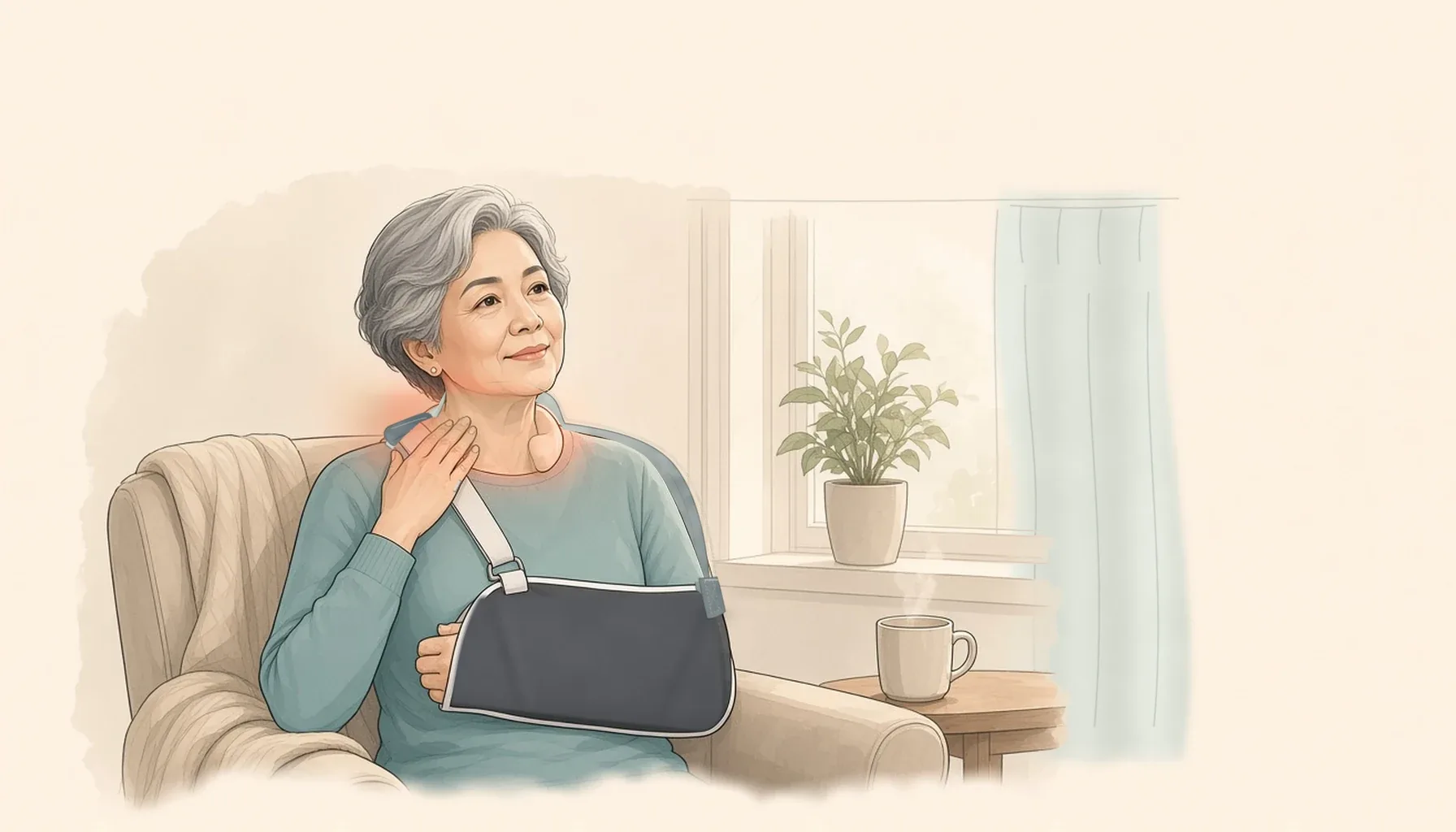
A standard shoulder sling hangs the weight of your arm from a strap that runs around the back of your neck, so the neck and the upper trapezius muscle carry that load for many hours a day. Over weeks of wear, the steady pressure can leave the neck sore, stiff, or rubbed raw. A correct fit, padding, relaxed posture, and an off-the-neck adapter may help. Keep following your surgeon's sling plan while you work on comfort.
Key takeaways
- A shoulder sling supports the weight of the arm, and in most designs that weight hangs from a strap across the neck.
- Bag and backpack strap studies in healthy people link one-sided or poorly designed straps with more upper trapezius activity and stress.
- In one sensor study, more hours of actual daily sling wear went with better early pain scores and fewer imaging failures.
- Check the fit first: a 90 degree elbow and a supported wrist.
- Neck pain with numbness, tingling, weakness, or skin breakdown is a reason to call your care team.
Our rotator cuff surgery recovery guide lays out the full timeline, and our post on how long you wear a sling after rotator cuff surgery explains why the sling matters early.
Why does a sling strap load your neck?
The MSD Manual's professional guide to applying a shoulder sling explains that a sling supports the weight of the arm and limits arm movement. In the standard method, the strap wraps across the neck on the opposite side and attaches to the front of the sling. So the strap, and the tissue under it, holds up the arm all day.
The tissue under the strap is mostly the upper trapezius, the broad muscle that runs from the base of the skull out to the top of the shoulder blade. It is the muscle you feel when you shrug. When a narrow strap presses on it for hours, the muscle works against a constant downward pull, and the skin under the strap takes concentrated pressure in a small area.
We found no clinical trial that measured neck muscle load during sling wear after rotator cuff repair, so the closest evidence comes from bag and backpack strap studies in healthy young people. They show a principle and do not predict what any one patient will feel.
- In a 2014 study by Yoon, 20 healthy students walked with a one-shoulder bag and with a backpack. Upper trapezius activity on both sides was significantly higher with the shoulder bag.
- A 2016 study by Abdelraouf and colleagues had 25 people walk for 15 minutes with backpack straps set long or short. With long straps, the upper trapezius became more sensitive to pressure, and the head drifted forward more on posture measures.
- A 2018 computer modeling study by Hadid and colleagues found that a stiffer strap cut trapezius stresses by about half compared with a soft strap, and a double layered strap cut skin stresses by about 50%.
Together, these findings suggest that a one-sided load works the upper trapezius harder, that strap length changes neck posture, and that strap design changes how pressure spreads. A sling combines all three for weeks.
In a 2026 sling design report by Nakamitsu and colleagues, the team moved the sling knot from the neck to above the same-side shoulder to avoid neck pain.
What does research say about wearing a sling after rotator cuff repair?
According to AAOS OrthoInfo, most people use a sling and avoid using the arm for the first 4 to 6 weeks after repair, and the exact time depends on the injury, tissue quality, and type of repair. The American Society of Shoulder and Elbow Therapists' consensus statement by Thigpen and colleagues describes about 2 weeks of strict immobilization followed by protected passive motion from weeks 2 to 6.
That is a long time to carry an arm from the neck, and wearing time appears to matter. A 2023 study by Weir and colleagues placed temperature sensors in the slings of 65 patients. Patients who wore the sling as prescribed had better pain scores at 6 weeks and 3 months. About 13.6 hours of daily wear was the best cut point for imaging outcomes at 6 weeks (0% failure compared with 16%), and about 15.4 hours was best at 1 year (3% compared with 28%). That study did not track neck pain. Still, a sore neck can tempt people to slip the sling off early, so comfort is worth taking seriously.
Surgeons also choose different slings. In a 2023 survey of 499 shoulder surgeons by Freehill and colleagues, 80% of United States respondents used an abduction pillow sling, which holds the arm slightly away from the body on a foam wedge, for rotator cuff tears under 3 centimeters, compared with 42% of European respondents.
Does the type of sling change results? A 2023 meta-analysis by Chen and colleagues pooled randomized trials with 302 patients and found no significant difference between abduction braces and simple slings in shoulder scores, pain, range of motion, or healing failures. Arm position can change comfort. In a 2014 study by Gumina and colleagues, 101 healthy office workers averaging 55 years old tried two braces. Severe discomfort was three times more common with the brace holding the arm in internal rotation, and 91% preferred the brace that kept the arm at the side.
At night, a 2026 retrospective study by Zhang and colleagues of 92 patients found better sleep, lower pain, and higher satisfaction when patients switched from an abduction brace to a simple sling overnight, with similar function. Patients were not randomized and healing was not checked, so night support stays your surgeon's call.
What helps a sore neck in a sling?
Most of what helps comes down to fit, pressure, and posture. Some tips below are standard fitting practice, and others are practical comfort advice your care team should confirm.
Check the basic fit
The MSD Manual describes the classic setup. The elbow sits at 90 degrees in the corner of the sling, the wrist is supported in slight extension, and the strap is adjusted until the elbow holds that 90 degree position. The guide also warns that a sling that is too short lets the wrist hang past the end, which puts undue pressure on the ulnar nerve. A strap that is too long lets the arm sag, and one that is too short hikes the arm toward the chin. Our guide on how to use a shoulder sling the right way walks through these steps.
Spread the pressure
A narrow strap concentrates force on a small strip of skin. The modeling study above suggests that a firmer, layered strap spreads stress better than a thin, soft one. Practical steps include centering the neck pad on the muscle, checking that the strap is not twisted, and keeping the skin under it dry. Check that skin daily for redness or rubbing.
Relax the shoulders
People in slings often shrug all day without noticing, which keeps the upper trapezius working even when the arm is supported. A few times an hour, let both shoulders drop and breathe out slowly. Ask your therapist which neck movements are safe for you.
Set up rest and sleep
Resting the forearm on a pillow when you sit lets the strap go slack without taking the sling off. Our posts on how to sleep after rotator cuff surgery and choosing a recliner or bed after shoulder surgery cover supported positions, and our checklist to prepare your home before shoulder surgery helps you set up a sitting area before surgery.
Ask before you change anything
Do not loosen, swap, or leave off the sling without talking to your care team. The sling holds the arm in a position chosen to protect your repair, and your clinician can recheck the fit or approve a setup that keeps it.
How does an off-the-neck adapter fit in?
An off-the-neck adapter follows the same idea of moving the suspension point away from the neck. The SlingThing v2 Off-The-Neck Arm Sling Adapter is designed to redirect sling weight across the torso and away from the neck while the arm stays supported. It attaches to a standard sling, so you keep using the sling your surgeon prescribed. The v2 design includes a shoulder opening and a shorter strap for improved fit on most individuals, and it comes in S/M and L/XL sizes.
The adapter does not replace medical guidance or the immobilization equipment your surgeon requires. Bring it to your next visit so your team can check your arm position. Once you move past the sling phase, the Rotator Cuff Repair Program can help you follow the home exercise stages your therapist approves.
When is neck pain a reason to call your clinician?
Call your surgeon or care team if you notice:
- Numbness, tingling, or weakness in the hand or fingers, especially near the little finger
- Fingers that look pale, blue, or swollen and do not improve when you adjust the sling
- Blisters, open skin, or rising redness under the strap
- Neck pain that keeps getting worse or comes with fever
- New shoulder pain, a pop, or loss of strength in the repaired arm
Chest pain, shortness of breath, or calf pain and swelling need emergency care.
Related reading
- Rotator cuff surgery recovery guide
- How long do you wear a sling after rotator cuff surgery?
- How to use a shoulder sling the right way
- How do you sleep after rotator cuff surgery?
Your next step
Stand at a mirror with your sling on and check that your elbow sits at about 90 degrees, your wrist is supported, and your shoulders are relaxed. Note where the strap presses and share that with your care team. If the neck strap is still the hardest part of sling weeks, ask whether the SlingThing v2 adapter can work with the sling you were given.
Common questions
Is neck pain from a sling normal?
It is common, because most slings hang the arm from a strap around the neck. Soreness alone is usually a fit and comfort problem. Numbness, tingling, or skin breakdown needs a call to your care team.
Can I loosen the strap to take pressure off my neck?
Loosening the strap lets the arm drop below the 90 degree elbow position that sling guides describe, which can change the position your surgeon wants and may push the neck forward. Ask your care team to recheck the fit before you change the length.
Does a pad on the sling strap help?
Many people find it does. Backpack strap modeling suggests firmer, layered straps spread pressure better. We found no trial of sling pads after rotator cuff repair, so treat padding as practical comfort advice.
Would a different kind of sling be easier on my neck?
Sling choice belongs to your surgeon. Trials show similar outcomes with abduction braces and simple slings, and arm position can change comfort. Ask whether your sling can be adjusted or adapted before you switch.
How long will the neck soreness last?
Strap soreness usually eases once the sling comes off, often after 4 to 6 weeks according to AAOS. If neck pain lingers after that or spreads down the arm, tell your clinician.
Medical disclaimer
The information in this article is for general education only. It is not medical advice, diagnosis, or treatment, and reading it does not create a provider-patient relationship with RangeMaster. Recovery plans differ from person to person. Talk with your surgeon, physician, or physical therapist before you start, stop, or change any exercise, product, or treatment, and follow their instructions when they differ from anything you read here.
If you think you are having a medical emergency, call 911 or your local emergency number right away.
RangeMaster makes and sells the products linked in this article. Full medical disclaimer.
Sources
- American Academy of Orthopaedic Surgeons. Rotator Cuff Tears: Surgical Treatment Options. OrthoInfo https://orthoinfo.aaos.org/en/treatment/rotator-cuff-tears-surgical-treatment-options/
- Thigpen CA, Shaffer MA, Gaunt BW, Leggin BG, Williams GR, Wilcox RB 3rd. The American Society of Shoulder and Elbow Therapists' consensus statement on rehabilitation following arthroscopic rotator cuff repair. J Shoulder Elbow Surg. 2016;25(4):521-535. doi:10.1016/j.jse.2015.12.018 https://pubmed.ncbi.nlm.nih.gov/26995456/
- Habrat D. How To Apply a Shoulder Sling and Swathe. MSD Manual Professional Edition. Reviewed by Birnbaumer DM. Modified September 2026 https://www.msdmanuals.com/professional/injuries-poisoning/how-to-splint-or-immobilize-an-upper-limb/how-to-apply-a-shoulder-sling-and-swathe
- Weir TB, Enobun B, Livesey MG, Sood A, Apte A, Hughes M, et al. Increased actual sling wear is associated with better early patient-reported and image-based outcomes after shoulder surgery. J Shoulder Elbow Surg. 2023;32(7):1392-1400. doi:10.1016/j.jse.2023.02.127 https://pubmed.ncbi.nlm.nih.gov/36948483/
- Yoon JG. Correlations between muscle activities and strap length and types of school bag during walking. J Phys Ther Sci. 2014;26(12):1937-1939. doi:10.1589/jpts.26.1937 https://pubmed.ncbi.nlm.nih.gov/25540502/
- Abdelraouf OR, Hamada HA, Selim A, Shendy W, Zakaria H. Effect of backpack shoulder straps length on cervical posture and upper trapezius pressure pain threshold. J Phys Ther Sci. 2016;28(9):2437-2440. doi:10.1589/jpts.28.2437 https://pubmed.ncbi.nlm.nih.gov/27799665/
- Hadid A, Gozes G, Atoon A, Gefen A, Epstein Y. Effects of an improved biomechanical backpack strap design on load transfer to the shoulder soft tissues. J Biomech. 2018;76:45-52. doi:10.1016/j.jbiomech.2018.05.016 https://pubmed.ncbi.nlm.nih.gov/29801661/
- Nakamitsu SI, Sakai N, Tajima T, Tsutsui T, Okawa H, Nagabuchi SI. Advanced shoulder sling: integrating versatile features into a triangular bandage. Prosthet Orthot Int. 2026;50(5):589-593. doi:10.1097/PXR.0000000000000484 https://pubmed.ncbi.nlm.nih.gov/41114551/
- Freehill MT, Murray IR, Calvo E, Lädermann A, Srikumaran U. Shoulder surgery postoperative immobilization: an international survey of shoulder surgeons. Biology (Basel). 2023;12(2):291. doi:10.3390/biology12020291 https://pubmed.ncbi.nlm.nih.gov/36829567/
- Chen H, Wu S, Qiang H, Liu S. Effectiveness of abduction brace versus simple sling rehabilitation following rotator cuff repair: systematic review and meta-analyses. J Shoulder Elbow Surg. 2023;32(7):1524-1533. doi:10.1016/j.jse.2023.03.018 https://pubmed.ncbi.nlm.nih.gov/37085009/
- Gumina S, Candela V, Passaretti D, Mariani L, Orsina L. Does immobilization position after arthroscopic rotator cuff repair impact work quality or comfort? Musculoskelet Surg. 2014;98 Suppl 1:55-59. doi:10.1007/s12306-014-0327-y https://pubmed.ncbi.nlm.nih.gov/24659204/
- Zhang F, Xu J, Zhang Q. Night-time sling use improves sleep, pain, and anxiety early after arthroscopic rotator cuff repair: a retrospective study. Physiother Theory Pract. 2026. doi:10.1080/09593985.2026.2744783 https://pubmed.ncbi.nlm.nih.gov/42858261/