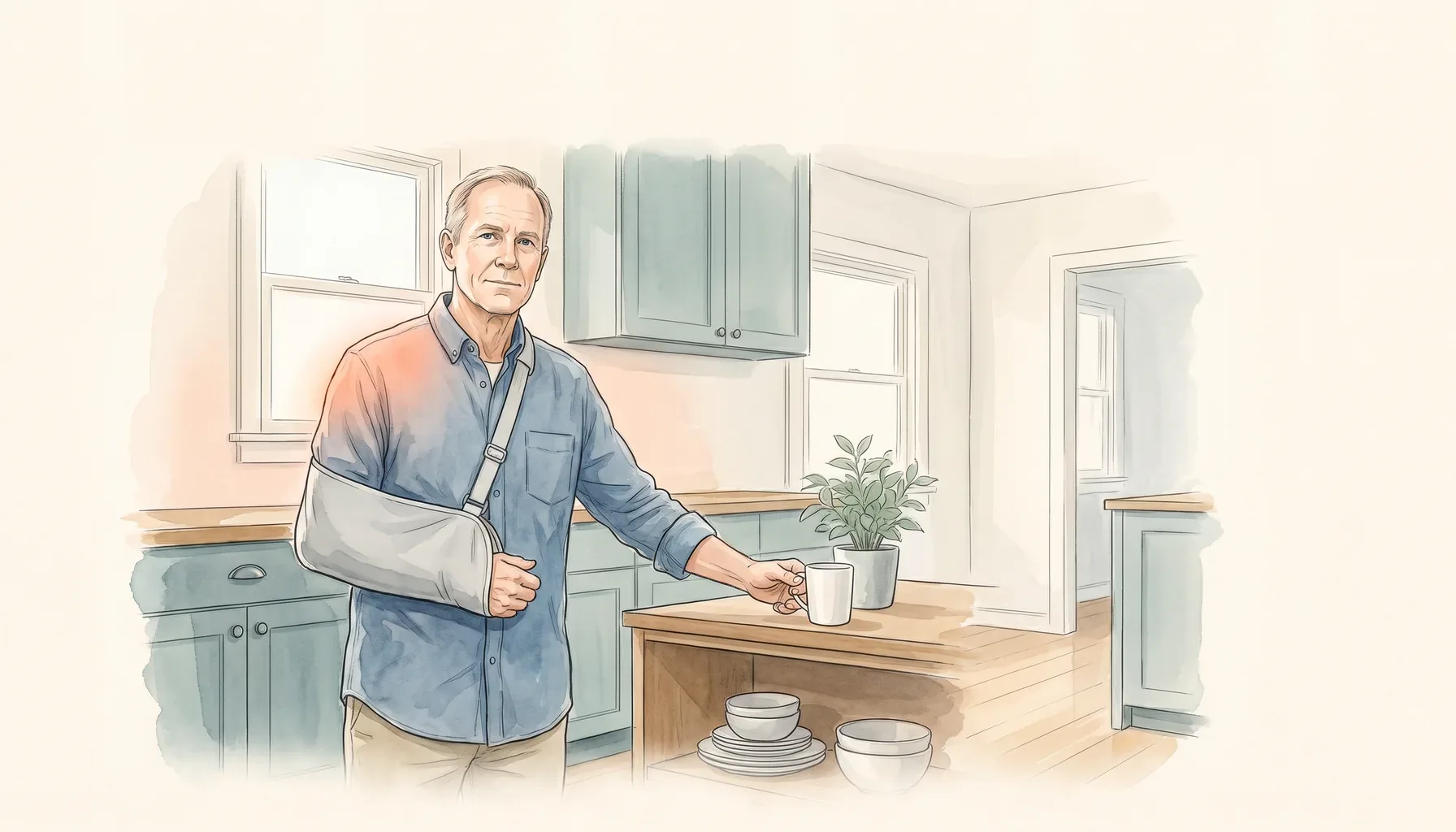
To prepare your home before shoulder surgery, set it up so you can sleep, wash, dress, eat and move around safely with one arm in a sling for several weeks. That means a raised place to sleep, everyday items moved to waist height on your good side, a bathroom you can use one handed, clear walkways and help lined up for the first two weeks.
Key takeaways
- Plan for about 4 to 6 weeks in a sling after rotator cuff repair, which is the usual range the American Academy of Orthopaedic Surgeons describes.
- Most people need help with bathing and dressing for about the first 2 weeks.
- Wearing a sling can affect balance, so clear trip hazards and add light before surgery day.
- Set up a raised sleep space and test it before your first night home.
For the full recovery timeline, from the sling to strengthening, see our rotator cuff surgery recovery guide.
Why does home setup matter after shoulder surgery?
Home setup matters because you will spend weeks doing daily tasks with one arm, and the early weeks are when the repair is most fragile. The American Academy of Orthopaedic Surgeons (AAOS) notes that the arm is usually protected in a sling for about 4 to 6 weeks after rotator cuff repair. During that time, reaching overhead, lifting or catching yourself with the repaired arm can put stress on the healing tendon.
The 2025 survey by Galetti and colleagues asked 300 patients what was hard while they were immobilized. About 84.5% had trouble sleeping, for an average of 6.5 weeks. About 51.8% needed help bathing, 47.5% needed help drying off and 71.1% needed help dressing. On average, patients needed help for 10.5 days to bathe, 11.5 days to dry off and 14.8 days to dress before they could manage alone. The authors concluded that telling patients about these challenges ahead of time helps set expectations.
Balance is another reason to plan. In a 2013 study by Lui and colleagues, 42 healthy young adults were tested on a balance machine. People wearing a shoulder sling had lower balance scores than people without one, and almost one third of sling wearers showed a drop in balance. Imbalance was more common when the sling was on the nondominant arm. The volunteers were young and healthy, and the study did not test older adults after surgery.
How to set up your bedroom
Set up a place to sleep with the upper body raised and the repaired arm supported. A 2026 review of sleep after shoulder surgery by Kunze and colleagues found that a semi-reclined position may ease pain, and that night pain appears to be the main reason sleep is disturbed.
Here is a bedroom checklist:
- Raise the upper body. Use a recliner, an adjustable base or a firm wedge or foam positioning support on the bed.
- Support the arm. Have a firm pillow ready to rest the forearm and elbow slightly in front of your body.
- Choose your side of the bed. Sleep on the side that lets you get up using your good arm.
- Light the path. Put a night light between the bed and the bathroom.
- Keep essentials close. Place water, medicine, phone, charger and glasses on a table on your good side.
If you are deciding where to sleep, our guide to choosing a recliner or a bed after shoulder surgery compares both setups. For arm position and the usual timeline, see how to sleep after rotator cuff surgery.
How to set up your bathroom
Bathing was one of the hardest tasks in the Galetti survey, and wet floors raise the risk of a slip. Set up the bathroom so you can wash and dry off with one hand while sitting or holding a stable support.
Here is a bathroom checklist:
- Add a seat. A shower chair or tub transfer bench lets you sit while you wash.
- Use a handheld shower head. It lets you rinse without turning or raising the repaired arm.
- Put down a nonslip mat. Place one inside the tub or shower and a dry, flat mat outside it.
- Move items to waist height. Keep soap, shampoo and a washcloth where your good hand can reach them.
- Switch to pump bottles. Pumps are easier to use with one hand than flip caps or screw tops.
- Plan for the incision. Ask your surgeon when you can shower and how to protect the dressing.
Many patients also find a long handled sponge useful for reaching the back and legs. Plan to have someone nearby for the first few showers, since about half of the patients in the survey needed help.
How to set up your kitchen
The kitchen is full of overhead reaching, which is one of the motions to avoid while the tendon heals. Move the items you use most to counter height or a low shelf on your good side.
Here is a kitchen checklist:
- Lower your daily items. Move plates, cups, bowls, pans and favorite foods off high shelves.
- Prepare meals ahead. Cook and freeze simple meals in single portions before surgery.
- Use light items. Swap heavy pots and pitchers for lighter ones you can lift with one hand.
How to clear walkways and reduce fall risk
Clear walkways matter because a fall can put sudden force through the repaired shoulder while it heals. Falls are also common in general: a 2012 Cochrane review by Gillespie and colleagues notes that about 30% of people over 65 who live in the community fall each year.
The same review found that home safety assessment and modification reduced the rate of falls by about 19% across six trials with 4,208 participants. These changes were more effective in people at higher risk of falling and appeared to work best when an occupational therapist carried them out. A 2026 meta-analysis by Fauziningtyas and colleagues of 10 randomized trials and 3,191 older adults found that home hazard assessment and modification lowered the odds of falling and of falls that needed medical care.
Here is a walkway checklist:
- Remove or tape down loose rugs.
- Move cords, clutter and low furniture out of walking paths.
- Add lighting in hallways, stairs and the path to the bathroom.
- Check that stair rails are secure, and plan to hold the rail on your good side.
- Wear shoes with closed backs and nonslip soles.
If your surgeon or hospital offers a home safety visit from an occupational therapist, ask about it before surgery.
How to prepare your clothes and daily routine
Dressing was the task that needed help the longest in the Galetti survey, at about 2 weeks on average. Clothing that is easy to put on with one arm can make this easier.
Here is a dressing checklist:
- Set out loose button front shirts, zip front tops or tops with wide armholes.
- Choose pants with elastic waists and slip on shoes.
- Learn the usual method of dressing the repaired arm first and undressing it last, and ask your therapist to show you.
A sling strap can press on the neck after a few days. If that becomes a problem, ask your care team about ways to make the sling more comfortable without changing how it supports the arm. Our guide on how long you wear a sling after rotator cuff surgery covers what sets that timeline.
How to plan for ice, pain and help at home
Cold therapy. Ask your surgeon whether to use ice or a cold therapy device. In a 1996 randomized study by Speer and colleagues, 50 patients had shoulder stabilization, rotator cuff repair or total shoulder replacement, and half used a cold therapy device after surgery. The cold therapy group had less pain and slept better on the night of surgery, and by day 10 they reported less pain and swelling. Keep ice packs or gel packs in the freezer and a thin cloth to protect the skin.
Help at home. Arrange for someone to stay with you or check in often for at least the first several days. The Galetti survey suggests most people need hands on help with bathing and dressing for about 2 weeks.
Rides. You will not be able to drive home after surgery, and driving with the arm in a sling is a safety concern. Line up rides to follow up visits and therapy.
For more questions people ask before and after the operation, see common questions before and after shoulder surgery. For what is usually allowed in the early weeks, see what you can do 2 weeks after rotator cuff surgery.
When to call your doctor
Call your surgeon or care team promptly if you notice:
- Fever, chills, or redness, warmth or drainage at the incisions
- Pain that keeps getting worse and does not ease with your prescribed plan
- Numbness, tingling, color change or coldness in the hand or fingers
- Swelling in the arm or hand that does not go down with elevation
- A fall onto the shoulder, a sudden pop or a new loss of strength
- Calf pain or swelling, chest pain or shortness of breath, which need emergency care
How RangeMaster products fit
The SlingThing v2 Off-The-Neck Arm Sling Adapter is designed to work with the sling your clinician prescribed and can help move sling weight off the neck and across the torso. It comes in S/M and L/XL sizes and does not replace the sling.
The Shoulder Compression Wrap is designed to hold a cold or warm pack around the shoulder, which can help when your surgeon recommends cold therapy at home.
When your surgeon or therapist clears you to start exercises, the Shoulder Kit Classic brings together a shoulder pulley, a collapsible ShoulderWand, a ShoulderFit resistance exerciser and an English and Spanish patient guide in one bag. Setting it up before surgery means it is ready when your plan calls for it. None of these products replaces the sling, the exercises or the timeline your surgeon prescribes.
Related reading
- Rotator cuff surgery recovery guide
- Recliner or bed after shoulder surgery
- How do you sleep after rotator cuff surgery?
- Common questions before and after shoulder surgery
Your next step
Pick one room a day for the week before surgery, starting with the bedroom and bathroom. Set up the raised sleep space, move daily items to waist height and clear the walkways. If you want your home exercise tools ready for when your therapist gives the go ahead, take a look at the Shoulder Kit Classic.
Common questions
How far ahead should I prepare my home for shoulder surgery?
Many people start about a week before surgery and finish the setup a few days ahead. That leaves time to test the sleep space, move kitchen items and fill prescriptions while you still have both arms.
Do I need someone to stay with me after shoulder surgery?
Most people benefit from help at home for at least the first several days. In a survey of 300 patients, people needed help with bathing and dressing for about 10 to 15 days on average.
Where should I sleep the first night after shoulder surgery?
Sleep where you can keep your upper body raised and your arm supported, such as a recliner or a bed with a wedge. Make sure you can get up safely using your good arm.
What should I buy before shoulder surgery?
Common items include a shower chair, a handheld shower head, a nonslip bath mat, pump bottles, loose front opening shirts, a night light and ice packs. Ask your surgeon which items fit your procedure.
Medical disclaimer
The information in this article is for general education only. It is not medical advice, diagnosis, or treatment, and reading it does not create a provider-patient relationship with RangeMaster. Recovery plans differ from person to person. Talk with your surgeon, physician, or physical therapist before you start, stop, or change any exercise, product, or treatment, and follow their instructions when they differ from anything you read here.
If you think you are having a medical emergency, call 911 or your local emergency number right away.
RangeMaster makes and sells the products linked in this article. Full medical disclaimer.
Sources
- Galetti TC, Sheth MM, Branche GC 3rd, Press CM, Narvaez MV, Novak DJ, et al. Challenges with sling use following shoulder surgery: the patients' perspective. JSES Int. 2025;9(4):1385-1389. doi:10.1016/j.jseint.2025.04.016 https://pubmed.ncbi.nlm.nih.gov/40959033/
- Lui DF, Memon A, Kwan S, Mullett H. Computerized dynamic posturography analysis of balance in individuals with a shoulder stabilization sling. Eur J Trauma Emerg Surg. 2013;39(6):635-639. doi:10.1007/s00068-013-0309-z https://pubmed.ncbi.nlm.nih.gov/26815548/
- Kunze KN, Sardesai KS, Barton K, Jesse JE, Caplan BE, Alfonsi SP 3rd, Shinn D, Cole BJ. Sleep disturbance in patients undergoing shoulder surgery: a current concepts review. JSES Rev Rep Tech. 2026;6(4):100820. doi:10.1016/j.xrrt.2026.100820 https://pubmed.ncbi.nlm.nih.gov/42668460/
- Gillespie LD, Robertson MC, Gillespie WJ, Sherrington C, Gates S, Clemson LM, Lamb SE. Interventions for preventing falls in older people living in the community. Cochrane Database Syst Rev. 2012;(9):CD007146. doi:10.1002/14651858.CD007146.pub3 https://pubmed.ncbi.nlm.nih.gov/22972103/
- Fauziningtyas R, Dhamanti I, Wahyuni SD, Astuti TP, Novitasari D, Chong MC. Effectiveness of home hazard assessment and environmental modification on fall-related outcomes in older adults: a systematic review and meta-analysis. J Community Health. 2026;51(3):513-525. doi:10.1007/s10900-026-01551-4 https://pubmed.ncbi.nlm.nih.gov/41874897/
- Speer KP, Warren RF, Horowitz L. The efficacy of cryotherapy in the postoperative shoulder. J Shoulder Elbow Surg. 1996;5(1):62-68. doi:10.1016/s1058-2746(96)80032-2 https://pubmed.ncbi.nlm.nih.gov/8919444/
- American Academy of Orthopaedic Surgeons. Rotator Cuff Tears: Surgical Treatment Options. OrthoInfo https://orthoinfo.aaos.org/en/treatment/rotator-cuff-tears-surgical-treatment-options/