Shoulder stiffness is one of the most common problems after breast cancer surgery and radiation. Research shows that a steady program of active exercise and stretching helps most women regain their reach, and that support from a physical therapist helps when progress stalls. Gentle motion usually starts within days of surgery, larger stretches follow about a week later, and light strength work often begins 4 to 6 weeks after surgery, once your care team gives the OK.
Key takeaways
- Shoulder restriction, arm pain and weakness are common after breast cancer treatment, and risk is highest after an axillary lymph node dissection.
- Axillary web syndrome, often called cording, can cause tight, painful cords in the underarm that limit how far you can raise your arm out to the side.
- Systematic reviews found that active exercise and combined programs of exercise and stretching improve shoulder motion and pain after surgery.
- A large UK trial found that a structured exercise program starting 7 to 10 days after surgery improved arm function at 1 year without raising complications.
- The American Cancer Society suggests asking for therapy help if you do not have full use of your arm within 3 to 4 weeks after surgery.
If swelling is your main concern, start with our breast cancer related lymphedema exercise guide. This guide focuses on shoulder motion and stiffness.
Why does the shoulder get stiff after breast cancer treatment?
The shoulder can get stiff because surgery, lymph node removal and radiation all affect the tissues around the chest wall, underarm and upper arm. Pain and protective guarding also lead many people to move the arm less in the first weeks, and less movement adds to the stiffness.
Breast cancer surgery works close to the muscles and skin that help the shoulder move. Removing lymph nodes from the underarm, called an axillary lymph node dissection, disturbs more tissue than a sentinel node biopsy, which removes only the first few nodes. Radiation can make the skin and the tissues underneath tighter over time. Our post on surgical options for breast cancer explains the main types of surgery in plain language.
The American Cancer Society (ACS) notes that radiation can affect the arm and shoulder long after treatment ends. That is why ACS stresses keeping up with exercise during and after radiation. Our post on restricted shoulder mobility after radiation looks at that link more closely.
How common are shoulder problems after breast cancer?
Shoulder and arm problems are common, and the numbers vary widely between studies because of differences in surgery, radiation and how each study measured the problem.
In a 2008 systematic review in Breast Cancer Research and Treatment, Lee and colleagues looked at 32 studies of women treated with surgery and radiation for early breast cancer. Shoulder restriction was reported in fewer than 1% up to 67% of participants. Shoulder or arm pain was reported in 9% to 68%, and arm weakness in 9% to 28%. Quality of life was high across the studies.
A 2014 systematic review in PLoS One by Hidding and colleagues reached a similar picture. Women treated with an axillary lymph node dissection were at the highest risk of reduced shoulder motion, reduced strength, pain, lymphedema and trouble with daily activities. The authors also found that radiation and hormonal therapy were the main risk factors for pain. They concluded that women who have a lymph node dissection need special attention so that arm and shoulder problems are found and treated.
What is axillary web syndrome, or cording?
Axillary web syndrome is a common condition after breast cancer surgery in which one or more thin, tight cords form under the skin of the underarm. The cords can run down the inner arm and sometimes toward the chest wall, and they often make it painful to raise the arm out to the side.
A 2015 systematic review by Yeung and colleagues in the Journal of Cancer Survivorship pooled 37 studies. Axillary web syndrome was reported in up to 85.4% of patients in some studies. Most cases appeared within the first 8 weeks after surgery, although it can also show up later than 3 months. Pain was common, and raising the arm out to the side, called abduction, was more limited than raising it forward. The review found that symptoms usually settle within 3 months, though they can last longer.
A 2018 review by Koehler and colleagues describes cording as most often becoming noticeable between 2 and 8 weeks after surgery, and notes that it can develop or come back months or years later. The authors recommend physical therapy, including manual therapy, exercise and education, to improve range of motion and ease pain.
Signs of cording include:
- A tight, rope-like or guitar string feeling in the underarm
- A visible or easy to feel cord when you raise the arm
- Pulling or pain that runs down the inner arm toward the elbow or wrist
- Trouble raising the arm out to the side or overhead
If you notice these signs, tell your surgeon or physical therapist. The research on the best treatment is still limited, and the Yeung review found that the current evidence is too thin to give firm guidance. Gentle, guided exercise within your comfort range is the approach most often described.
Does exercise help shoulder stiffness after breast cancer?
Yes. Several systematic reviews found that active exercise improves shoulder range of motion and pain after breast cancer surgery.
A Cochrane review by McNeely and colleagues pooled 24 trials with 2,132 participants. Exercise improved shoulder range of motion, and starting exercise early improved shoulder flexion, the movement of raising the arm forward and up, in the short term. The review also found that starting exercise very early increased the amount and duration of wound drainage, which is one reason your surgeon sets the timing for each step.
A 2015 systematic review by De Groef and colleagues in the Archives of Physical Medicine and Rehabilitation included 18 randomized trials. Five studies found that active exercises worked better than no therapy or written information alone. Two studies found that combining general exercise with stretching improved shoulder range of motion. The authors concluded that active exercise and multi-part programs of stretching and exercise were effective for pain and limited motion after breast cancer treatment.
The UK PROSPER trial, published in the BMJ in 2021, studied 392 women at higher risk of arm problems. One group received a physiotherapy-led program of stretching, strengthening and physical activity that started 7 to 10 days after surgery. After 1 year, that group had better arm function and less pain, with no increase in complications or lymphedema.
Exercise after breast cancer surgery: a phase by phase guide
Shoulder recovery usually moves from gentle motion in the first days, to larger stretches after about a week, to strengthening from about 4 to 6 weeks. Your surgeon and care team set your exact timing, especially if you had reconstruction or still have drains.
Phase 1: the first days after surgery
ACS describes gentle movements for the first 3 to 7 days, once your team says it is OK. These include using the affected arm for light daily tasks such as brushing your hair or eating, and raising your arms to shoulder height, or as high as you can without pulling on your drains. Deep breathing exercises are also part of this early phase.
ACS notes that some exercises should wait until drains and stitches are removed. If you are unsure whether a movement is allowed yet, ask before you try it. Our post on when you can start arm exercises after mastectomy walks through these first weeks in more detail.
Phase 2: stretching to get your reach back
ACS says larger stretches usually start a week or more after surgery. ACS describes doing each exercise 5 to 7 times, twice a day, moving slowly until you feel a gentle stretch, with no bouncing or jerky movements.
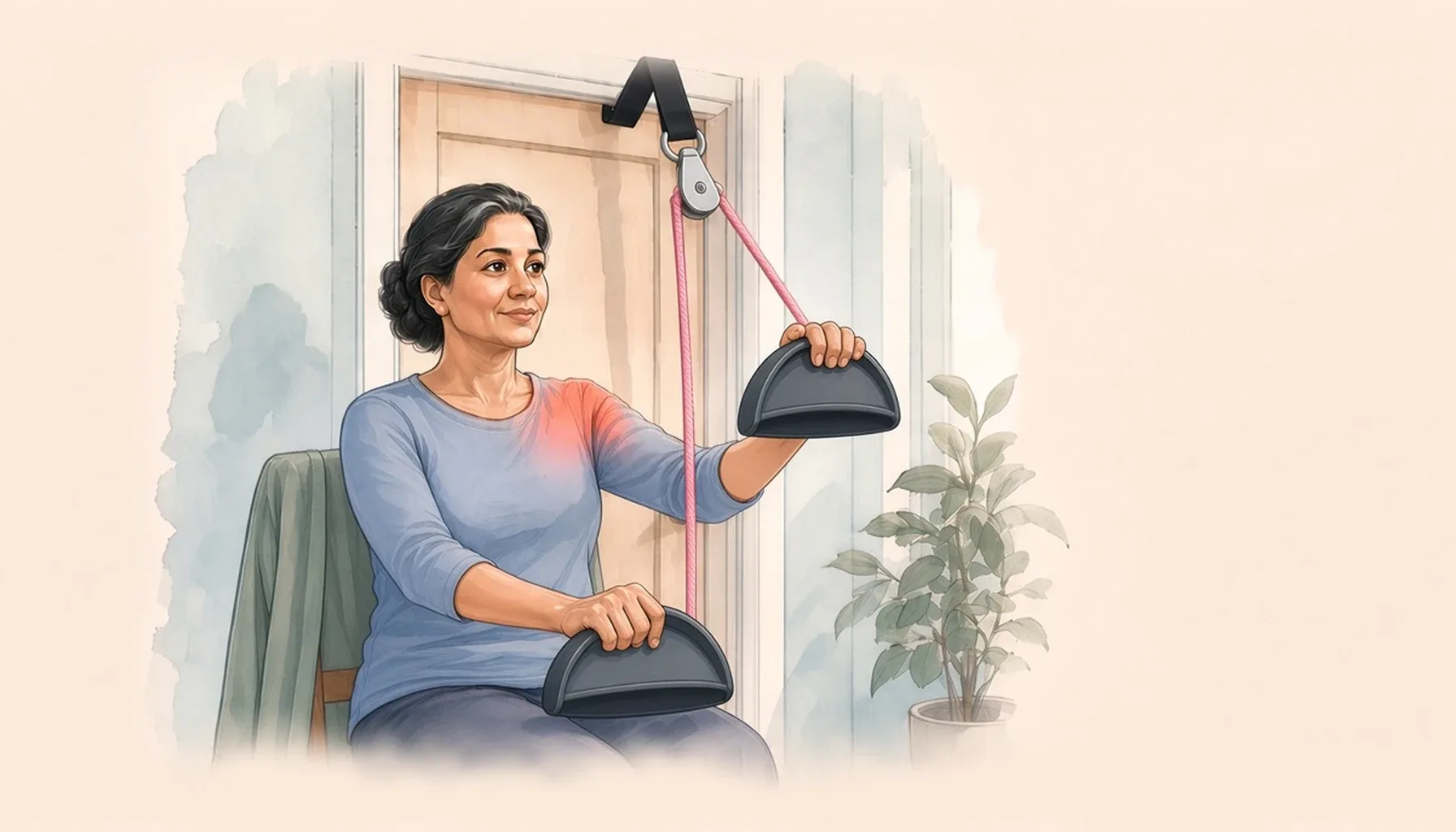
A door pulley lets your other arm help lift the affected arm, so the shoulder can move through a larger range with less effort from the healing side. Our guide on how to use a shoulder pulley shows the basic setup, and our post on shoulder flexion using pulleys shows one of the most common pulley movements.
Phase 3: strength training from about 4 to 6 weeks
ACS says strength training usually begins about 4 to 6 weeks after surgery, starting with light weights or resistance bands. In a 2012 trial by Kilbreath and colleagues, 160 women started an 8-week program of stretching and progressive resistance training 4 to 6 weeks after surgery. Compared with the control group, the exercise group gained more shoulder flexion and abduction range and more shoulder strength, and the authors reported that the program did not trigger lymphedema.
Many women worry that lifting weights will cause swelling. In the 2010 PAL trial in JAMA, Schmitz and colleagues assigned 154 survivors who had at least 2 lymph nodes removed to slowly progressive weight lifting or to no exercise. New lymphedema developed in 11% of the weight lifting group and 17% of the control group. Our post on whether exercise can raise lymphedema risk covers that research in depth.
Long term: staying active for life
The international exercise guidelines for cancer survivors, published by Campbell and colleagues in 2019, concluded that exercise is generally safe for cancer survivors and that every survivor should avoid inactivity. The guidelines found that exercise can improve fatigue, anxiety, physical function and quality of life.
When should you see a physical therapist?
ACS suggests asking for help from a physical or occupational therapist if you do not have full use of your arm within 3 to 4 weeks after surgery. A therapist can also help sooner if you notice cording, new swelling or pain that keeps you from moving.
A physical therapist can:
- Measure your shoulder motion and strength and set a starting point
- Check for cording and treat it with manual therapy and guided stretching
- Build a program that fits your surgery, reconstruction and radiation timing
- Progress your strength work safely and watch for early signs of lymphedema
The National Cancer Institute (NCI) describes a certified lymphedema therapist, or CLT, as a physical or occupational therapist trained to treat lymphedema. If swelling is also a concern, ask your team whether working with one makes sense for you. Our post on treatment of shoulder dysfunction in relation to lymphedema explains how therapists handle both problems together.
Other causes of shoulder pain to keep in mind
Shoulder pain after breast cancer is often linked to treatment, and common shoulder problems can also show up at the same time. Frozen shoulder causes a slow, painful loss of motion in all directions. A rotator cuff problem can cause pain when you lift or reach. If your pain or stiffness does not follow the usual pattern, or keeps getting worse, ask your doctor to check for these.
Our guides on everything you need to know about frozen shoulder and shoulder pain compared with frozen shoulder explain how these conditions differ. Our rotator cuff surgery recovery guide covers rotator cuff repair.
Daily habits that support shoulder recovery
A few simple habits help you keep your exercise routine going.
- Use the affected arm for light daily tasks, such as combing your hair, washing your face and eating, as your team allows.
- Do your stretches at the same times each day, so they become part of your routine.
- Move slowly and stop at a gentle stretch. Avoid bouncing or forcing the arm.
NCI also lists habits that may lower lymphedema risk, such as protecting the skin on the affected arm, staying at a healthy weight and avoiding tight sleeves or jewelry on that side.
When to call your doctor
Contact your doctor promptly if you notice:
- Shoulder motion that is getting worse
- New tight cords in the underarm or inner arm
- New heaviness, fullness or swelling in the arm, hand, fingers or chest on the surgery side
- Pain that keeps you from sleeping or doing your exercises
Call your doctor right away if you have signs of infection near your incision or in the arm, such as redness, warmth, increasing pain, swelling or fever. NCI describes cellulitis, a skin infection, as a common complication of lymphedema that can become serious.
Talk with your clinician before you start or change an exercise program.
How RangeMaster products fit
Regular range-of-motion work at home is part of many programs after breast cancer surgery. The PinkPulley Cancer Care Shoulder Pulley is designed for gentle shoulder range-of-motion work at home, with a metal door bracket and a breast cancer patient guide. Use it only within the timing, range and precautions your care team gives you.
When your team clears you for light strengthening, the Cancer Recovery Strength and Mobility Kit (Pink) can help you move, stretch and strengthen at a slow, steady pace. It includes the PinkPulley, a ShoulderWand, the ShoulderFit Resistance Exerciser, a breast cancer patient guide and a storage bag.
Related reading
Your next step
If your care team has cleared you for gentle range-of-motion work, the PinkPulley Cancer Care Shoulder Pulley can help you keep a steady home routine.
Common questions
How long does shoulder stiffness last after breast cancer surgery?
It varies. Many women regain most of their motion within a few months with regular exercise. Cording usually settles within 3 months, according to the Yeung review, though it can last longer or come back. Radiation can affect the shoulder long after treatment ends, so keep up the exercises your team gives you.
What is the best exercise for shoulder stiffness after a mastectomy?
Research supports active exercise and combined programs of stretching and exercise. The American Cancer Society describes movements such as raising the arm overhead, reaching out to the side and moving the arm behind the head, and pulley exercises are often used in the stretching phase. Your therapist will choose the right ones for your surgery.
Is it normal to feel a tight cord in my armpit after breast surgery?
Yes, it can be. Axillary web syndrome, or cording, is common after lymph node surgery and often appears 2 to 8 weeks after surgery. Tell your surgeon or therapist so they can confirm it and guide your exercises.
Can I use a shoulder pulley after breast cancer surgery?
Many therapists use pulley exercises during the stretching phase, once drains and stitches are out and your team approves larger stretches. Ask your care team before you start.
Will exercise cause lymphedema?
In the PAL trial of women at risk, slowly progressive weight lifting did not raise lymphedema rates. Start light, build slowly and report any new heaviness or swelling.
Medical disclaimer
The information in this article is for general education only. It is not medical advice, diagnosis, or treatment, and reading it does not create a provider-patient relationship with RangeMaster. Recovery plans differ from person to person. Talk with your surgeon, physician, or physical therapist before you start, stop, or change any exercise, product, or treatment, and follow their instructions when they differ from anything you read here.
If you think you are having a medical emergency, call 911 or your local emergency number right away.
RangeMaster makes and sells the products linked in this article. Full medical disclaimer.
Sources
- Lee TS, Kilbreath SL, Refshauge KM, Herbert RD, Beith JM. Prognosis of the upper limb following surgery and radiation for breast cancer. Breast Cancer Res Treat. 2008;110(1):19-37. doi:10.1007/s10549-007-9710-9 https://pubmed.ncbi.nlm.nih.gov/17899373/
- Hidding JT, Beurskens CH, van der Wees PJ, van Laarhoven HW, Nijhuis-van der Sanden MW. Treatment related impairments in arm and shoulder in patients with breast cancer: a systematic review. PLoS One. 2014;9(5):e96748. doi:10.1371/journal.pone.0096748 https://pubmed.ncbi.nlm.nih.gov/24816774/
- Yeung WM, McPhail SM, Kuys SS. A systematic review of axillary web syndrome (AWS). J Cancer Surviv. 2015;9(4):576-598. doi:10.1007/s11764-015-0435-1 https://pubmed.ncbi.nlm.nih.gov/25682072/
- Koehler LA, Haddad TC, Hunter DW, Tuttle TM. Axillary web syndrome following breast cancer surgery: symptoms, complications, and management strategies. Breast Cancer (Dove Med Press). 2018;11:13-19. doi:10.2147/BCTT.S146635 https://pubmed.ncbi.nlm.nih.gov/30588087/
- McNeely ML, Campbell K, Ospina M, et al. Exercise interventions for upper-limb dysfunction due to breast cancer treatment. Cochrane Database Syst Rev. 2010;(6):CD005211. doi:10.1002/14651858.CD005211.pub2 https://pubmed.ncbi.nlm.nih.gov/20556760/
- De Groef A, Van Kampen M, Dieltjens E, et al. Effectiveness of postoperative physical therapy for upper-limb impairments after breast cancer treatment: a systematic review. Arch Phys Med Rehabil. 2015;96(6):1140-1153. doi:10.1016/j.apmr.2015.01.006 https://pubmed.ncbi.nlm.nih.gov/25595999/
- Bruce J, Mazuquin B, Canaway A, et al. Exercise versus usual care after non-reconstructive breast cancer surgery (UK PROSPER): multicentre randomised controlled trial and economic evaluation. BMJ. 2021;375:e066542. doi:10.1136/bmj-2021-066542 https://pubmed.ncbi.nlm.nih.gov/34759002/
- Kilbreath SL, Refshauge KM, Beith JM, et al. Upper limb progressive resistance training and stretching exercises following surgery for early breast cancer: a randomized controlled trial. Breast Cancer Res Treat. 2012;133(2):667-676. doi:10.1007/s10549-012-1964-1 https://pubmed.ncbi.nlm.nih.gov/22286332/
- Schmitz KH, Ahmed RL, Troxel AB, et al. Weight lifting for women at risk for breast cancer-related lymphedema: a randomized trial. JAMA. 2010;304(24):2699-2705. doi:10.1001/jama.2010.1837 https://pubmed.ncbi.nlm.nih.gov/21148134/
- Campbell KL, Winters-Stone KM, Wiskemann J, et al. Exercise guidelines for cancer survivors: consensus statement from international multidisciplinary roundtable. Med Sci Sports Exerc. 2019;51(11):2375-2390. doi:10.1249/MSS.0000000000002116 https://pubmed.ncbi.nlm.nih.gov/31626055/
- American Cancer Society. Exercises After Breast Cancer Surgery https://www.cancer.org/cancer/types/breast-cancer/treatment/surgery-for-breast-cancer/exercises-after-breast-cancer-surgery.html
- National Cancer Institute. Lymphedema https://www.cancer.gov/about-cancer/treatment/side-effects/lymphedema