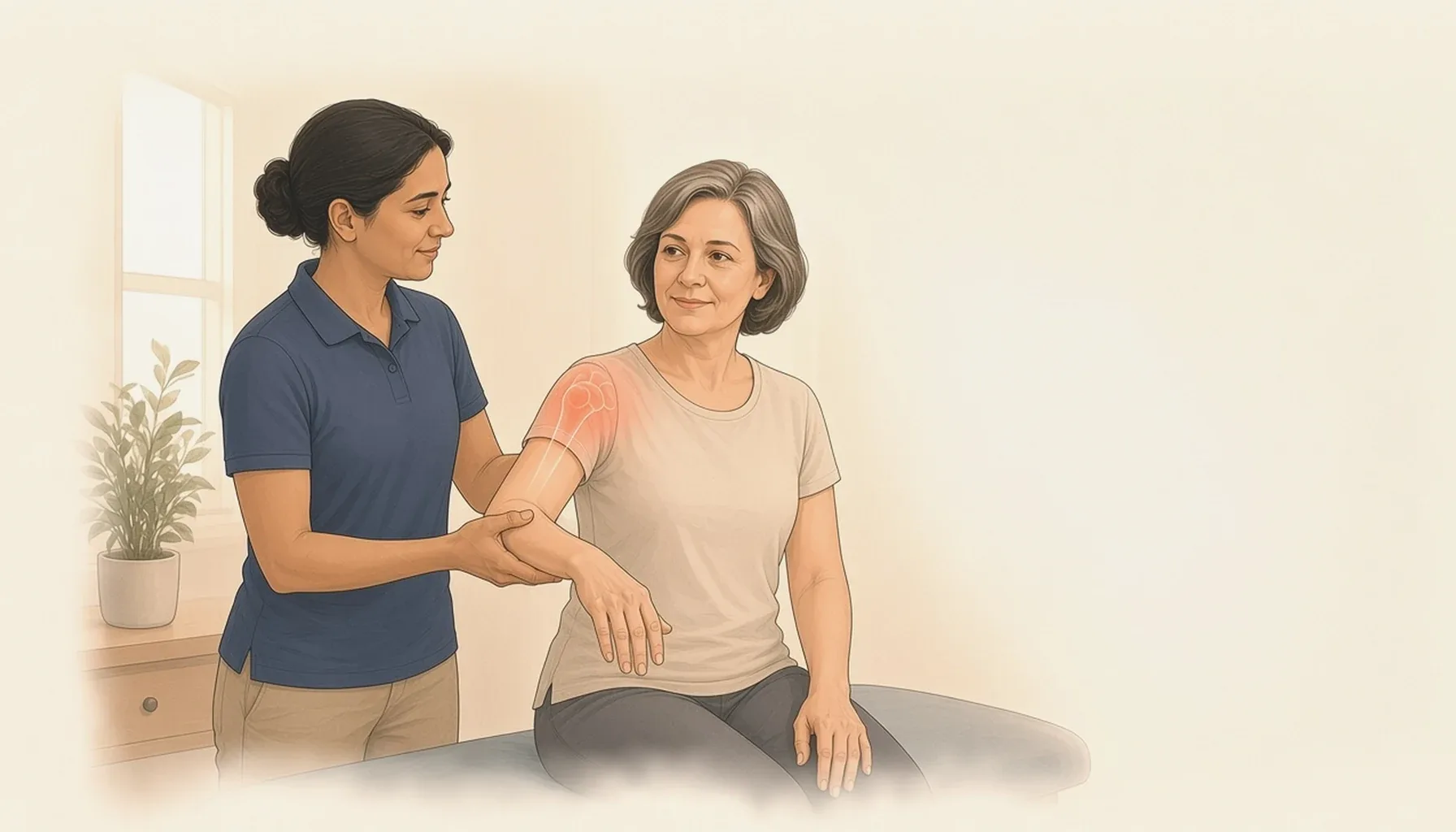
Frozen shoulder, also called adhesive capsulitis, is a condition in which the tissue around the shoulder joint becomes thick, stiff and inflamed. It causes pain and loss of motion both when you move the arm and when someone else moves it. The American Academy of Orthopaedic Surgeons (AAOS) describes 3 stages and says full recovery may take up to 3 years. Physical therapy focused on flexibility is the primary treatment AAOS recommends.
Key takeaways
- Frozen shoulder causes pain and stiffness, with limited motion both on your own and when someone else moves the arm.
- AAOS describes 3 stages: freezing, typically 6 weeks to 9 months; frozen, about 4 to 6 months; and thawing, about 6 months to 2 years.
- Full recovery may take up to 3 years. In a long-term study of 269 shoulders, 59% were normal or near normal at a mean of 4.4 years from onset, and most leftover symptoms were mild.
- It most often affects people aged 40 to 60, women more than men, and people with diabetes or thyroid conditions. It can also follow injury, surgery or a period of not moving the shoulder.
- AAOS says physical therapy focused on flexibility is the primary treatment. A 2020 review found that an early steroid injection into the joint had short-term advantages for pain and function, especially when paired with a home exercise program.
This guide focuses on duration, risk and what treatment studies show. We also have an earlier overview, everything you need to know about frozen shoulder, which many readers start with and which covers home therapy tools in a more how-to style.
What is frozen shoulder?
The shoulder is a ball and socket joint. A sleeve of connective tissue called the joint capsule surrounds it, and fluid inside the capsule helps the joint move smoothly.
In frozen shoulder, AAOS says, that capsule thickens and becomes stiff and tight. Bands of tissue called adhesions can form, and there is often less lubricating fluid in the joint. The result is pain and a shoulder that is hard to move.
The hallmark, according to AAOS, is being unable to move the shoulder either on your own (active motion) or with the help of someone else (passive motion). That second point helps tell frozen shoulder from other problems, such as a rotator cuff tear. Our post on shoulder pain vs frozen shoulder lays out those differences.
Pain is usually dull or aching, often over the outer shoulder and sometimes the upper arm. AAOS says it is typically worse early in the condition and when you move the arm.
What are the 3 stages of frozen shoulder?
AAOS describes frozen shoulder in 3 stages. The timelines overlap from person to person, and they are a guide rather than a precise clock.
Freezing
In the freezing stage, pain slowly increases and the shoulder loses range of motion as the pain worsens. AAOS says this stage typically lasts anywhere from 6 weeks to 9 months. Nights can be especially hard in this period. Our post on why frozen shoulder hurts more at night covers that pattern.
Frozen
Painful symptoms may actually improve during the frozen stage, but the stiffness remains. AAOS says this stage lasts about 4 to 6 months, and daily activities such as reaching or dressing may be very difficult.
Thawing
Shoulder motion slowly improves during the thawing stage. AAOS says a return to normal or close to normal strength and motion typically takes anywhere from 6 months to 2 years.
These stages help explain why symptoms can feel worse before they improve, and why a full course can last many months.
How long does frozen shoulder last?
AAOS says a frozen shoulder tends to get better after a period of worsening symptoms, although full recovery may take up to 3 years. Frozen shoulder generally improves over time without surgery, AAOS adds, and the focus of treatment is to control pain and restore motion and strength through physical therapy.
A 2008 study by Hand and colleagues followed 269 shoulders in 223 patients with primary frozen shoulder. The mean follow-up from symptom onset was 4.4 years (range 2 to 20 years). The mean age at onset was 53.4 years, and women were affected more often than men, at a ratio of 1.6 to 1. In the long term, 59% had normal or near normal shoulders, and 41% reported some ongoing symptoms. Most of those ongoing symptoms were mild (94%), with pain the most common leftover complaint. Six percent of the whole group had severe symptoms with pain and functional loss. People with the most severe symptoms at the start had the worst long-term outlook.
In that same study, 20% of patients reported symptoms in both shoulders, though not at the same time, and the authors found no recurrent cases in the group they followed. AAOS says frozen shoulder can come back, though this is uncommon, especially if a contributing factor such as diabetes is still present.
Many people do get back to a normal or near normal shoulder, but the timeline is long, and a minority have lasting symptoms. In the Hand study, the worst symptoms at the start were the clearest sign of a harder course.
Who gets frozen shoulder?
The causes are not fully understood. AAOS says there is no clear link to which arm you use most, or to your occupation. A frozen shoulder can happen to anyone, but some groups are at higher risk.
AAOS says it most commonly affects people between the ages of 40 and 60, and that it occurs in women more often than men. People with diabetes and thyroid conditions are at increased risk. Other medical problems AAOS lists as associated include Parkinson's disease and heart disease. Frozen shoulder can also develop after the shoulder has been held still for a period after surgery, a fracture or another injury. Moving the shoulder soon after, when a clinician says it is safe, is one step used to lower that risk.
Diabetes deserves a closer look. AAOS says frozen shoulder occurs much more often in people with diabetes, that the reason is not known, and that people with diabetes who get it tend to have more stiffness that lasts longer before thawing. A 2016 meta-analysis by Zreik and colleagues of 18 studies found that people with diabetes were 5 times more likely than controls to have adhesive capsulitis (95% confidence interval, 3.2 to 7.7). The overall prevalence of adhesive capsulitis in people with diabetes was estimated at 13.4% (95% confidence interval, 10.2% to 17.2%). Among people who already had adhesive capsulitis, the prevalence of diabetes was estimated at 30% (95% confidence interval, 24% to 37%). The authors suggested that screening for diabetes should be considered in people who present with adhesive capsulitis. That is a discussion to have with your clinician.
AAOS also notes that if you have diabetes and your hemoglobin A1C is elevated, working with your primary care clinician or endocrinologist to improve glucose control can help the shoulder recover more quickly.
How is frozen shoulder treated?
Most people improve with relatively simple treatments to control pain and restore motion, according to AAOS. Surgery is reserved for cases that do not improve with those steps.
Physical therapy and home stretching
AAOS says physical therapy, with a focus on shoulder flexibility, is the primary treatment recommendation. Exercises may be done with a physical therapist or as a home program. They include stretching and range of motion work for the shoulder. Sometimes heat is used to loosen the shoulder before stretching.
Our guide to moving a painful frozen shoulder is a practical starting point for home motion work, and it draws on a 2017 physical therapy review by Chan and colleagues. A related article reviews what setting is best for frozen shoulder range of motion exercises. Your therapist can tailor the details.
Injections and other office procedures
Cortisone, AAOS says, is a strong anti-inflammatory medicine that can be injected directly into the shoulder joint. If other nonsurgical methods do not relieve symptoms, AAOS says a clinician may recommend hydrodilatation, in which a large volume of sterile fluid is gently injected into the joint, with imaging to guide placement, to expand and stretch the capsule.
A 2020 systematic review and meta-analysis by Challoumas and colleagues in JAMA Network Open looked at 65 studies with 4,097 participants. In the short term, only a corticosteroid injection into the joint showed both statistical and clinical advantages over other options for pain and function, including no treatment or placebo and physiotherapy alone. That advantage appeared to last for as long as 6 months. Adding a home exercise program of simple stretches, and in some comparisons physiotherapy such as mobilizations, may bring added mid-term benefit. The authors suggested early use of an injection for people with frozen shoulder of less than 1 year, together with a home exercise program.
That review does not mean an injection is right for every person or that therapy is optional. AAOS still names physical therapy as the primary treatment, and the review itself says a home exercise program should accompany an injection. The decision belongs to you and your clinician.
AAOS also mentions anti-inflammatory medicines such as ibuprofen or aspirin to reduce pain and swelling. Ask your clinician before you start or change them, since those medicines have their own risks.
Procedures for stubborn cases
If therapy and other conservative methods do not relieve symptoms, AAOS says you and your doctor may discuss surgery. It is typically offered during the frozen stage. The goal is to stretch and release the stiffened capsule. The most common methods are manipulation under anesthesia, in which the shoulder is moved while you are asleep so tight tissue stretches or tears, and shoulder arthroscopy, in which a surgeon cuts through tight portions of the capsule through small incisions. The two are often combined.
After surgery, physical therapy is needed to keep the motion that was gained. AAOS says recovery times range from 6 weeks to 3 months, and that your commitment to therapy is the most important factor in returning to the activities you enjoy. Long-term results are generally good, though in some cases some stiffness remains even after several years. People with diabetes often have some continued stiffness after surgery.
How is frozen shoulder different from a rotator cuff tear?
Both can cause night pain and a limited arm, which is why the two get confused. The examination difference AAOS emphasizes is this: people with frozen shoulder have limited range of motion both actively and passively. A clinician will move your arm for you and compare that to what you can do yourself.
Imaging such as X-rays, MRI or ultrasound can help rule out other causes of stiffness and pain, including arthritis or a tendon tear. AAOS says MRI and ultrasound are not required to diagnose frozen shoulder, but they may help identify other soft tissue injuries, such as a rotator cuff tear.
If you are not sure of the cause, see our posts on shoulder pain vs frozen shoulder and why frozen shoulder hurts more at night.
When should you call a clinician?
See a doctor or a physical therapist if you notice:
- Shoulder pain and stiffness that limit dressing, reaching or sleep for more than a few weeks
- Pain and stiffness after an injury, a fall or surgery
- A shoulder that is stiff even when someone else tries to move it
- Numbness, tingling, or color or temperature change in the arm or hand
- Fever, redness or warmth over the joint, or a shoulder that quickly becomes severely painful
- Chest pain, shortness of breath or pain that travels into the jaw or left arm, which need emergency care
If you already have diabetes, thyroid disease or a recent period of immobilization, mention that at the visit.
How RangeMaster products fit
Home motion work is a large part of frozen shoulder care. The BlueRanger Shoulder Pulley is designed to help with gentle, assisted range of motion over a door, which can help you follow stretching your therapist recommends. The ShoulderWand is designed for guided stretching with both hands, and the Shoulder Finger Ladder can help with a gradual walk of the fingers up a wall. These tools may support a home program. They do not replace a diagnosis, an injection or the limits your clinician sets.
RangeMaster surveyed over 300 patients about our pulleys, and 97% of our patients who use a shoulder pulley say that they're feeling better. That is a survey of our own customers about how they felt. It does not measure tendon healing.
Related reading
- Everything you need to know about frozen shoulder
- How to move that painful frozen shoulder
- Shoulder pain vs frozen shoulder
- Why does frozen shoulder hurt more at night?
Your next step
If your shoulder is stiff and painful, and especially if someone else cannot move it much farther than you can, make an appointment with a clinician who can examine both active and passive motion. While you wait, read our earlier overview, everything you need to know about frozen shoulder, and start only the motion work your clinician has approved. If you want a simple assisted motion tool for a home program, the BlueRanger Shoulder Pulley is designed for that.
Common questions
Can frozen shoulder go away on its own?
It often improves over time, even without surgery. AAOS says a frozen shoulder tends to get better after a period of worsening symptoms, although full recovery may take up to 3 years. Physical therapy and, for some people, an injection can help with pain and motion in the meantime.
How long do the 3 stages of frozen shoulder last?
AAOS describes freezing as typically 6 weeks to 9 months, the frozen stage as about 4 to 6 months, and thawing as about 6 months to 2 years. The stages can overlap, and your timeline may be shorter or longer.
Is frozen shoulder more common if I have diabetes?
Yes. AAOS says it occurs much more often in people with diabetes, and a 2016 meta-analysis estimated that people with diabetes were 5 times more likely than controls to have it. About 13.4% of people with diabetes had adhesive capsulitis in that analysis, and about 30% of people with adhesive capsulitis had diabetes.
Does a cortisone shot help frozen shoulder?
A 2020 review found that a steroid injection into the joint had short-term advantages for pain and function compared with other options, especially when symptoms had lasted less than a year, and that a home exercise program should go with it. Ask your clinician whether it fits your situation.
Does frozen shoulder come back?
In the 2008 long-term study, there were no recurrent cases, though 20% of patients had symptoms in both shoulders at different times. AAOS says recurrence is uncommon but can happen, especially if a factor such as diabetes is still present.
Medical disclaimer
The information in this article is for general education only. It is not medical advice, diagnosis, or treatment, and reading it does not create a provider-patient relationship with RangeMaster. Recovery plans differ from person to person. Talk with your surgeon, physician, or physical therapist before you start, stop, or change any exercise, product, or treatment, and follow their instructions when they differ from anything you read here.
If you think you are having a medical emergency, call 911 or your local emergency number right away.
RangeMaster makes and sells the products linked in this article. Full medical disclaimer.
Sources
- American Academy of Orthopaedic Surgeons. Frozen Shoulder. OrthoInfo https://orthoinfo.aaos.org/en/diseases--conditions/frozen-shoulder/
- Hand C, Clipsham K, Rees JL, Carr AJ. Long-term outcome of frozen shoulder. J Shoulder Elbow Surg. 2008;17(2):231-236. doi:10.1016/j.jse.2007.05.009 https://pubmed.ncbi.nlm.nih.gov/17993282/
- Zreik NH, Malik RA, Charalambous CP. Adhesive capsulitis of the shoulder and diabetes: a meta-analysis of prevalence. Muscles Ligaments Tendons J. 2016;6(1):26-34. doi:10.11138/mltj/2016.6.1.026 https://pubmed.ncbi.nlm.nih.gov/27331029/
- Challoumas D, Biddle M, McLean M, Millar NL. Comparison of treatments for frozen shoulder: a systematic review and meta-analysis. JAMA Netw Open. 2020;3(12):e2029581. doi:10.1001/jamanetworkopen.2020.29581 https://pubmed.ncbi.nlm.nih.gov/33326025/
- Chan HBY, Pua PY, How CH. Physical therapy in the management of frozen shoulder. Singapore Med J. 2017;58(12):685-689. doi:10.11622/smedj.2017107 https://pmc.ncbi.nlm.nih.gov/articles/PMC5917053/