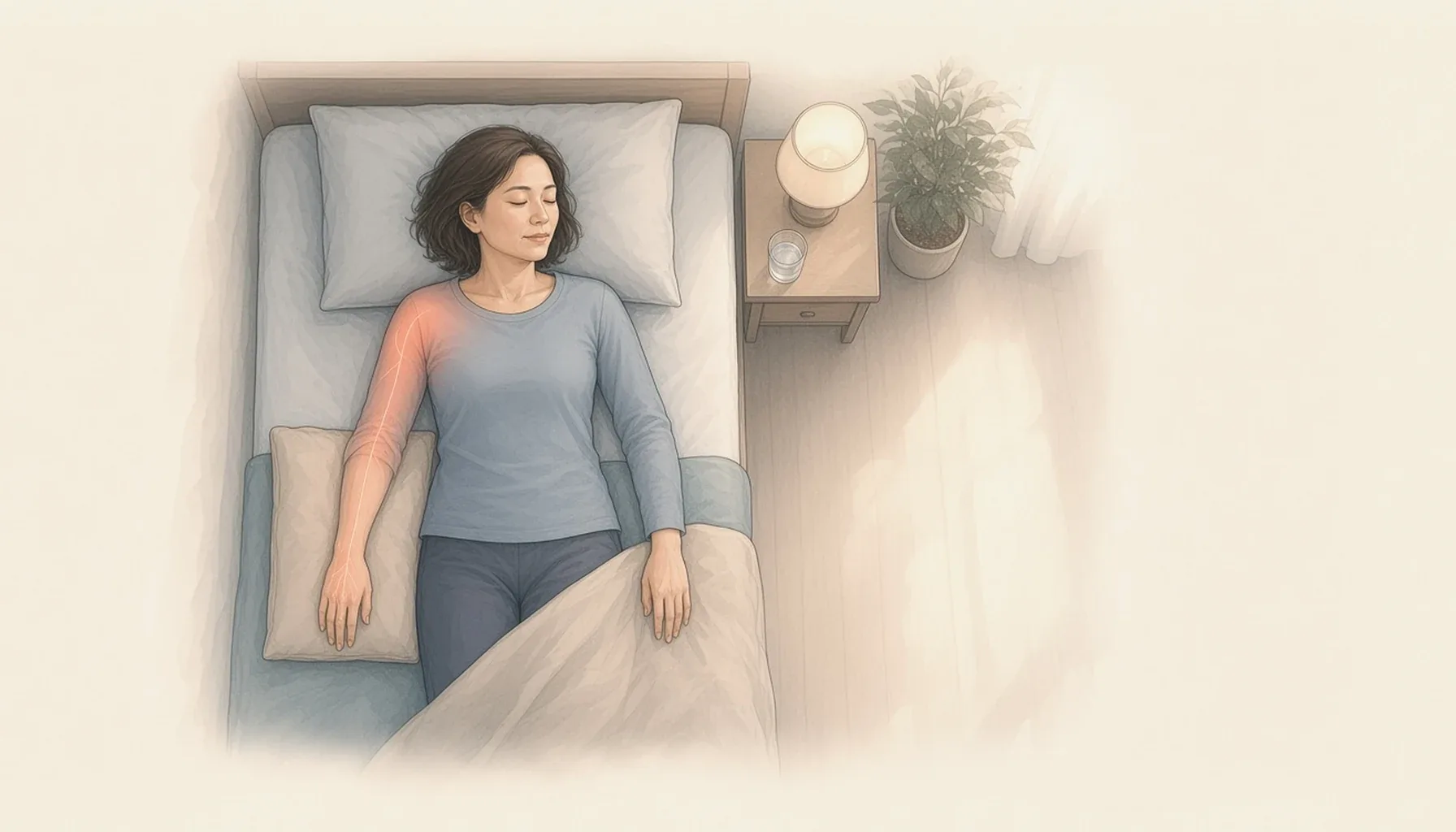
Waking at 3 a.m. with an arm that feels heavy, tingly or gone is common, and it often eases within minutes of changing position. The research we found points to pressure or stretch on a nerve as the usual route, with the wrist, elbow, shoulder and neck all possible sites. This post covers what studies say, which positions may contribute, and which signs call for a clinician.
Key takeaways
- A 2026 review in the Journal of Hand Surgery describes nerve injuries from prolonged positioning, including during sleep, that involve the radial, median and ulnar nerves and the brachial plexus. Outcomes range from a short-lived conduction block to lasting impairment.
- In a survey of 396 people, 33% had nighttime tingling or numbness in the hand at least weekly. Sleeping with the wrist flexed and a higher body mass index were linked to more frequent symptoms.
- In that same survey, side sleeping was linked to less frequent hand symptoms, so the position that bothers your shoulder may not be the one that bothers your hand.
- The American Academy of Orthopaedic Surgeons (AAOS) says nerve problems at the neck, elbow and wrist can all send numbness into the arm, and that heart disease can look similar.
- Numbness that comes with sudden weakness, chest pain, trouble speaking or a drooping face needs emergency care right away.
If your main concern is shoulder pain after dark, start with our guide to why shoulder pain gets worse at night. For a broader look at arm symptoms, see our post on shoulder pain and numbness in the arm.
What is happening when your arm goes numb?
Numbness and pins and needles are signals from a nerve that is being squeezed, stretched or irritated. A 2026 review by Fischer and colleagues in the Journal of Hand Surgery describes upper-extremity nerve palsies from prolonged positioning as a spectrum. Outcomes range from transient conduction block to irreversible functional impairment. The authors say these problems arise when the arm stays in one position long enough for sustained compression or stretch to pass the threshold for injury, and they name the radial, median and ulnar nerves and the brachial plexus, the network of nerves running from the neck into the arm, as the structures most often involved. Sleep is one of several situations they list, alongside anesthesia and intoxication, where people lose the usual protective cue to shift position.
That review addressed serious, prolonged cases. For an arm that tingles and clears in a few minutes, we found no study that measured how long a nerve can be pressed before symptoms start.
How common is nighttime tingling?
A 2019 survey by Roth Bettlach and colleagues asked 396 young adults, healthy volunteers and patients about nocturnal paresthesias, meaning tingling or numbness at night, in the hand. Thirty-three percent reported symptoms at least weekly. Two findings stood out. A higher body mass index and sleeping with the wrist flexed were both associated with more frequent symptoms. Side sleeping was associated with less frequent symptoms. In people without carpal tunnel syndrome, the link between symptoms and wrist position held up in a subgroup analysis, and the authors suggested that changing sleep position may be a useful step for people with mild compression of a nerve before it develops into carpal tunnel syndrome.
This was a survey, so it shows association only, and it asked about the hand. It does show that nighttime tingling is common and that wrist position matters.
Where the pressure can come from
Because one nerve path runs from the neck to the fingertips, numbness at night can start at several points.
The shoulder and upper arm
When you lie on your side, your body weight rests on the shoulder and the arm beneath it. A 2012 study by Kempf and Kongsted of 83 people with one sore shoulder found that 67% of those who slept on a side lay on the painful one. If you also have shoulder pain, you may be pressing that side for hours. Our post on side sleeping and shoulder pain goes into this in more detail. Sleeping with the arm raised overhead or tucked under a pillow can also stretch or press the nerves that pass the shoulder. We found no trial that tested that idea directly, so it remains a reasonable possibility.
The elbow
A 2026 narrative review by Donati and colleagues describes ulnar neuropathy at the elbow as the second most common entrapment neuropathy of the upper limb. Cubital tunnel syndrome is one form. The ulnar nerve is the one that runs behind the inner elbow, where a bump produces the "funny bone" tingle. People with elbow involvement often notice numbness in the ring and small fingers, and sleeping with the elbow bent is a commonly suggested trigger. We found no trial that confirms the sleep link. The review says conservative treatment is usually first line.
The wrist and hand
Carpal tunnel syndrome is compression of the median nerve at the wrist. A 2024 rapid evidence review in American Family Physician by Wipperman and Penny describes pain, tingling and, less often, weakness in the median nerve area, which covers the thumb, index and middle fingers. The review says that people with mild to moderate disease may be offered splinting or a local corticosteroid injection, that night-only splinting is as effective as continuous wear, and that a neutral wrist splint may be more effective than an extension splint. Those findings are about carpal tunnel syndrome. Your clinician can tell you whether your symptoms fit that pattern.
The neck
The AAOS describes cervical radiculopathy, often called a pinched nerve in the neck, as compression or irritation of a nerve where it leaves the spinal cord. It can cause pain that travels into the shoulder or arm, plus tingling, weakness or numbness. The AAOS says certain neck movements, such as extending the neck or turning the head, may increase the pain, and that some people feel relief when they place a hand on top of the head. A pillow that leaves your neck tilted for hours may be worth a look. Our guide to how to choose a pillow for shoulder pain covers height and firmness.
The AAOS also states that most people with cervical radiculopathy improve over time with nonsurgical care such as medication and physical therapy. A 2022 systematic review by Luyao and colleagues of 6 randomized trials with 464 participants found that surgery lowered pain scores faster, and its authors judged that about 3 months of conservative care can still be beneficial in the long term.
Other causes that can look the same
The AAOS lists several conditions that can mimic a pinched nerve in the neck, including thoracic outlet syndrome, scapular dyskinesis, AC joint arthritis, nerve entrapment at the elbow or wrist, and heart disease. Arm numbness is a symptom with several possible causes, and a clinician can sort out which cause fits using your history, an exam and sometimes nerve testing.
What can you try tonight?
No trial has tested pillow setups for a sleeping arm, so the steps below draw on the studies above and general comfort. Change one thing at a time and keep what helps.
- Notice which side and which fingers. Numbness in the thumb to middle fingers points toward the wrist or neck, and numbness in the ring and small fingers points toward the elbow, according to the usual nerve maps.
- Keep the wrist straight. The survey above linked a flexed wrist to more frequent symptoms. Rest your hand open beside you and avoid curling it under a pillow or your chin.
- Keep the elbow only mildly bent. Many people let the elbow fold tightly while they sleep. A loosely bent arm resting on a pillow may be more comfortable.
- Keep the arm below the shoulder. Avoid sleeping with the arm stacked overhead or pinned under your head or torso.
- Rest the top arm on a pillow. If you sleep on your side, hug a firm pillow so the upper arm is supported and does not drop forward. Our post on the best sleeping position for shoulder pain shows several arrangements.
- Try your back for a while. Lying on your back with the arms resting by your sides takes your body weight off the shoulder. Many people find it easier with a small pillow under the forearm.
Shift position when you wake with tingling and give the arm a few minutes to settle.
Can a shoulder support help?
We found no trial of a sleep pillow for arm numbness, so any case for one rests on what it is designed to do. The Shoulder Sleeper Pillow is designed to support the arm at night with a waist strap, arm strap and wrist strap, and it can help limit unwanted arm rotation while you sleep. Straps should never feel tight. If numbness or tingling gets worse with any support, stop using it and speak with your clinician, who can tell you whether it suits your condition.
When should you call a clinician?
Call your doctor or care team if you notice:
- Numbness or tingling that happens most nights for more than a couple of weeks
- Numbness that is still present after you are up and moving for the morning
- Weakness, clumsiness with buttons or a grip that feels weaker
- Neck pain that travels down the arm
- Shoulder pain that limits daily tasks, as in our guide to shoulder impingement
- Loss of feeling in a patch of skin, or visible muscle thinning in the hand
Call emergency services or go to the nearest emergency department right away for numbness that comes with chest pain, shortness of breath, pain spreading to the jaw, sudden weakness on one side, a drooping face or trouble speaking.
Related reading
- Why does shoulder pain get worse at night?
- Shoulder pain and numbness in the arm
- Does sleeping on your side cause shoulder pain?
- What is the best sleeping position for shoulder pain?
- How to choose a pillow for shoulder pain
- Shoulder impingement
Your next step
Tonight, rest your arm on a pillow with the wrist straight and the elbow only mildly bent, and note which fingers tingle if you wake. After a week, bring your notes to a clinician if the pattern continues. If you want a strap based arm support to try, take a look at the Shoulder Sleeper Pillow.
Common questions
Why does my arm go numb when I sleep on my side?
The research we found points to pressure or stretch on a nerve, at the shoulder, elbow, wrist or neck. Lying on the arm, bending the elbow or wrist for long periods and sleeping with the arm overhead are common suggestions, although few studies test them directly.
Is it dangerous if my arm falls asleep at night?
An arm that tingles and clears within a few minutes of moving is common. Symptoms that return often, last into the day, come with weakness or appear alongside chest pain or other sudden changes call for medical attention.
Which sleeping position is best to prevent arm numbness?
No trial has ranked positions. In one survey, a flexed wrist was linked to more nighttime hand symptoms and side sleeping was linked to fewer. Many people do well with the wrist straight, the elbow mildly bent and the arm supported on a pillow.
Can a pinched nerve in the neck cause arm numbness at night?
Yes. The AAOS says a pinched nerve in the neck can cause pain, tingling, weakness or numbness in the arm and hand, and that certain neck positions may make it worse. Most cases improve with nonsurgical care, and a clinician can confirm the cause.
When should I see a doctor about a numb arm?
See a clinician if numbness is frequent, lasts into the day, comes with weakness or follows an injury. Get emergency care for numbness with chest pain, trouble speaking, a drooping face or sudden one-sided weakness.
Medical disclaimer
The information in this article is for general education only. It is not medical advice, diagnosis, or treatment, and reading it does not create a provider-patient relationship with RangeMaster. Recovery plans differ from person to person. Talk with your surgeon, physician, or physical therapist before you start, stop, or change any exercise, product, or treatment, and follow their instructions when they differ from anything you read here.
If you think you are having a medical emergency, call 911 or your local emergency number right away.
RangeMaster makes and sells the products linked in this article. Full medical disclaimer.
Sources
- Fischer FS, Garg R, Elhassan B, Zhang D. Upper-Extremity Neuropathies Secondary to Prolonged Decubitus Positioning. J Hand Surg Am. 2026 (online ahead of print, Nov 10). doi:10.1016/j.jhsa.2026.09.009 https://pubmed.ncbi.nlm.nih.gov/43013382/
- Roth Bettlach CL, Hasak JM, Krauss EM, Yu JL, Skolnick GB, Bodway GN, Kahn LC, Mackinnon SE. Preferences in Sleep Position Correlate With Nighttime Paresthesias in Healthy People Without Carpal Tunnel Syndrome. Hand (N Y). 2019;14(2):163-171. doi:10.1177/1558944717735942 https://pubmed.ncbi.nlm.nih.gov/29020829/
- Kempf B, Kongsted A. Association between the side of unilateral shoulder pain and preferred sleeping position: a cross-sectional study of 83 Danish patients. J Manipulative Physiol Ther. 2012;35(5):407-412. doi:10.1016/j.jmpt.2012.04.015 https://pubmed.ncbi.nlm.nih.gov/22608285/
- Donati D, Morselli M, Ricci V, D'Auria L, Boccolari P, Tedeschi R, Vita F, Amoruso V, Tarallo L. Ulnar neuropathy at the elbow: from diagnosis to rehabilitation. Neurol Sci. 2026;47(11):872. doi:10.1007/s10072-026-09481-8 https://pubmed.ncbi.nlm.nih.gov/42897360/
- Wipperman J, Penny ML. Carpal Tunnel Syndrome: Rapid Evidence Review. Am Fam Physician. 2024;110(1):52-57 https://pubmed.ncbi.nlm.nih.gov/39028782/
- American Academy of Orthopaedic Surgeons. Cervical Radiculopathy (Pinched Nerve). OrthoInfo https://www.orthoinfo.org/en/diseases--conditions/cervical-radiculopathy-pinched-nerve/
- Luyao H, Xiaoxiao Y, Tianxiao F, Yuandong L, Wang P. Management of Cervical Spondylotic Radiculopathy: A Systematic Review. Global Spine J. 2022;12(8):1912-1924. doi:10.1177/21925682221075290 https://pubmed.ncbi.nlm.nih.gov/35324370/