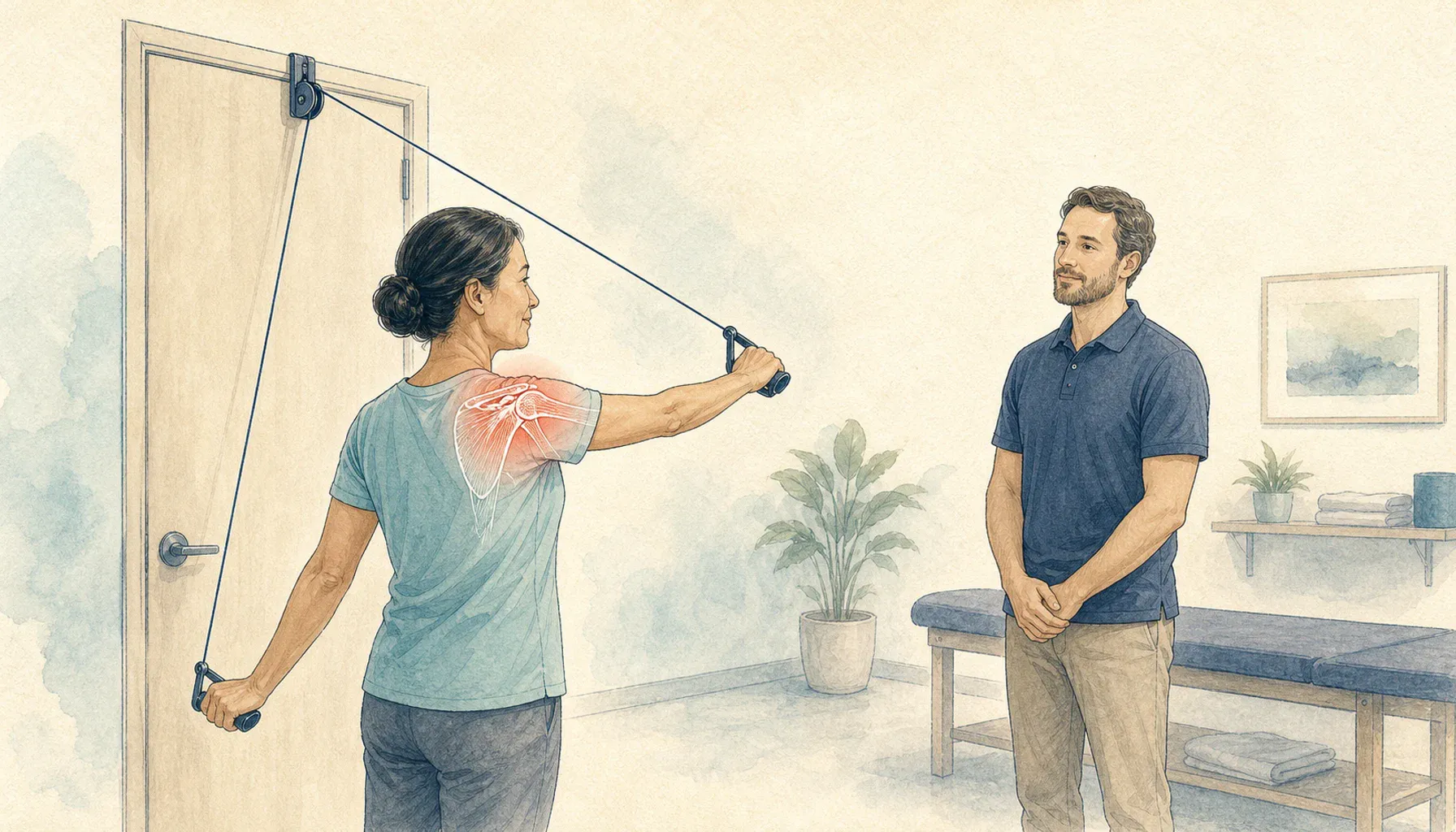
Shoulder pain 8 weeks after rotator cuff surgery can occur as the tendon continues healing and rehabilitation begins to advance. Soreness, stiffness, and fatigue after approved exercises may still be present. A sudden increase in pain, a new injury, progressive weakness, fever, wound changes, or numbness needs a call to your surgical team.
Eight weeks is still a protected stage for many repairs. Your surgeon's protocol takes priority because tear size, tissue quality, surgical technique, and additional procedures can all change what is safe.
What pain at 8 weeks can mean
| Pattern | Possible explanation | Practical response |
|---|---|---|
| Mild soreness after approved therapy | Muscles and stiff tissues adapting to movement | Track how long it lasts and tell your therapist |
| Aching with limited motion | Postoperative stiffness | Follow the prescribed mobility plan |
| Pain for days after each session | Rehabilitation load may be too high | Ask the therapist and surgeon to review the program |
| Sharp pain after a fall or sudden pull | New injury or stress to the repair | Contact the surgical team promptly |
| Increasing redness, drainage, or fever | Possible infection | Seek urgent medical advice |
The repair is still healing
Rotator cuff surgery usually secures a torn tendon back to bone. Johns Hopkins Medicine explains that the tendon begins healing to bone during the first several weeks, develops a stronger attachment over roughly three months, and continues maturing for months after that. This is why an 8-week shoulder can feel better without being ready for unrestricted lifting.
The American Academy of Orthopaedic Surgeons describes rehabilitation as a staged process. A sling and restricted arm use are common early on. Passive movement often begins before active motion. Strengthening begins only when the surgeon determines that the repair is ready. Timing varies with tear size, tissue quality, and additional procedures.
Therapy soreness and concerning pain
A short-lived ache after a newly introduced exercise can be useful information for your therapist. Record which exercise caused it, the pain level, and whether it settled by the next day. A program can often be adjusted by changing range, repetitions, assistance, or frequency.
Repeatedly forcing the arm through pain can delay progress. The AAOS advises using pain as a guide during shoulder surgery rehabilitation and warns that doing too much too soon can delay healing. Our guide to what to do when shoulder therapy is not working can help you prepare specific questions for the next visit.
Contact the surgical team for a marked change from your recent baseline, especially after a fall, forceful reach, or unexpected load. Pain alone cannot show whether a repair is intact. Your surgeon decides whether an examination or imaging is useful.
Movement tools at the 8-week stage
If your surgeon or physical therapist has cleared assisted flexion, a BlueRanger Shoulder Pulley can support the exact home exercise they prescribe. Clearance should include the starting position, allowed range, repetitions, and stopping rules. A pulley cannot assess tendon healing or replace the postoperative protocol.
The article on shoulder flexion with a pulley shows the general movement. Do not use that article to advance your own timeline after surgery. Large repairs and combined procedures may require extra protection.
After your rehabilitation team approves pulley-assisted motion, the Home Ranger, RangeMaster, and Vive pulley comparison can help you choose among handle, door attachment, and progress-marking options.
Night pain can also persist. The positioning ideas in our nighttime shoulder pain guide may help you discuss support with your care team. Follow current sling and sleep instructions, even if another position seems comfortable.
If your surgeon has approved a supported sleep setup, the MedCline and Shoulder Sleeper comparison explains the difference between a full inclined system and compact, targeted arm positioning.
When to call your surgeon
Call promptly for pain that keeps intensifying, pain that does not settle with the plan your team provided, or a sudden loss of movement or strength. Fever, chills, increasing redness, warmth, swelling, bleeding, or drainage around the incision need medical attention.
New numbness or tingling, a hand that becomes cool or discolored, significant arm swelling, chest pain, or shortness of breath also requires urgent assessment. Emergency symptoms call for emergency services.
What happens after 8 weeks
Rehabilitation usually progresses from protected motion toward active movement and later strengthening. Improvement is seldom perfectly linear. The plan should respond to your examination and the work performed during surgery.
At later stages, strength and endurance often lag behind basic motion. Our article about shoulder pain 8 months after rotator cuff surgery covers persistent symptoms after the main healing period. Pain after other procedures or farther from the operation is addressed in shoulder pain 1 year after surgery.
Common questions
Is shoulder pain normal 8 weeks after rotator cuff surgery?
Some pain, soreness, stiffness, and fatigue can still occur at 8 weeks. Your surgeon should assess pain that is worsening, severe, linked to a new injury, or accompanied by fever, drainage, new weakness, numbness, or hand color changes.
Can physical therapy cause a pain flare at 8 weeks?
Therapy can produce temporary soreness as movement advances. Pain that is intense, lasts for days, or increases after each session may mean the program needs adjustment. Tell your physical therapist and surgeon rather than pushing through it.
Can I use a shoulder pulley 8 weeks after rotator cuff repair?
Use a shoulder pulley only after your surgeon or physical therapist has cleared that movement and shown you the allowed range. Repair size, tissue quality, and the procedure performed can change the timeline.
This article provides general education and is not a diagnosis or postoperative protocol. Read our medical disclaimer. Follow the instructions from the surgeon and rehabilitation team who know what was repaired.