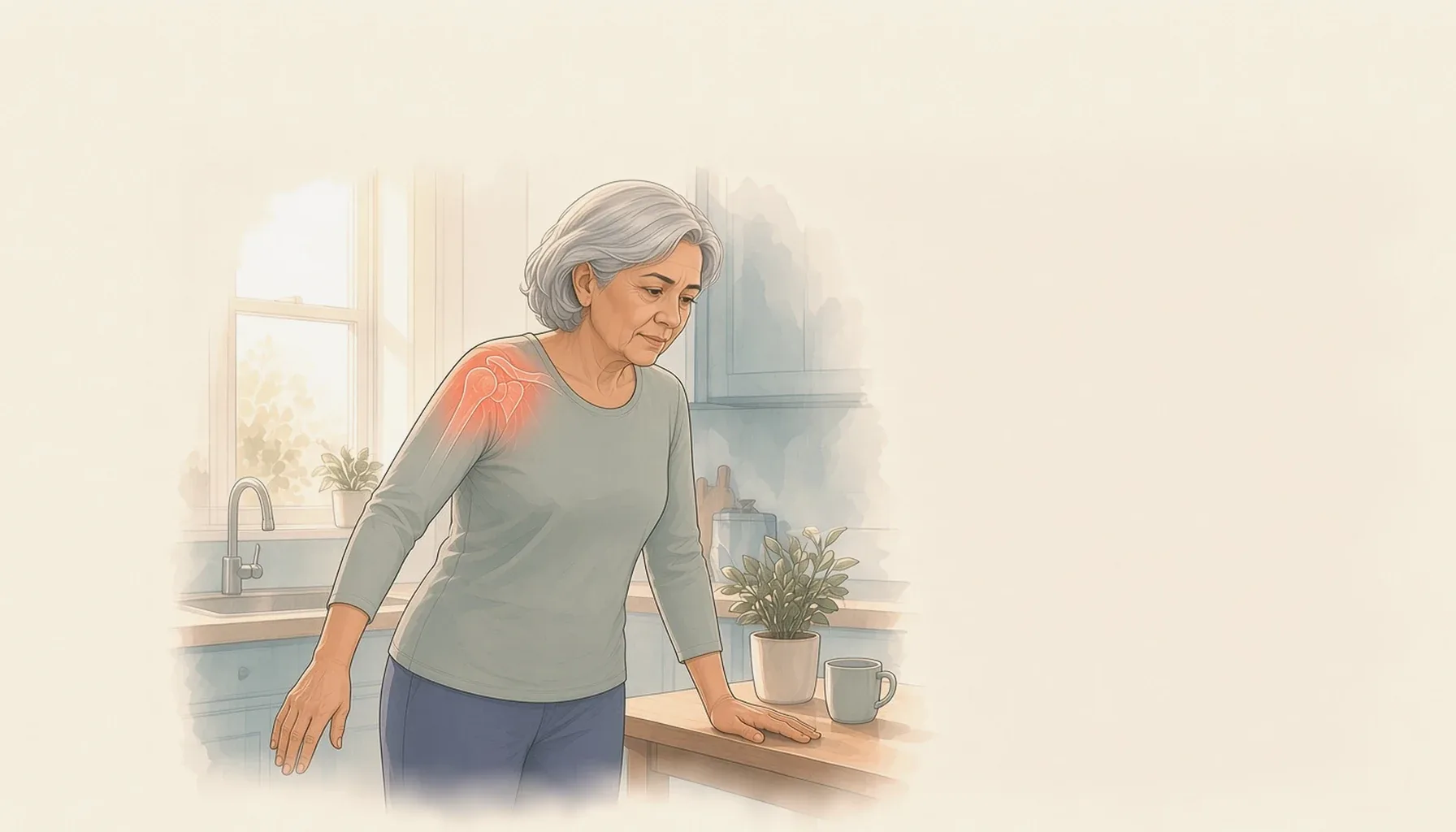
Gentle stretching and range of motion work is the main home care for frozen shoulder. The American Academy of Orthopaedic Surgeons (AAOS) calls physical therapy, with a focus on shoulder flexibility, the primary treatment recommendation. A 2017 physical therapy review describes short, gentle moves for the painful early stage, then more stretching and light strengthening as the shoulder loosens. This guide covers those exercises by stage, the research behind them and when to ask for help.
Key takeaways
- AAOS says exercises for frozen shoulder can be done with a physical therapist or as a home program.
- In the painful freezing stage, a physical therapy review advises short holds of 1 to 5 seconds in a relatively pain-free range.
- Later stages add stretching for the chest and back of the shoulder, then light strengthening.
- A 2000 study of 75 patients treated with a four-direction stretching program found that 90% reported a satisfactory outcome.
- A Cochrane review of 32 trials found that the evidence on exercise is mostly low quality, so your clinician's advice should guide your program.
For the bigger picture of the condition, see our frozen shoulder guide. This post focuses on the exercises.
Why does exercise matter for frozen shoulder?
Frozen shoulder, also called adhesive capsulitis, is a condition in which the capsule around the shoulder joint thickens and becomes stiff and tight. AAOS says the hallmark signs are severe pain and being unable to move the shoulder, either on your own or with someone else's help. The shoulder usually gets better over time, although AAOS says full recovery may take up to 3 years.
AAOS names physical therapy as the primary treatment, and it says exercises may be done with a therapist or at home. The 2017 review by Chan and colleagues in the Singapore Medical Journal says physical therapy and home exercises can be a first-line treatment, with the choice of exercise matched to the stage of the condition. The same review notes that full range of motion may never be fully restored, so steady gains are a sensible goal.
What does the research say about home stretching?
Evidence for stretching comes from several kinds of studies, and each has limits.
A 2000 study by Griggs and colleagues followed 75 patients, 77 shoulders, with phase II idiopathic adhesive capsulitis. All were treated with a four-direction shoulder stretching program, and the mean follow-up was 22 months. Sixty-four patients, 90%, reported a satisfactory outcome, and 5 patients, 7%, went on to manipulation or capsular release. On average, active forward elevation increased 43 degrees and active external rotation increased 25 degrees. The shoulder still differed from the unaffected side in pain and motion at the end. This study had no comparison group, so it cannot show that stretching caused the result.
A 2014 Cochrane review by Page and colleagues pooled 32 trials with 1,836 participants. Moderate quality evidence showed that six weeks of manual therapy plus exercise probably led to less improvement at seven weeks than a glucocorticoid injection. Differences in pain and function at six and 12 months were not clinically important. For exercise delivered on its own, the reviewers were uncertain of the effect because most evidence was low quality, and they called for better trials.
The UK FROST trial, published in The Lancet in 2020, randomized 503 adults with frozen shoulder to manipulation under anesthesia, arthroscopic capsular release, or early structured physiotherapy. The physiotherapy arm included mobilization techniques, a graduated home exercise program and a steroid injection, over up to 12 sessions in 12 weeks. At 12 months, none of the three treatments was clinically superior on the Oxford Shoulder Score.
A 2020 meta-analysis by Challoumas and colleagues covered 65 studies with 4,097 participants. It found short-term advantages for a corticosteroid injection, and it said a home exercise program should go with an injection.
Taken together, the research supports gentle motion work as a standard part of care, and it also shows that no single exercise routine has been proven best. Treat the moves below as common options and let your clinician set your program.
How do you exercise safely at home?
These habits come from the Chan review and from AAOS.
- Start with warmth if it helps. AAOS says heat is sometimes used to loosen the shoulder before stretching. Chan and colleagues say a heat or ice pack can be applied before exercises, and that moist heat combined with stretching has been shown to improve muscle extensibility.
- Stay in a comfortable range. The review warns that aggressive stretching beyond the pain threshold can result in worse outcomes, especially in the early phase.
- Keep holds short at first. In the freezing stage the review advises holds of 1 to 5 seconds in a relatively pain-free range.
- Watch your posture. The review notes that a forward shoulder posture may cost some forward and sideways motion, so sit and stand tall during exercises.
- Ask about timing. Your therapist can tell you how many repetitions and how many sessions a day suit your shoulder. We did not find a published dose that fits everyone.
What exercises fit the freezing stage?
The freezing stage is the painful one. AAOS says pain slowly increases and the shoulder loses motion. The Chan review suggests gentle mobilization within the tolerated range, including:
- Pendulum exercise. Lean forward with your good hand on a table, let the sore arm hang, and swing it in small forward and back, side to side, or circular motions, using your body weight to start the movement.
- Passive forward elevation lying on your back. Use your good hand to lift the sore arm toward the ceiling and overhead as far as it comfortably goes.
- Passive external rotation. With your elbow bent near your side, use your good hand or a stick to turn the forearm outward.
- Active assisted motion for extension, horizontal adduction and internal rotation. These use your good arm or a support to help the sore arm move through a small range.
The review also lists pulley exercises as tolerated, plus neck and scapular muscle releases. Our guide to how to use a shoulder pulley shows a basic setup. Because sleep is often affected at this stage, see why frozen shoulder hurts more at night.
What exercises fit the frozen stage?
During the frozen stage, AAOS says pain may improve while stiffness remains. Chan and colleagues say the earlier home exercises can continue within the tolerated limit, and they add more:
- Stretches for the chest and the back of the shoulder. The review says to keep these going, and it names the posterior capsule stretch as one example.
- External rotation before elevation. The review recommends rotation work first, because it can help avoid more pain and inflammation.
- Scapular retraction. Gently pull your shoulder blades toward each other. The review says this stretches the chest muscles and works as basic strengthening for the shoulder blade muscles.
- Isometric external rotation. Press the back of your hand into a wall or door frame without moving the joint. Isometric means no joint movement, and the review says it can be done without much worry about increasing pain.
Even here, the review cautions against overenthusiastic treatment, which could aggravate pain.
What exercises fit the thawing stage?
In the thawing stage, motion slowly returns. AAOS says a return to normal or close to normal strength and motion typically takes 6 months to 2 years. The Chan review says you can do more mobility work with longer holds, within tolerated limits. Strengthening can progress from isometric holds to resistance bands and later to free weights. Rotator cuff exercises, posture work and exercises for the deltoid and chest muscles can also be included.
This is a good time to ask a therapist to check your form, because the shoulder has often been weak after months of limited use. Our frozen shoulder guide explains the stages and how their timelines overlap.
Can tools help with home exercises?
Several tools are designed to help you follow a home program. The BlueRanger Shoulder Pulley is designed to help with gentle, assisted range of motion over a door, which can help you follow stretching your therapist recommends. The ShoulderWand is designed for guided stretching with both hands, similar to the wand moves described in the Chan review. The Shoulder Finger Ladder can help with a gradual walk of the fingers up a wall.
These tools may support a home program. They do not replace a diagnosis, an injection or the limits your clinician sets. We found no trial that tested a specific tool in people with frozen shoulder, so the case for them rests on what they are designed to do.
When should you call a clinician?
See a doctor or physical therapist if you notice:
- Pain or stiffness that is getting worse over weeks despite gentle exercise
- A shoulder that is stiff even when someone else tries to move it, and you have not had an exam
- Exercise that leaves pain much worse for hours afterward
- Numbness, tingling, fever or redness
- Symptoms that began after an injury or a fall
- Chest pain, shortness of breath or pain that travels into the jaw or left arm, which need emergency care
Related reading
- Frozen shoulder guide
- How to move that painful frozen shoulder
- How to use a shoulder pulley
- Shoulder pain vs frozen shoulder
- Why does frozen shoulder hurt more at night?
Your next step
This week, pick two or three of the gentle moves above and ask your clinician to confirm they suit your stage. Keep each session short and comfortable. If you want a simple way to add assisted motion at home, the BlueRanger Shoulder Pulley is designed for that.
Common questions
What are the best exercises for frozen shoulder at home?
There is no single proven best routine. A 2017 physical therapy review suggests pendulum swings, passive forward elevation and passive external rotation early on, then stretches for the chest and back of the shoulder, scapular retraction and isometric holds later.
How often should I do frozen shoulder exercises?
We did not find a published schedule that fits everyone. Ask your therapist for a plan that matches your pain and stage. The Chan review advises short holds of 1 to 5 seconds in the painful stage.
Should frozen shoulder exercises hurt?
They should stay in a relatively pain-free range. The review says aggressive stretching beyond the pain threshold can result in worse outcomes, especially early on.
Can exercise alone fix a frozen shoulder?
AAOS says physical therapy is the primary treatment, and a 2000 study found that 90% of 75 patients reported satisfactory outcomes after a stretching program. That study had no comparison group. Some people also need an injection or a procedure, so talk with your clinician.
Should I use heat before stretching?
AAOS says heat is sometimes used to loosen the shoulder before stretching, and the Chan review says moist heat with stretching has been shown to improve muscle extensibility. Check your skin and follow your clinician's advice.
Medical disclaimer
The information in this article is for general education only. It is not medical advice, diagnosis, or treatment, and reading it does not create a provider-patient relationship with RangeMaster. Recovery plans differ from person to person. Talk with your surgeon, physician, or physical therapist before you start, stop, or change any exercise, product, or treatment, and follow their instructions when they differ from anything you read here.
If you think you are having a medical emergency, call 911 or your local emergency number right away.
RangeMaster makes and sells the products linked in this article. Full medical disclaimer.
Sources
- American Academy of Orthopaedic Surgeons. Frozen Shoulder. OrthoInfo https://orthoinfo.aaos.org/en/diseases--conditions/frozen-shoulder/
- Chan HBY, Pua PY, How CH. Physical therapy in the management of frozen shoulder. Singapore Med J. 2017;58(12):685-689. doi:10.11622/smedj.2017107 https://pmc.ncbi.nlm.nih.gov/articles/PMC5917053/
- Griggs SM, Ahn A, Green A. Idiopathic adhesive capsulitis. A prospective functional outcome study of nonoperative treatment. J Bone Joint Surg Am. 2000;82(10):1398-1407. doi:10.2106/00004623-200010000-00005 https://pubmed.ncbi.nlm.nih.gov/11057467/
- Page MJ, Green S, Kramer S, Johnston RV, McBain B, Chau M, Buchbinder R. Manual therapy and exercise for adhesive capsulitis (frozen shoulder). Cochrane Database Syst Rev. 2014;(8):CD011275. doi:10.1002/14651858.CD011275 https://pubmed.ncbi.nlm.nih.gov/25157702/
- Rangan A, Brealey SD, Keding A, et al. Management of adults with primary frozen shoulder in secondary care (UK FROST): a multicentre, pragmatic, three-arm, superiority randomised clinical trial. Lancet. 2020;396(10256):977-989. doi:10.1016/S0140-6736(20)31965-6 https://pubmed.ncbi.nlm.nih.gov/33010843/
- Challoumas D, Biddle M, McLean M, Millar NL. Comparison of treatments for frozen shoulder: a systematic review and meta-analysis. JAMA Netw Open. 2020;3(12):e2029581. doi:10.1001/jamanetworkopen.2020.29581 https://pubmed.ncbi.nlm.nih.gov/33326025/