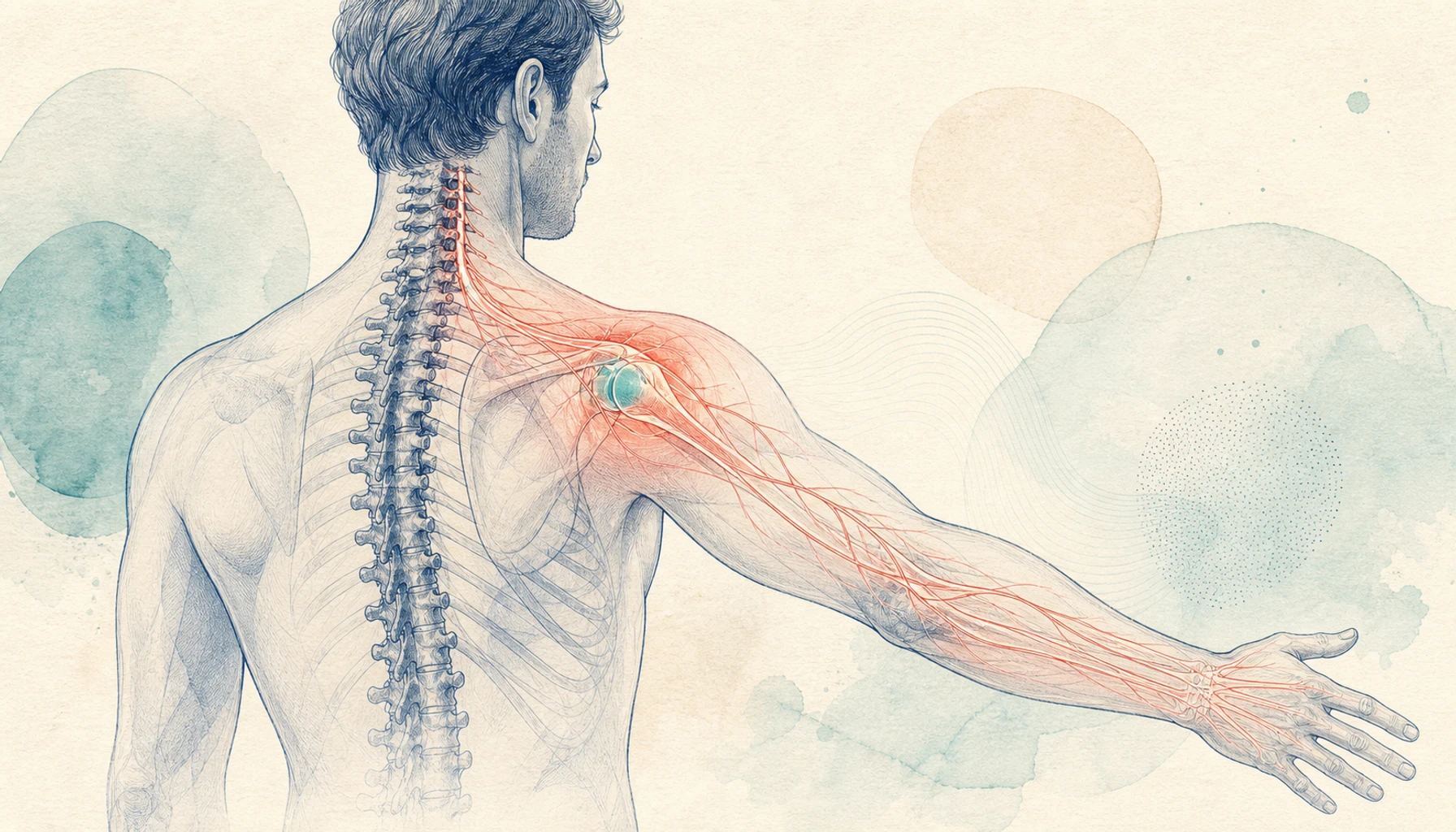
A shoulder condition usually hurts most with shoulder movement. Cervical radiculopathy often starts in the neck and sends sharp or burning pain into the shoulder and arm, sometimes with tingling, numbness, reflex changes, or weakness. The patterns overlap, so clinicians often examine both areas.
A rotator cuff injury and cervical radiculopathy can also occur together. The physical examination helps identify which movements reproduce symptoms and whether a nerve pathway is affected.
Shoulder pain vs cervical radiculopathy
| Clue | Shoulder condition | Cervical radiculopathy |
|---|---|---|
| Where pain begins | Shoulder or outer upper arm | Often the neck, shoulder blade, or shoulder |
| What changes it | Lifting, reaching, rotation, or lying on the shoulder | Some neck positions or movements |
| How far it travels | Often into the upper arm | Can reach the forearm, hand, or fingers |
| Tingling or numbness | Uncommon in an isolated tendon or bursa problem | Common possible symptoms |
| Weakness | May affect a painful shoulder movement | May follow a nerve-root pattern into the arm or hand |
| Exam focus | Shoulder motion, strength, tenderness, and stability | Neck motion, sensation, reflexes, and strength |
Clues that point toward the shoulder
Rotator cuff problems commonly hurt when lifting or lowering the arm. Pain may be felt over the outer shoulder and upper arm, and lying on that side can be uncomfortable. Weakness may show up during lifting or rotation. The guide to rotator cuff anatomy and function explains the role of these tendons.
Arthritis can cause a deep ache, stiffness, and grinding. Frozen shoulder creates pain with a significant loss of motion. Bursitis and impingement often make overhead reaches painful. Each of these conditions has its own examination pattern, described more broadly in common causes of shoulder discomfort.
Clues that point toward cervical radiculopathy
Cervical radiculopathy begins when a nerve root in the neck is compressed or inflamed. A herniated disc and age-related changes in the cervical spine are common causes. Pain may feel sharp, burning, or electric and extend down one arm.
Turning or extending the neck can increase symptoms in some people. Tingling, pins and needles, numbness, or weakness may affect the arm, hand, or fingers. The exact distribution can help guide an examination, though it cannot identify a nerve root with certainty at home.
Read shoulder pain with hand tingling for nerve-pathway possibilities. Our article on shoulder pain traveling down the arm explains how the distance and quality of radiating pain can help describe the problem.
How clinicians tell them apart
The examination may begin with the neck, shoulder, arm, and hand. A clinician compares active and passive shoulder motion, tests rotator cuff strength, and checks for painful shoulder positions. Neck movement, arm sensation, muscle strength, and reflexes help evaluate cervical nerve function.
No single maneuver answers every case. The clinician interprets the tests as a group. A shoulder injection is sometimes used diagnostically in specialist care. Imaging is selected when it may change management. Shoulder X-rays can show arthritis or bone changes. Cervical MRI can show discs and nerve structures, though scan findings must match the symptoms and examination.
Electrodiagnostic tests may help when the source remains unclear or when a peripheral nerve disorder is also possible. These tests are not required for every episode.
Safe next steps
Reduce activities that clearly provoke symptoms and avoid forceful stretching. Keep the shoulder and neck gently mobile within a comfortable range unless a clinician has given different instructions. Stop an exercise that causes spreading pain, tingling, numbness, or increasing weakness.
If a clinician or physical therapist has prescribed assisted shoulder mobility, a BlueRanger Shoulder Pulley can support that home program. It cannot diagnose or treat cervical radiculopathy, spinal cord compression, or an acute nerve injury. Use it only for the movement and range your clinician recommends.
Our guide to gentle shoulder exercise starting points is general education. Diagnosis-specific advice is especially important when numbness or weakness is present.
When symptoms need prompt or emergency care
Arrange an evaluation for persistent radiating pain, repeated tingling, numbness, or weakness. Seek prompt care if weakness is increasing, you are dropping objects, walking feels unsteady, or symptoms began after a significant neck injury. Problems with balance, hand coordination, or bladder or bowel control can signal spinal cord involvement and need urgent assessment.
Call emergency services for sudden one-sided weakness or numbness, facial drooping, or speech difficulty. Shoulder or arm discomfort with chest pressure, shortness of breath, sweating, nausea, or lightheadedness can be a heart emergency.
Common questions
Can cervical radiculopathy feel like a rotator cuff injury?
Yes. Both can cause shoulder and upper-arm pain and weakness. Hand tingling, numbness, reflex changes, and pain affected by neck motion support a nerve evaluation. Shoulder-specific pain during lifting supports a shoulder examination.
Can a shoulder problem and cervical radiculopathy happen together?
Yes. Coexisting conditions are possible, especially when symptoms have developed over time. Examining both the neck and shoulder helps prevent one source from being overlooked.
Does cervical radiculopathy always cause neck pain?
No. Arm or shoulder pain can be the dominant symptom. Tingling, numbness, weakness, and the examination findings can still indicate a cervical nerve source.
This article provides general education and is not a diagnosis or rehabilitation plan. Read our medical disclaimer. A qualified clinician can examine the neck, shoulder, strength, sensation, and reflexes to identify the likely source.