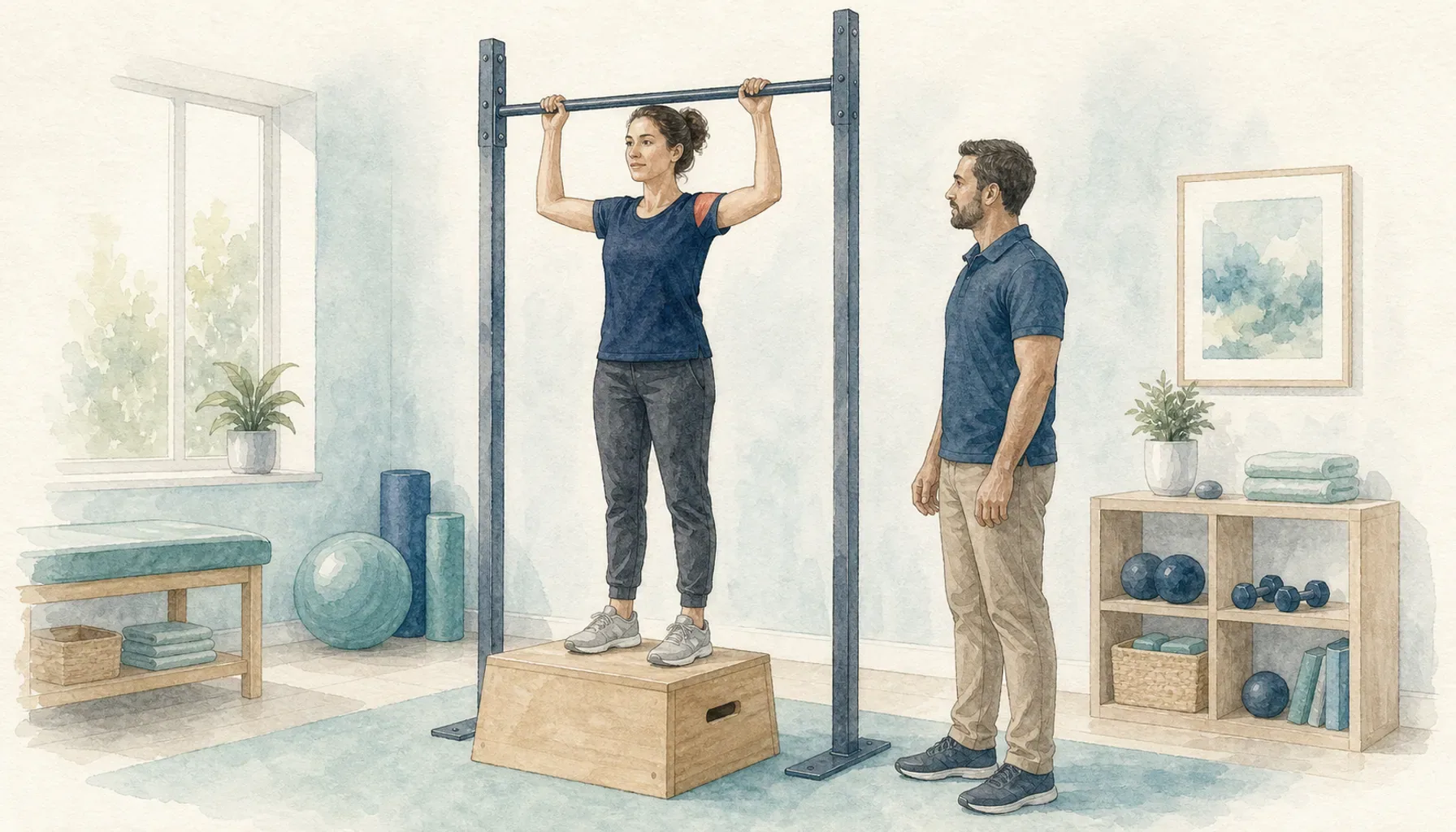
If a dead hang causes shoulder pain, come off the bar and do not keep hanging to force a stretch. Dead hangs place body weight through the hands into an overhead shoulder position. There is not enough direct clinical research to prescribe them as a general treatment for shoulder pain, and the exercise can be unsuitable for instability, a recent injury, tendon damage, nerve symptoms, or postoperative restrictions.
Some people describe a comfortable stretch during hanging. That experience does not establish that hanging will treat a painful shoulder. A safe decision depends on why the shoulder hurts, whether full overhead motion is available, and how much load the tissues can currently tolerate.
Read the signal before hanging again
| What you feel | What it may suggest | Response |
|---|---|---|
| Broad effort in both shoulders and grip | Expected muscular work may be present | Keep the dose short and technically controlled |
| Sharp pain at the front or top of one shoulder | Tendon, joint, or other tissue irritation | Stop and have recurrent pain assessed |
| Clunking with a sense of slipping | Possible instability | Avoid hanging and seek an evaluation |
| Tingling or numb fingers | Nerve irritation or pressure | Come down immediately and track the distribution |
| Sudden weakness after a painful event | Possible acute injury | Arrange prompt medical care |
What a dead hang asks of the shoulder
During a dead hang, the shoulder is elevated overhead while the grip supports much of your body weight. The rotator cuff, shoulder blade muscles, joint capsule, tendons, and nervous system all contribute to control. Relaxing completely changes the load distribution, while an active hang asks the shoulder blade muscles to maintain more control.
Neither version is automatically therapeutic. The American Academy of Orthopaedic Surgeons conditioning program uses gradual, diagnosis-aware stretching and strengthening and advises that exercises should not hurt. Its pendulum exercise lets the arm hang while the other arm supports the body. A pendulum is not equivalent to a bar hang because the painful arm does not carry body weight.
If you are sorting out exercise discomfort, compare shoulder pain vs soreness. Our guide to which exercise fits shoulder pain explains why a tendon problem, frozen shoulder, arthritis, and nerve pain need different loading choices.
Who should avoid dead hangs
Do not use dead hangs as self-treatment after a recent dislocation, fracture, significant fall, or sudden tearing sensation. Chronic shoulder instability can cause repeated slipping or a loose feeling. AAOS guidance emphasizes restoring stability through an individualized program and sometimes surgery, depending on the injury and recurrence.
A recent rotator cuff or labral surgery has strict healing and loading stages. Full body-weight hanging should wait for explicit clearance from the surgeon or physical therapist. The same applies after a shoulder replacement.
Pause hanging when symptoms include night pain, meaningful weakness, loss of active motion, numbness, tingling, or neck pain that travels into the arm. Read why shoulder pain can go down the arm and shoulder pain with tingling fingers before trying to load through those symptoms.
A lower-load progression
If a clinician has cleared hanging, begin with feet on the floor or a box so the legs control how much weight reaches the shoulders. Use a stable bar, dry hands, and a position you can exit immediately. Start with a very short hold. Stop for sharp pain, slipping, electrical symptoms, or loss of control.
Progress only one factor at a time: duration, number of holds, or percentage of body weight. Do not jump from feet-supported work to fatigue-length full hangs. A qualified physical therapist or strength coach can assess overhead range, shoulder blade control, grip, and response the next day.
If assisted overhead motion has been prescribed instead, a BlueRanger Shoulder Pulley lets the other arm help guide the affected shoulder through a clinician-selected range. It carries a very different load from a dead hang and cannot diagnose or treat a tear or instability. The general movement is shown in our guide to shoulder flexion using a pulley.
When pain needs evaluation
Arrange care when pain returns each time you hang, persists into daily tasks, wakes you at night, or comes with weakness. A clinician may examine active and passive motion, rotator cuff strength, stability, the neck, sensation, and reflexes. Imaging is selected only when the history and examination indicate it.
Seek prompt care after an injury if you cannot raise the arm, the shoulder appears deformed, or swelling is substantial. A cold, pale, blue, or numb arm also requires urgent attention. Call emergency services for shoulder or arm pain with chest pressure, shortness of breath, sweating, nausea, or faintness.
Common questions
Are dead hangs good for shoulder pain?
There is not enough direct clinical evidence to recommend dead hangs as a general treatment for shoulder pain. A hang may feel comfortable for some trained people, but it places substantial load through an overhead shoulder position and can aggravate instability, tendon injury, or nerve symptoms.
Why does my shoulder hurt when I dead hang?
Possible reasons include insufficient tolerance for full body weight, rotator cuff or biceps tendon irritation, limited overhead motion, instability, a labral problem, or nerve symptoms. Pain location alone cannot identify the cause.
Can I try a partial dead hang instead?
A feet-supported hang reduces the amount of body weight on the arms, but it is still an overhead loading exercise. Try it only after a clinician or qualified coach confirms that hanging fits your shoulder and gives you a progression and stopping rules.
This article provides general education and is not a diagnosis, exercise prescription, or clearance to hang. Read our medical disclaimer. A clinician can evaluate shoulder stability, tendon function, nerves, and safe loading.
Sources
- American Academy of Orthopaedic Surgeons: Rotator Cuff and Shoulder Conditioning Program
- American Academy of Orthopaedic Surgeons: Chronic Shoulder Instability
- American Academy of Orthopaedic Surgeons: Rotator Cuff Tears
- American Physical Therapy Association: Physical Therapy Guide to Rotator Cuff Tear