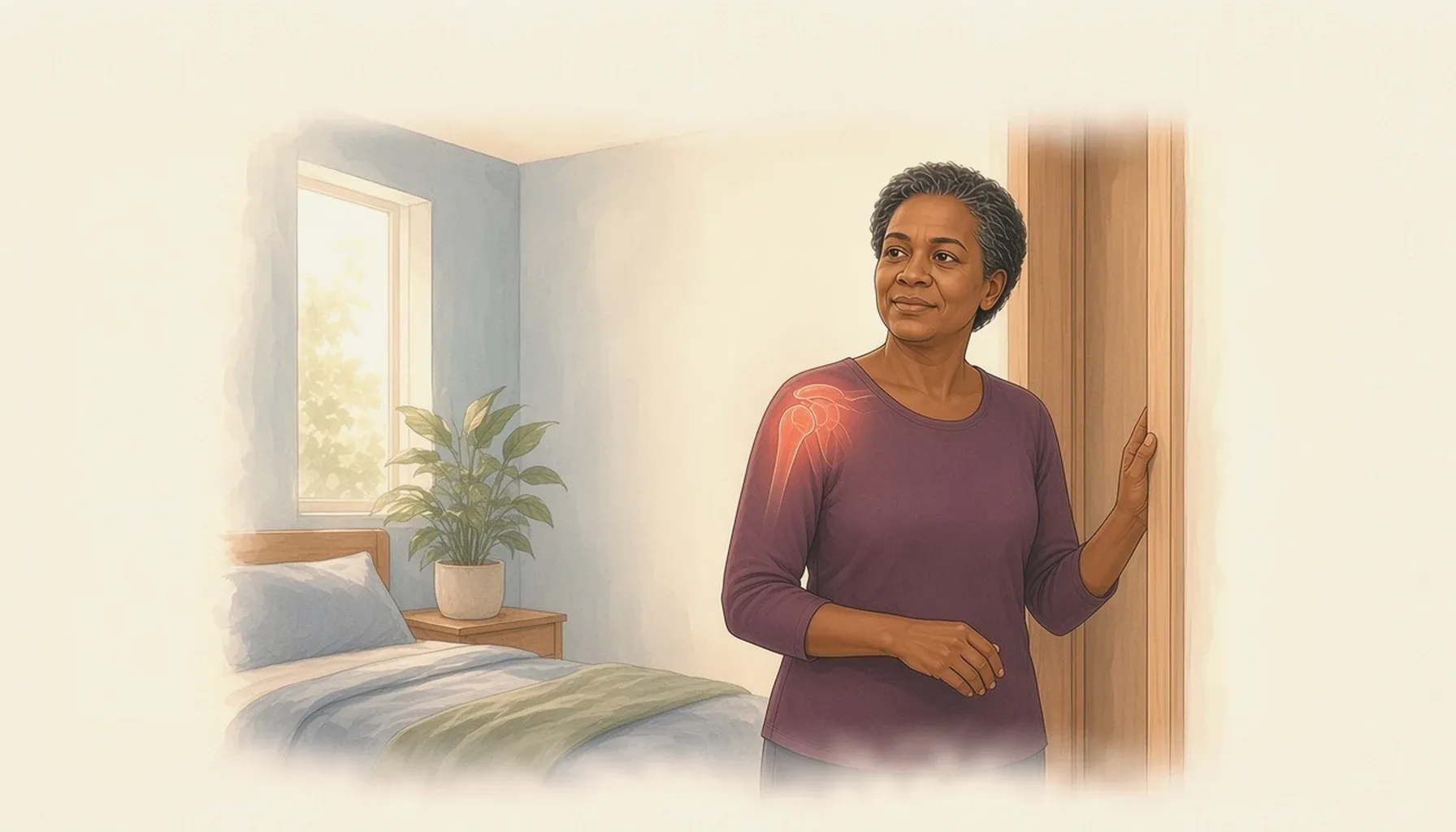
Frozen shoulder usually moves through 3 stages: freezing, frozen and thawing. The American Academy of Orthopaedic Surgeons (AAOS) says freezing typically lasts 6 weeks to 9 months, the frozen stage about 4 to 6 months, and thawing about 6 months to 2 years. The timelines overlap from person to person, and they are a guide rather than a precise clock. Pain often leads in the first stage, then stiffness, then a slow return of motion.
Key takeaways
- AAOS describes 3 stages of frozen shoulder: freezing, frozen and thawing.
- Freezing typically lasts 6 weeks to 9 months, as pain rises and motion declines.
- In the frozen stage, pain may ease but stiffness remains for about 4 to 6 months, and daily tasks can be very difficult.
- Thawing is a slow return of motion, typically 6 months to 2 years, and a full course may take up to 3 years.
- The stages help plan care, but they do not replace an exam. A clinician can confirm that motion is limited both when you move the arm and when someone else moves it.
If you want a broader picture of the condition, start with our earlier overview, everything you need to know about frozen shoulder. For night pain during these stages, see why frozen shoulder hurts more at night.
Why do clinicians talk about stages?
Frozen shoulder, also called adhesive capsulitis, is a condition in which the capsule around the shoulder joint becomes thick, stiff and inflamed. AAOS says the hallmark is limited motion both on your own and when someone else moves the arm. Our post on shoulder pain vs frozen shoulder explains how that differs from other shoulder problems.
The 3 stages are a way to describe a long, changing course. They are not 3 sharp switches. One person may have a shorter freezing stage and a long thaw. Another may stay stiff for most of a year. AAOS still finds the pattern useful: pain tends to dominate first, stiffness next, and motion last.
Stage 1: Freezing
In the freezing stage, AAOS says you slowly have more and more pain. As the pain worsens, your shoulder loses range of motion. This stage typically lasts anywhere from 6 weeks to 9 months.
Pain is often dull or aching, over the outer shoulder and sometimes the upper arm, and it is typically worse when you move the arm. Nights are commonly difficult in this period, because pain is still rising and it is hard to find a position that does not provoke the joint.
You may first notice trouble reaching a seat belt, hooking a bra, washing your hair or reaching into a cupboard. Because the loss of motion builds over weeks, people sometimes wait, hoping it is a simple strain. If the shoulder is also stiff when someone else tries to move it, it is worth getting an exam rather than waiting for the full freezing period to pass.
Treatment in this stage is usually conservative. AAOS says physical therapy focused on flexibility is the primary treatment, and that heat is sometimes used to loosen the shoulder before stretching. A 2020 review by Challoumas and colleagues found that a steroid injection into the joint had short-term advantages for pain and function, and the authors suggested early use for people who had frozen shoulder for less than 1 year, along with a home exercise program. That window often includes the freezing stage, but the choice belongs to you and your clinician.
Stage 2: Frozen
Painful symptoms may actually improve during the frozen stage, AAOS says, but the stiffness remains. This stage lasts about 4 to 6 months, and daily activities may be very difficult.
This is the period when the shoulder can feel stuck even if the sharpest pain has settled. Dressing, reaching behind your back and sleeping on that side can still be limited. Because pain may be lower than it was in the freezing stage, some people assume they are done. The stiffness is the main problem now, and it still needs a plan.
AAOS says that if therapy and other conservative methods do not relieve symptoms, surgery is typically offered during this frozen stage. The goal is to stretch and release the stiffened capsule, most often with manipulation under anesthesia, arthroscopy, or both. That is not the first step for most people. It is an option to discuss if motion stays tightly limited after simpler care.
Home stretching should still be guided by a therapist, because pushing too hard in a very stiff joint can flare pain. Our guide to moving a painful frozen shoulder is a practical starting point, and it draws on a 2017 physical therapy review by Chan and colleagues.
Stage 3: Thawing
Shoulder motion slowly improves during the thawing stage. AAOS says a complete return to normal or close to normal strength and motion typically takes anywhere from 6 months to 2 years.
This is the long, often uneven part of recovery. Gains can be slow week to week, which is frustrating after months of already being limited. AAOS says a frozen shoulder tends to get better after a period of worsening symptoms, although full recovery may take up to 3 years. That outer figure lines up with a long freezing stage plus a long thaw.
People with diabetes may find this stage longer. AAOS says people with diabetes who get frozen shoulder tend to have more stiffness that continues for a longer time before thawing. A 2016 meta-analysis by Zreik and colleagues found that people with diabetes were 5 times more likely than controls to have adhesive capsulitis, and that about 13.4% of people with diabetes had the condition. If you have diabetes, mention it at your visits and ask whether glucose control is part of the shoulder plan. AAOS says improving an elevated hemoglobin A1C can help the shoulder recover more quickly.
How long does the whole course last?
Adding the typical ranges gives a wide span, from well under a year to about 3 years. Individual course varies.
A 2008 study by Hand and colleagues followed 269 shoulders in 223 patients for a mean of 4.4 years from onset. In the long term, 59% had normal or near normal shoulders, and 41% reported some ongoing symptoms, most of them mild. Six percent of the whole group had severe leftover symptoms. People with the most severe symptoms at the start, which is often during freezing, had the worst long-term outlook. Twenty percent later had symptoms in the other shoulder, and that study found no recurrent cases. AAOS still notes that recurrence is uncommon but can happen, especially if a factor such as diabetes remains.
The stages tell you what to expect next. They do not guarantee a date by which you will be done.
What should you do in each stage?
The details belong to your clinician, but the pattern from AAOS and from the treatment review is fairly consistent.
- In freezing, the priority is to control pain and keep as much gentle motion as you can without forcing the joint. Ask about heat before stretching, and ask whether an injection plus a home program is appropriate if you are still in the first year.
- In the frozen stage, keep working on flexibility, and if motion stays tightly limited, ask whether a procedure should be considered.
- In thawing, stick with the motion program even when gains are slow. That consistency is also important after any procedure. AAOS says commitment to therapy is the most important factor in getting back to the activities you enjoy after surgery.
The BlueRanger Shoulder Pulley is designed to help with gentle, assisted range of motion over a door, which can help you follow a home program your therapist recommends. The ShoulderWand is designed for guided stretching with both hands. These tools may support stretching in any stage, but they do not replace an exam or the limits your clinician sets, especially when pain is still high.
When should you call a clinician?
See a doctor or a physical therapist if you notice:
- Pain and stiffness that are getting worse over weeks, or that limit dressing, reaching or sleep
- A shoulder that is stiff even when someone else tries to move it
- Symptoms that started after an injury, a fall or a period in a sling
- No useful gain in motion after months of a home program
- Numbness, fever, redness or a sudden severe worsening
- Chest pain, shortness of breath or pain that travels into the jaw or left arm, which need emergency care
Related reading
- Everything you need to know about frozen shoulder
- How to move that painful frozen shoulder
- Shoulder pain vs frozen shoulder
- Why does frozen shoulder hurt more at night?
Your next step
If your shoulder is getting stiffer week by week, or if someone else cannot move it much farther than you can, get an exam rather than waiting to see which stage comes next. Read our earlier overview, everything you need to know about frozen shoulder, and start only the motion work your clinician has approved. If you want a simple assisted motion tool for a home program, the BlueRanger Shoulder Pulley is designed for that.
Common questions
What are the 3 stages of frozen shoulder?
AAOS describes freezing, frozen and thawing. Pain and loss of motion build in freezing, stiffness dominates the frozen stage, and motion slowly returns during thawing.
How long does each stage of frozen shoulder last?
AAOS says freezing typically lasts 6 weeks to 9 months, the frozen stage about 4 to 6 months, and thawing about 6 months to 2 years. Your course may be shorter or longer, and the stages can overlap.
Which stage of frozen shoulder is the most painful?
Pain is typically worst early, during the freezing stage, and when you move the arm. In the frozen stage, pain may improve even though stiffness remains. Nights are often hardest while pain is still rising.
Can treatment change depending on the stage?
Yes. Physical therapy focused on flexibility is the primary treatment in every stage. An injection is more often considered early, and surgery, if it is discussed at all, is typically offered during the frozen stage.
How long does frozen shoulder last overall?
AAOS says full recovery may take up to 3 years. A long-term study found that 59% of shoulders were normal or near normal at a mean of 4.4 years from onset, and that most leftover symptoms were mild.
Medical disclaimer
The information in this article is for general education only. It is not medical advice, diagnosis, or treatment, and reading it does not create a provider-patient relationship with RangeMaster. Recovery plans differ from person to person. Talk with your surgeon, physician, or physical therapist before you start, stop, or change any exercise, product, or treatment, and follow their instructions when they differ from anything you read here.
If you think you are having a medical emergency, call 911 or your local emergency number right away.
RangeMaster makes and sells the products linked in this article. Full medical disclaimer.
Sources
- American Academy of Orthopaedic Surgeons. Frozen Shoulder. OrthoInfo https://orthoinfo.aaos.org/en/diseases--conditions/frozen-shoulder/
- Hand C, Clipsham K, Rees JL, Carr AJ. Long-term outcome of frozen shoulder. J Shoulder Elbow Surg. 2008;17(2):231-236. doi:10.1016/j.jse.2007.05.009 https://pubmed.ncbi.nlm.nih.gov/17993282/
- Challoumas D, Biddle M, McLean M, Millar NL. Comparison of treatments for frozen shoulder: a systematic review and meta-analysis. JAMA Netw Open. 2020;3(12):e2029581. doi:10.1001/jamanetworkopen.2020.29581 https://pubmed.ncbi.nlm.nih.gov/33326025/
- Zreik NH, Malik RA, Charalambous CP. Adhesive capsulitis of the shoulder and diabetes: a meta-analysis of prevalence. Muscles Ligaments Tendons J. 2016;6(1):26-34. doi:10.11138/mltj/2016.6.1.026 https://pubmed.ncbi.nlm.nih.gov/27331029/
- Chan HBY, Pua PY, How CH. Physical therapy in the management of frozen shoulder. Singapore Med J. 2017;58(12):685-689. doi:10.11622/smedj.2017107 https://pmc.ncbi.nlm.nih.gov/articles/PMC5917053/