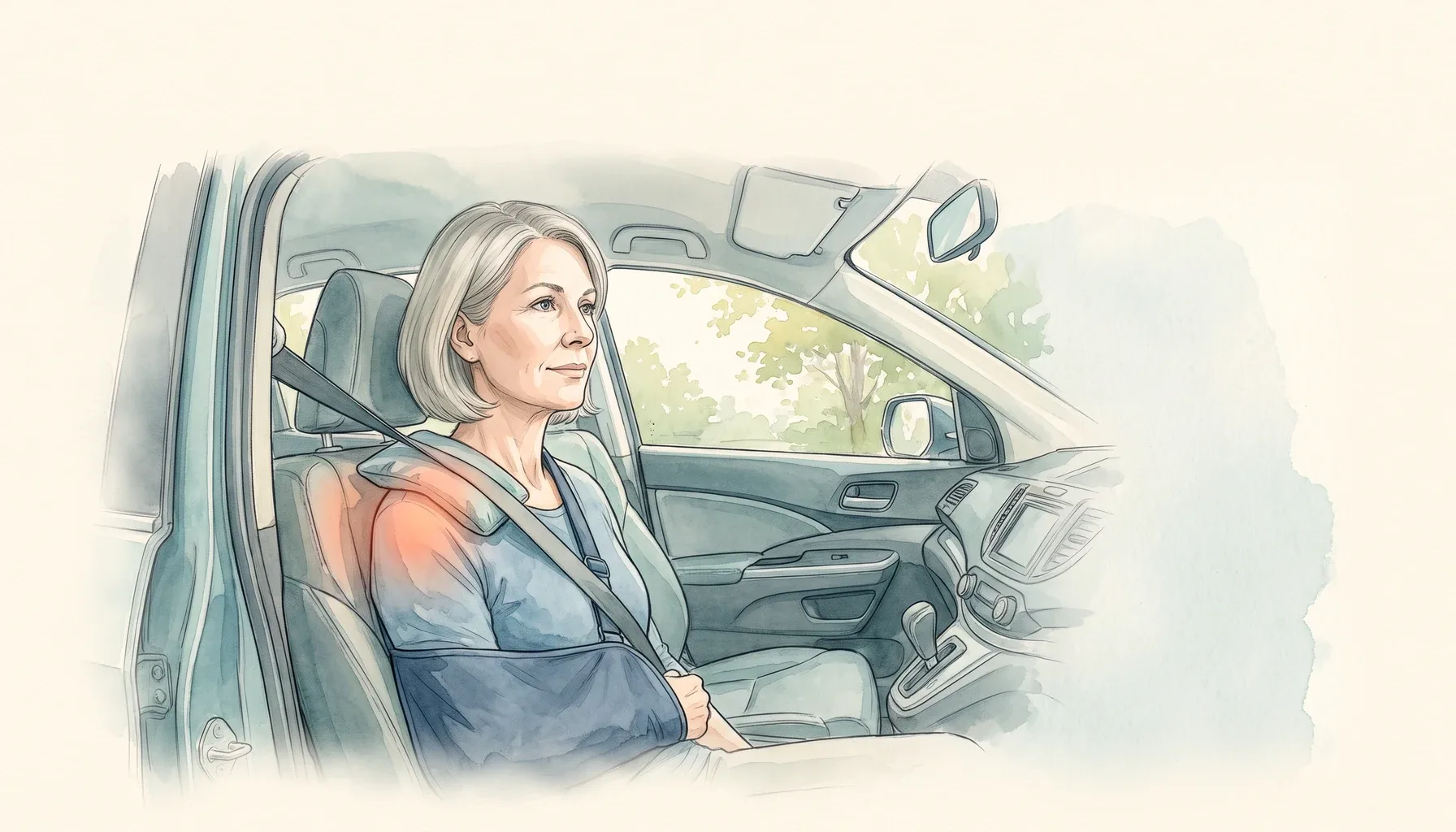
Many people return to driving about 6 to 8 weeks after rotator cuff repair, once they are out of the sling, off opioid pain medicine, and able to steer and react quickly. In a 2025 study of 128 patients, 23% were driving at 1 month, 70% at 2 months, and 99% at 6 months. Your surgeon decides when it is safe for you.
Key takeaways
- Most people drive again somewhere around 2 months after repair, with wide variation.
- Driving with a sling on your dominant arm doubled collisions in a simulator study.
- Opioid pain medicine, limited motion and weak grip all affect safe driving.
- People often feel ready before testing shows their reactions are back to normal.
- Ask your surgeon for a clear go-ahead before you drive.
Driving is one of several milestones in the first months. See our rotator cuff surgery recovery guide for the full week by week picture.
Why is driving after rotator cuff surgery a concern?
Driving asks the shoulder to steer, turn, brace and react fast, and in the early weeks the repaired arm cannot do those things safely. Pain medicine can also slow your reactions.
The rotator cuff is a group of four muscles and tendons that help you lift and rotate your arm. After repair, the tendon needs weeks of protection while it heals back onto the bone. AAOS notes that most people use a sling and avoid using the arm for the first 4 to 6 weeks. Turning the wheel hard, grabbing the wheel in a skid, or bracing in a sudden stop can load the tendon in ways your therapist would not allow yet.
There is also a safety concern for everyone else on the road. Steering one-handed limits how quickly and how far you can turn the wheel in an emergency.
Can you drive with a sling on?
Driving while wearing a sling on your driving arm is unsafe, according to simulator research. Plan for someone else to drive while you are in the sling.
In a 2015 study by Hasan and colleagues, 21 healthy volunteers drove a validated simulator with and without a sling on their dominant arm. With the sling, they had 73 collisions in total. Without it, they had 36. About 70% of drivers in a sling had 3 or more collisions. Overall lane position was similar, and the authors linked the extra collisions to difficulty making evasive moves in hazardous moments.
A 2016 systematic review by DiSilvestro and colleagues in Clinical Orthopaedics and Related Research reached a similar view, noting that driving ability is often impaired while wearing a shoulder sling on the dominant arm. A systematic review gathers and sums up all the studies on a question, which makes it a stronger source than any single study.
How long do most people wait to drive?
Most people wait about 6 to 8 weeks, and almost everyone is driving again by 6 months. Timing varies with your repair, your car and your comfort.
The 2025 study by Antoni and colleagues in the Journal of Experimental Orthopaedics looked back at 128 patients after rotator cuff repair. The average time to drive a short distance, under 5 kilometers, was 7.3 weeks, with a range from half a week to 26 weeks. Return rates were:
- 23% at 1 month
- 70% at 2 months
- 99% at 6 months
The people in this study were 59 years old on average, with ages from 35 to 79. Just over half (53%) had a superior tear, which involves only the supraspinatus tendon on top of the shoulder, and 69% had the right shoulder repaired. The study left out people with surgery on both shoulders, earlier surgery on the same shoulder, or pain in the other shoulder. Of 151 eligible patients, 6 did not drive, 8 needed another operation, and 9 were lost to follow-up, which left the final 128.
The study was a retrospective case series, which is a lower level of evidence than a trial, so treat these numbers as a rough guide. The DiSilvestro review found that patients reported returning to driving about 2 months after rotator cuff repair on average.
What affects when you can drive?
Your type of car, which shoulder was repaired, your pain medicine, and your strength and motion all affect timing. Your surgeon may also set a rule based on your repair.
In the Antoni study, people returned to driving earlier if they were male, drove an automatic car, or drove more each week before surgery. About 70% of that group drove manual cars, which need the left hand off the wheel to shift. That detail matters if your left shoulder was repaired and you drive a manual car.
The DiSilvestro review advised that strength, range of motion and opioid use should be considered before a return to driving. AAOS advises taking opioids only as directed. Do not drive while taking opioid pain medicine unless your doctor tells you it is safe.
How do you know you are ready to drive?
You are likely ready to ask your surgeon about driving when you are out of the sling, off opioids, and able to steer with both hands, turn to check blind spots, and make a quick evasive move without sharp pain.
The DiSilvestro review noted that patients often return to driving before driving tests show their abilities are back to normal. That review screened 446 articles and included 48 that studied driving after many kinds of orthopaedic surgery and injury. Its authors described the available evidence as a best-case scenario for when patients can return to driving. Your own sense of readiness is one piece of the decision, and your surgeon's view is another. A simple self-check while the car is parked, and with your surgeon's permission, can help:
- Can you put both hands on the wheel and turn it fully both ways?
- Can you turn your head and upper body to look over each shoulder?
- Can you fasten and unfasten the seat belt with little discomfort?
- Can you reach the gear shift, turn signals and parking brake?
- Can you grip firmly with the surgical hand?
If any of these is painful or hard, wait and practice the motions your therapist has given you. When you do return, start with short, familiar drives in light traffic and daylight, with another licensed driver along. Some people check with their auto insurer if they are unsure how a recent surgery affects their coverage.
How do you get around before you can drive?
Plan rides before surgery, since you will likely need help getting to appointments for at least the first several weeks. Physical therapy usually means regular visits over several months, so transport adds up.
A few ideas that help many families:
- Make a simple ride calendar with family, friends or neighbors before surgery day.
- Ask your therapy clinic whether they can cluster visits at times that suit your driver.
- Check whether your area has community or senior ride services.
- Keep a small pillow in the car to cushion the seat belt over your shoulder.
- Ask your driver to take turns and stops gently while your shoulder is sore.
Our post on common questions before and after shoulder surgery has more ideas for getting your home and schedule ready.
When to call your doctor
Call your surgeon before driving if you are unsure, and call promptly if you notice:
- A sudden pop, tearing feeling or new weakness after a jolt, near miss or crash
- Pain that keeps increasing after driving and does not settle with rest
- Numbness or tingling in the hand that does not go away
- Swelling, redness or drainage at the incisions, or a fever
Talk with your clinician about your own timeline for driving.
How RangeMaster products fit
Steering, shoulder checks and reaching for the seat belt all depend on range of motion and strength, which come back step by step through rehab. The Rotator Cuff Repair Program is designed to support that work at home. It includes a home exercise kit with a pulley, wand and light resistance tools, a compression wrap with a gel pack, and 30 lessons across surgical and non-surgical pathways, so you can follow the phase your therapist sets.
Related reading
- Rotator cuff surgery recovery guide
- How to recover from shoulder surgery faster
- How to use a shoulder sling the right way
- Common questions before and after shoulder surgery
Your next step
To build back the motion and strength that safe driving depends on, follow your therapist's plan at home with the Rotator Cuff Repair Program.
Common questions
Can I drive 2 weeks after rotator cuff surgery?
Driving at 2 weeks is uncommon, since most people are still in a sling and may be using pain medicine. Your surgeon can tell you which tasks are safe for you at that point.
Can I drive an automatic car sooner?
In one study, people who drove automatic cars returned to driving sooner. Your surgeon still needs to clear you.
Can I drive once my sling is off?
Coming out of the sling is an important step. You also need to be off opioids and able to steer and react quickly. Ask your surgeon to confirm all three before your first drive.
Can I ride as a passenger?
Yes, most people ride as passengers in the first weeks. A small pillow between the seat belt and your shoulder may feel more comfortable.
Does it matter which shoulder was repaired?
It can. Shifting gears, steering habits and reaching for controls load each shoulder differently, so ask your surgeon how your repair side affects timing.
Medical disclaimer
The information in this article is for general education only. It is not medical advice, diagnosis, or treatment, and reading it does not create a provider-patient relationship with RangeMaster. Recovery plans differ from person to person. Talk with your surgeon, physician, or physical therapist before you start, stop, or change any exercise, product, or treatment, and follow their instructions when they differ from anything you read here.
If you think you are having a medical emergency, call 911 or your local emergency number right away.
RangeMaster makes and sells the products linked in this article. Full medical disclaimer.
Sources
- Antoni M, Zaibi M, ReSurg, Baldairon F. Return to driving following rotator cuff repair: 23%, 70% and 99% at 1, 2 and 6 months. J Exp Orthop. 2025;12(2):e70201. doi:10.1002/jeo2.70201 https://pubmed.ncbi.nlm.nih.gov/40242188/
- Hasan S, Chay E, Atanda A, McGee AW Jr, Jazrawi LM, Zuckerman JD. The effect of shoulder immobilization on driving performance. J Shoulder Elbow Surg. 2015;24(2):273-279. doi:10.1016/j.jse.2014.06.046 https://pubmed.ncbi.nlm.nih.gov/25217988/
- DiSilvestro KJ, Santoro AJ, Tjoumakaris FP, Levicoff EA, Freedman KB. When can I drive after orthopaedic surgery? A systematic review. Clin Orthop Relat Res. 2016;474(12):2557-2570. doi:10.1007/s11999-016-5007-9 https://pubmed.ncbi.nlm.nih.gov/27492688/
- American Academy of Orthopaedic Surgeons. Rotator Cuff Tears: Surgical Treatment Options. OrthoInfo https://orthoinfo.aaos.org/en/treatment/rotator-cuff-tears-surgical-treatment-options/