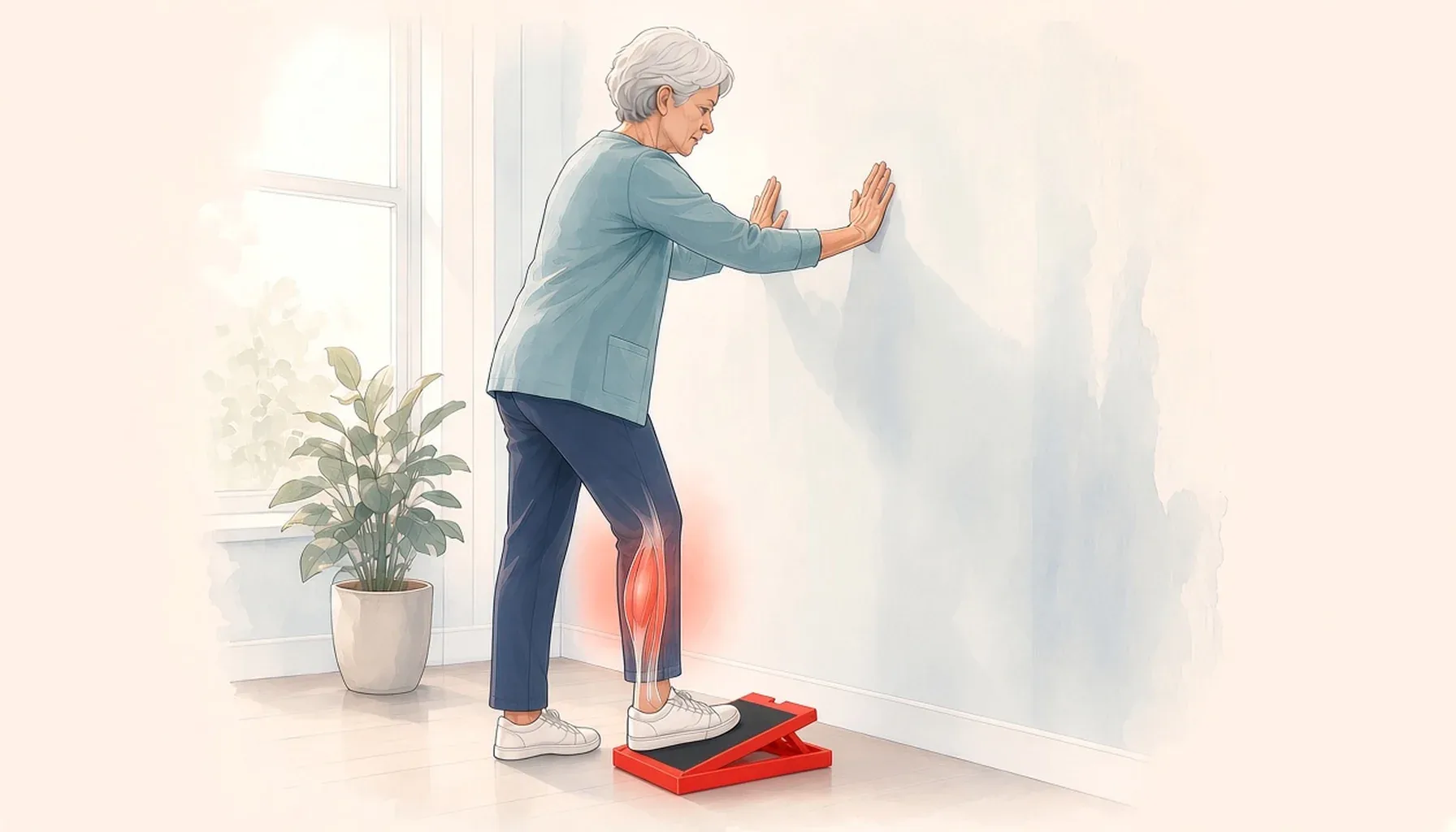
A slant board is a small, angled platform that holds your foot with the toes higher than the heel, so you can stretch your calf and the back of your ankle while you stand. People use one for calf tightness, heel pain routines and general mobility. Research links calf and ankle flexibility with heel pain in working adults and with walking and balance in older adults. A clinician can tell you which stretches fit you.
Key takeaways
- A slant board gives a steady, repeatable calf stretch while you stand, with your hands on a wall for support.
- Limited upward ankle bend was the strongest risk factor for plantar fasciitis in one well known study, alongside body weight and long workdays on the feet.
- Ankle mobility tends to decrease with age, and in older adults it is linked with balance and walking.
- Regular calf stretching gives a small gain in ankle motion, and in older adults it has been linked with faster walking and fewer night leg cramps.
- Stretching works best as one part of a plan from your physical therapist or doctor, especially if you already have pain.
What does a slant board actually do?
When you stand on a slant board, your toes sit higher than your heel. That position bends your ankle upward, a motion called dorsiflexion, and gently lengthens the calf muscles and the Achilles tendon at the back of your lower leg. Leaning your body forward toward a wall increases the stretch. Leaning back eases it.
The board does one simple job: it holds your foot at the same angle every time. On a flat floor, a wall calf stretch depends on how far back you place your foot and how much you lean, so it can feel different from day to day. On a board, the angle stays the same, which makes it easier to repeat a stretch your therapist showed you and to notice small changes over the weeks.
Adjustable boards let you start at a gentle angle and move to a steeper one as your calf allows. That gradual approach matches how most stretching programs are taught: a gentle pull, never sharp pain, and slow progress.
Why does calf flexibility matter for your feet?
Your calf and ankle take part in every step. As your body moves forward over your foot, the ankle needs to bend upward. When the calf is tight, the body finds that motion somewhere else, for example by rolling the foot inward, lifting the heel early or shortening the stride. Over time that extra load can show up as pain in the heel, the arch or the Achilles tendon.
A 2003 case-control study by Riddle and colleagues compared 50 people with plantar fasciitis to 100 people of the same age and sex without it. The risk of plantar fasciitis rose as ankle dorsiflexion went down, and reduced dorsiflexion appeared to be the most important risk factor. Spending most of the workday on your feet and a higher body weight were also independent risks.
Plantar fasciitis is a common cause of heel pain, often felt with the first steps in the morning or after sitting. The physical therapy clinical practice guidelines for heel pain, last revised in 2023, include calf and plantar fascia stretching among the options therapists use, usually as one part of a broader plan with other treatments. Calf flexibility also comes up in the 2024 guideline for Achilles tendon pain, where exercise is the core of care.
Who can benefit from a slant board?
Calf tightness looks different at different stages of life, and the research reflects that.
People who stand or walk all day. Nurses, teachers, retail and warehouse workers, and parents chasing small children spend hours on their feet. In the Riddle study, a workday spent mostly on the feet was an independent risk for plantar fasciitis. A short calf stretch after a long shift is a simple way to give the lower leg some attention.
Runners, walkers and weekend athletes. Repetitive loading asks a lot of the calf and Achilles tendon. Many athletes use a slant board before or after activity as part of a routine their coach or therapist sets.
People who sit most of the day. Long hours in a chair or a car can leave the calves feeling stiff when you stand up. A slant board near a desk can be a reminder to stand and stretch.
Adults over 55 with night leg cramps. A 2012 randomized trial by Hallegraeff and colleagues followed 80 adults over 55 who had night leg cramps. People who stretched their calves and hamstrings every night just before bed for six weeks had fewer cramps, and the cramps they did have were less severe, compared with people who did no specific stretching.
Older adults who want to keep moving with confidence. Ankle mobility tends to drop with age. A 1992 study by Vandervoort and colleagues found that dorsiflexion range decreased across age groups, more in women than in men. Ankle motion matters for walking and balance, which is the next question.
Can calf stretching help balance and walking as you age?
Several studies point the same way, though most are small.
- In 34 women aged 64 to 87, more ankle range of motion went along with better balance and gait scores. The authors noted that more research is needed to know whether increasing ankle motion improves balance.
- In a prospective study of 176 older adults living in a retirement village, the people who fell during the following year had less ankle flexibility, along with other foot problems such as weaker toes and foot pain.
- In a small randomized trial of 19 women aged 65 to 89 with limited ankle motion, stretching the calves three times a week for eight weeks increased ankle motion. The stretching group also finished a timed agility course and a 10 meter walk faster. A standing reach test did not change.
- A 2025 review of 16 studies found that ankle and foot exercise programs improved ankle flexibility, ankle strength and balance with eyes open in older people, based on low quality evidence. The review found no effect on falls.
The fair summary: flexible, strong ankles are part of moving well as you get older, and calf stretching may support ankle motion and walking. Stretching alone has not been shown to prevent falls. Balance and strength training, good footwear and a check of foot problems all matter too, and a physical therapist can put those pieces together for you.
How much does calf stretching change your ankle?
Honestly, the change is modest. A 2006 systematic review by Radford and colleagues pooled five trials and found that static calf stretching gave a small, statistically significant increase in ankle dorsiflexion, about 2 to 3 degrees. The authors noted it was unclear whether that change matters clinically.
For heel pain, the same research group ran a randomized trial in 92 adults. After two weeks, people who did calf stretches did not improve significantly more than people who did not stretch. Two weeks is short, and both groups got better.
What this means for you: think of calf stretching as a daily habit that adds up over weeks and months. It is one tool among several, and it pairs well with strengthening, activity changes and supportive shoes when a clinician recommends them.
How do you use a slant board safely?
The printed guide that comes with the EZ Slant describes a simple routine. Ask your physical therapist or doctor whether it suits you, especially if you have pain, an injury or balance concerns.
- Place the board on a flat, level, non-slip floor, about six inches from a wall.
- Set the angle you want. Start at the lowest setting.
- Face the wall and rest your hands on it at about shoulder height.
- Place the heel of one foot flush with the bottom of the board and the rest of your foot flat on the top surface. Wear rubber-soled shoes or sneakers.
- Lean forward until you feel a gentle stretch in the back of your lower leg. For one version, keep your knee straight. For the other, bend your knee slightly, which shifts the stretch lower in the calf.
- Hold for 20 to 30 seconds, then step off and switch legs.
The guide suggests repeating the stretch 3 to 5 times, 3 to 4 times a day. Your therapist may adjust that. You should feel a steady pull, never sharp pain, numbness or tingling. If you feel unsteady, move closer to the wall, use a lower angle or have someone nearby.
When should I call my doctor or physical therapist?
Stretching is meant to feel mild. Check with a clinician before you start, or stop and call, if you notice:
- Heel or calf pain that lasts more than a few weeks or keeps getting worse
- Sudden pain at the back of the ankle, a pop or trouble pushing off when you walk
- Calf swelling, warmth, redness or tenderness, especially after surgery, travel or time in bed
- Numbness, tingling or burning in the foot
- Diabetes, poor circulation or nerve problems in your feet
- A recent fall, or a feeling that your balance is getting worse
Get urgent care for sudden calf swelling with pain, or for chest pain or shortness of breath.
How RangeMaster products fit
The RangeMaster EZ Slant is a portable slant board designed for calf, Achilles, ankle and foot stretching routines. It has an adjustable angle, a textured surface and folds flat for storage and travel, so it can live by a wall at home, under a desk or in a bag. It can help you repeat the same stretch your therapist taught you, before activity, after long periods on your feet or as part of a clinician-directed home program. If you prefer to stretch your calves while seated, the StretchStrap is designed for that. Neither product replaces the plan your physical therapist or doctor sets.
Related reading
- A simple way to stretch your calves with the StretchStrap
- A more advanced way to strengthen the legs
- StretchStrap videos
Your next step
Tonight, before bed or after your longest stretch of time on your feet, try a gentle wall calf stretch on each leg and notice how your ankles feel the next morning. If you want a steady, repeatable angle for that stretch, the EZ Slant is designed to make it simple. If you have ongoing heel or calf pain, start with a visit to your physical therapist.
Common questions
Is a slant board better than stretching on a step?
Both stretch the calf. A step lets your heel drop freely, which can be hard to control. A slant board holds a fixed angle with your whole foot supported, which many people find steadier and easier to repeat.
How long should I stand on a slant board?
A common routine is 20 to 30 seconds per stretch, repeated a few times on each leg. Longer standing is not needed for most people. Follow your therapist's plan if you have one.
Can a slant board help plantar fasciitis?
Calf stretching is one of several options in physical therapy guidelines for heel pain. Short-term trials show mixed results, so it usually works best inside a broader plan from your clinician.
Is a slant board safe for older adults?
Many older adults stretch their calves safely with support. Use a wall, start at the lowest angle and wear rubber-soled shoes. Ask your clinician first if you have balance problems or have fallen recently.
Should I bend my knee when I stretch?
Doing both versions covers more of the calf. A straight knee stretches the upper calf muscle more, and a slightly bent knee shifts the stretch to the deeper, lower calf.
Medical disclaimer
The information in this article is for general education only. It is not medical advice, diagnosis, or treatment, and reading it does not create a provider-patient relationship with RangeMaster. Recovery plans differ from person to person. Talk with your surgeon, physician, or physical therapist before you start, stop, or change any exercise, product, or treatment, and follow their instructions when they differ from anything you read here.
If you think you are having a medical emergency, call 911 or your local emergency number right away.
RangeMaster makes and sells the products linked in this article. Full medical disclaimer.
Sources
- Riddle DL, Pulisic M, Pidcoe P, Johnson RE. Risk factors for plantar fasciitis: a matched case-control study. J Bone Joint Surg Am. 2003;85(5):872-877. doi:10.2106/00004623-200305000-00015 https://pubmed.ncbi.nlm.nih.gov/12728038/
- Koc TA Jr, Bise CG, Neville C, Carreira D, Martin RL, McDonough CM. Heel pain, plantar fasciitis: revision 2023. J Orthop Sports Phys Ther. 2023;53(12):CPG1-CPG39. doi:10.2519/jospt.2023.0303 https://pubmed.ncbi.nlm.nih.gov/38037331/
- Chimenti RL, Neville C, Houck J, Cuddeford T, Carreira D, Martin RL. Achilles pain, stiffness, and muscle power deficits: midportion Achilles tendinopathy revision 2024. J Orthop Sports Phys Ther. 2024;54(12):CPG1-CPG32. doi:10.2519/jospt.2024.0302 https://pubmed.ncbi.nlm.nih.gov/39611662/
- Hallegraeff JM, van der Schans CP, de Ruiter R, de Greef MH. Stretching before sleep reduces the frequency and severity of nocturnal leg cramps in older adults: a randomised trial. J Physiother. 2012;58(1):17-22. doi:10.1016/S1836-9553(12)70068-1 https://pubmed.ncbi.nlm.nih.gov/22341378/
- Vandervoort AA, Chesworth BM, Cunningham DA, Paterson DH, Rechnitzer PA, Koval JJ. Age and sex effects on mobility of the human ankle. J Gerontol. 1992;47(1):M17-M21. doi:10.1093/geronj/47.1.m17 https://pubmed.ncbi.nlm.nih.gov/1730848/
- Mecagni C, Smith JP, Roberts KE, O'Sullivan SB. Balance and ankle range of motion in community-dwelling women aged 64 to 87 years: a correlational study. Phys Ther. 2000;80(10):1004-1011 https://pubmed.ncbi.nlm.nih.gov/11002436/
- Menz HB, Morris ME, Lord SR. Foot and ankle risk factors for falls in older people: a prospective study. J Gerontol A Biol Sci Med Sci. 2006;61(8):866-870. doi:10.1093/gerona/61.8.866 https://pubmed.ncbi.nlm.nih.gov/16912106/
- Gajdosik RL, Vander Linden DW, McNair PJ, Williams AK, Riggin TJ. Effects of an eight-week stretching program on the passive-elastic properties and function of the calf muscles of older women. Clin Biomech (Bristol). 2005;20(9):973-983. doi:10.1016/j.clinbiomech.2005.05.011 https://pubmed.ncbi.nlm.nih.gov/16054737/
- Liang SG, Chow JCM, Leung NM, et al. The effects of ankle and foot exercises on ankle strength, balance, and falls in older people: a systematic review and meta-analysis. Phys Ther. 2025;105(1):pzae157. doi:10.1093/ptj/pzae157 https://pubmed.ncbi.nlm.nih.gov/39657220/
- Radford JA, Burns J, Buchbinder R, Landorf KB, Cook C. Does stretching increase ankle dorsiflexion range of motion? A systematic review. Br J Sports Med. 2006;40(10):870-875. doi:10.1136/bjsm.2006.029348 https://pubmed.ncbi.nlm.nih.gov/16926259/
- Radford JA, Landorf KB, Buchbinder R, Cook C. Effectiveness of calf muscle stretching for the short-term treatment of plantar heel pain: a randomised trial. BMC Musculoskelet Disord. 2007;8:36. doi:10.1186/1471-2474-8-36 https://pubmed.ncbi.nlm.nih.gov/17442119/